🕷️ Ant communication: pheromone trails
🧾 Quick Facts
Ant communication through pheromone trails is a fascinating behavior found among various ant species worldwide. It helps ants coordinate activities within their colonies.
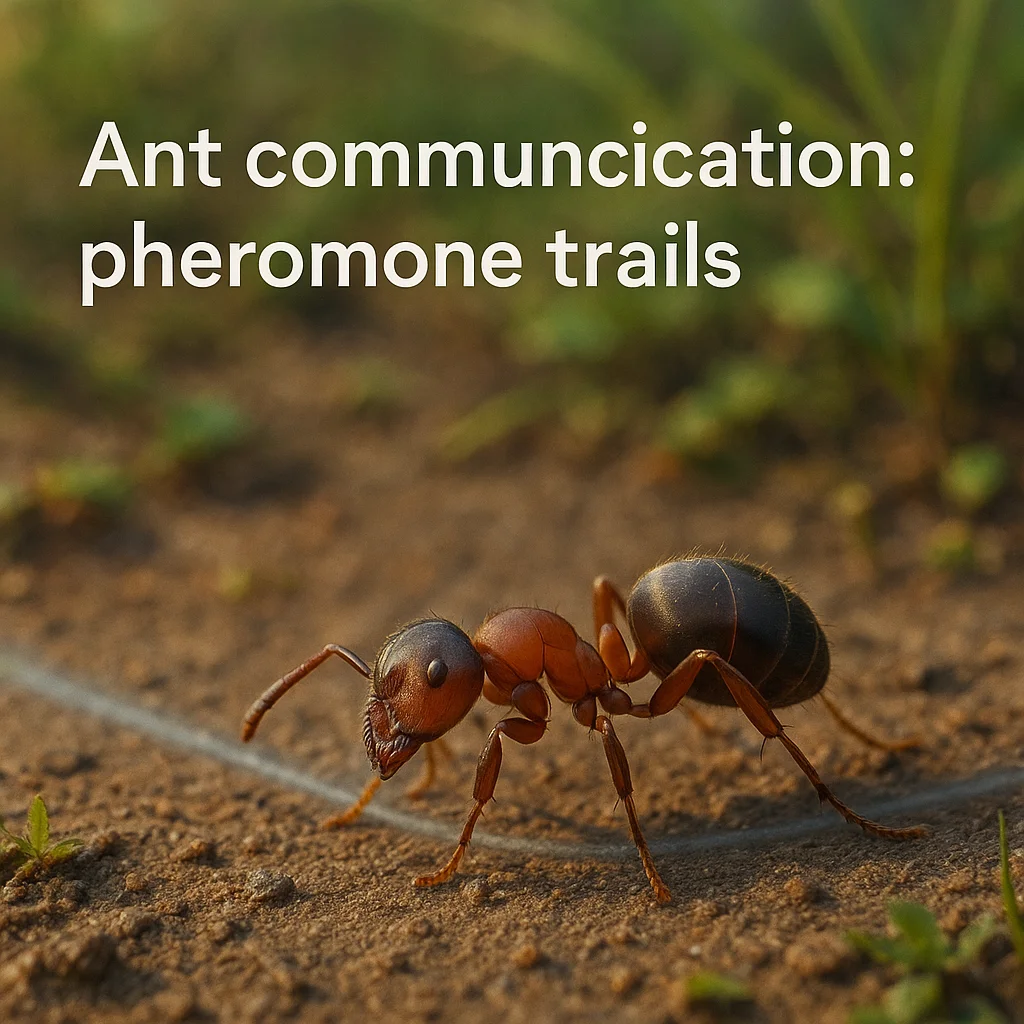
- Common Names: Ants
- Scientific Name: Varies by species
- Insect or Not: Insect (invertebrate)
- Order / Family: Hymenoptera / Formicidae
- Typical Size Range: 0.1 to 2 inches (2.5 mm to 5 cm), depending on species
- Key Colors/Patterns: Black, brown, red, or yellow; usually a solid color
- Activity: Mostly diurnal
- Typical Habitats: Forests, grasslands, urban areas, agricultural lands
- Where in the World It Occurs: Ants are found worldwide.
- Seasonality: Mainly active from spring to fall, varies with climate
🔍 Identification
Ants can be identified by their segmented body and small size. They have a distinct body shape with a head, thorax, and abdomen. Ants possess elbowed antennae that are crucial for their communication and sensory perception. Most ants are wingless, except during mating seasons when some are seen with wings.
- Top ID Tips:
- Three distinct body segments: head, thorax, abdomen
- Elbowed antennae
- Usually wingless except during mating flights
- Six legs adapted for walking
- May be confused with termites but have a pinched waist
- Typically move in coordinated lines
- Varies in color from black to red tones
- Look for ground trails, a sign of pheromone pathways
- Observe near food sources
- Found constructively storing food
🧠 Basic Body Structure
Ants are small invertebrates with a hard exoskeleton that protects their bodies. Like all insects, ants have three main body parts: the head, thorax, and abdomen. They have six legs attached to the thorax and use their strong mandibles for a variety of tasks, including carrying food and defending their colonies. Ants do not undergo molting in their adult stage.
Ants are invertebrates, meaning they lack a backbone but have an exoskeleton for support and protection.
🌍 Habitat & Distribution
Ants are highly adaptable and thrive in diverse habitats, from rainforests and savannas to deserts and urban areas. They are commonly found in soil, under rocks, leaf litter, and within wood crevices. Their geographic range extends worldwide, inhabiting regions ranging from temperate to tropical climates. Habitat alterations such as urban development can influence ant distribution and visibility.
📅 Seasonal Appearance & Activity
Ants are most active during warmer months, typically from spring through the end of fall. They are primarily diurnal, although some species are nocturnal. Ant activity is responsive to weather conditions, with increased movements noted during humid and warm periods.
- Best Time to Spot It:
- Spring through fall
- Warm and humid days
- Daytime – primarily active during daylight
- Near food sources post rainfall
🥚 Reproduction & Egg-Laying
Ants exhibit fascinating reproductive behaviors, often involving a synchronized nuptial flight when winged males and females leave their colonies to mate. The queen lays fertilized eggs, which become workers, and unfertilized ones, which become males. The exact number of eggs varies by species and environmental conditions. Eggs are typically laid in the nest, within soil, or hidden areas away from predators.
🌀 Metamorphosis & Life Cycle
Ants undergo complete metamorphosis with four life stages: egg, larva, pupa, and adult.
During the egg stage, the queen lays thousands of eggs that hatch into larvae. Larvae stage lasts a few weeks and involves rapid growth as they are fed by worker ants. The pupal stage follows, during which the developing ants are inactive and undergo transformation. Finally, adult ants emerge to forage, maintain the nest, care for the queen and brood, and engage in colony defense. The entire process can last several weeks to months, depending on species and conditions.
🍽️ Diet & Feeding Behavior
Ants have varied diets and may act as scavengers, predators, or herbivores. They use mandibles to chew and process food. Many are attracted to sweet substances like nectar and honeydew, produced by aphids. Protein from other insects or meat is vital for larvae development. Ants are significant decomposers and help in nutrient recycling.
🦉 Predators & Defense
Ants face predation by birds, reptiles, amphibians, spiders, and mammals. They employ several defense mechanisms such as biting, stinging, or releasing chemical substances (pheromones) to ward off threats. Alarming pheromones prompt colony members to defend, while camouflage or mimicry can reduce predation.
- Defense Highlights:
- Bites and stings for self-defense
- Releases alarm pheromones
- Camouflage and mimicry to avoid predators
- En masse attack in threatened colonies
- Seek shelter within nest structure
👥 Social Behavior & Swarms
Ants are highly social insects known for their complex colony structures and division of labor. Each colony has a queen, workers, and sometimes males. Workers gather food, care for eggs, and defend against threats. Communication within colonies relies heavily on pheromone trails, which guide foragers to food sources and back to the nest. Swarms occur during mating seasons to establish new colonies.
🧭 Senses & Communication
Ants have highly developed senses crucial for their survival. They rely heavily on their sense of smell through antennae to detect pheromone trails. These paths mark routes to food and are essential for communication, orientation, and colony efficiency. Visual acuity varies, with some species having compound eyes for light detection. Vibration and touch also signal alarms or coordinate work.
Communication is primarily via pheromones but can include other sensory forms like touch and vibrations.
🌱 Role in the Ecosystem
Ants play critical roles in ecosystems as pollinators, decomposers, and contributors to soil aeration. Their interactions with other organisms, such as mutualistic relationships with aphids for honeydew, illustrate their ecological importance. They also control pest populations, proving beneficial in agriculture. On the flip side, invasive species can disrupt local biodiversity.
📉 Population & Conservation Notes
Most ant species are commonly found in suitable habitats, while some face threats from habitat loss, pesticide use, and climate change. Data on specific species can be limited, with local abundance varying widely.
- How to Help (Low-Impact):
- Plant native flora to support diverse insects
- Minimize pesticide usage to preserve ant habitats
- Leave leaf litter for habitat
- Create spaces with natural materials for nests
- Promote biodiversity in garden settings
⚠️ Human Interaction & Safety
Ants rarely pose significant threats to humans, though some species may bite or sting if their nests are disturbed. Ensuring first aid response includes washing bites or stings and avoiding scratching. In case of severe reactions, seeking professional help is advisable. Observing ants respectfully without disrupting colonies is recommended, and the collection of wild specimens is discouraged.
📌 Summary
- Pheromone trails are vital for ant communication and colony coordination.
- Ants have a global distribution and are highly adaptable to various environments.
- They are most active during warm, humid conditions.
- Ants undergo complete metamorphosis.
- They serve critical roles as decomposers and control pest populations.
- Pheromone trails utilize smell as a primary communication method.
- Ants demonstrate complex social structures with task allocation.
- Humans should interact safely with ants, respecting their ecological roles.