🕷️ Ant mimic insects: look-alike strategies
🧾 Quick Facts
Ant mimicry is a fascinating strategy employed by various insects and arachnids to deceive predators and prey alike. Known for their remarkable resemblance to ants, these mimics are found across the world, adapting to regional ant species.
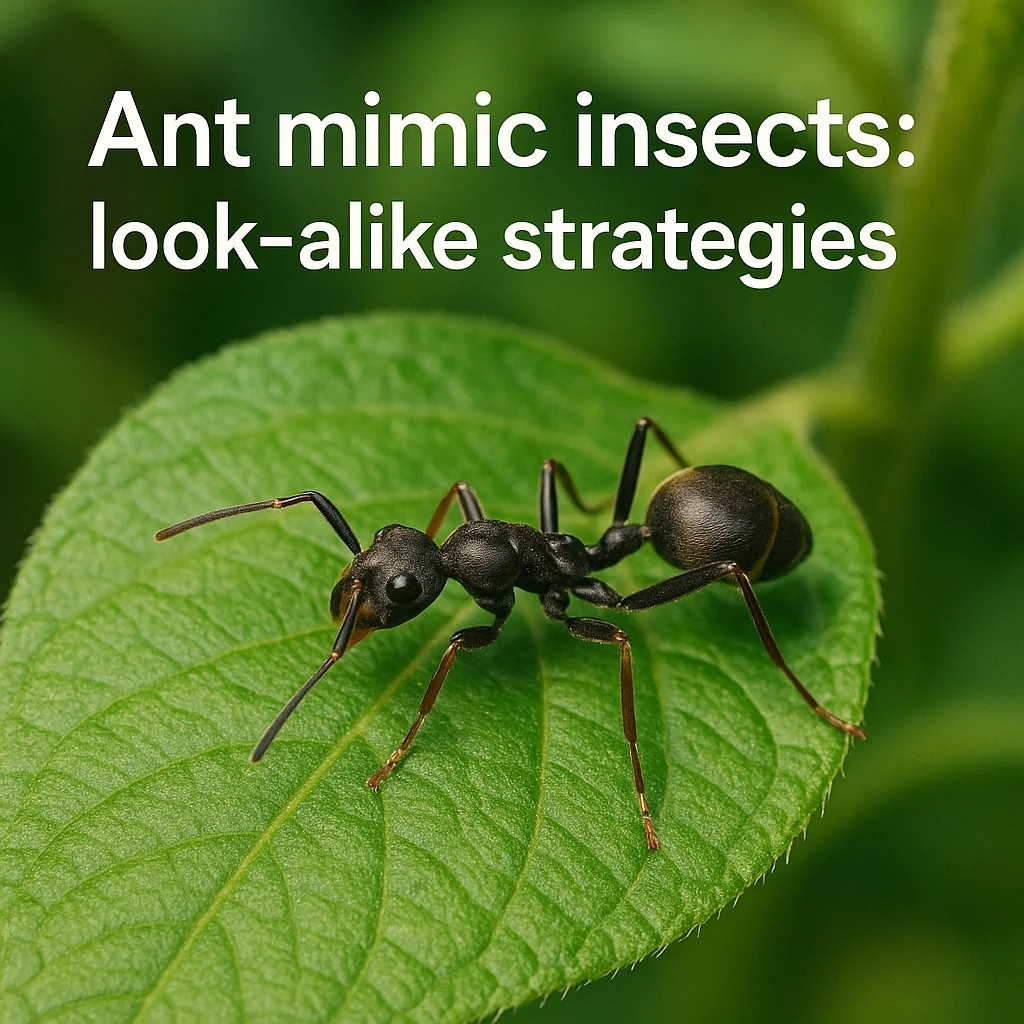
- Common names: Ant mimic spiders, Myrmecomorphs
- Scientific name: Varies
- Insect or not: Many are insects, but some are arachnids (spiders)
- Order / family: Varies (e.g., Blattodea, Formicidae, Araneae, Salticidae)
- Typical size range: 0.15 to 1 inch (4 to 25 mm)
- Key colors/patterns: Black, brown, red; segmented appearance
- Activity: Mostly diurnal
- Typical habitats: Forests, grasslands, urban gardens
- Where in the world it occurs: Primarily in tropical and temperate regions
- Seasonality: Varies; generally more visible in warm months
🔍 Identification
Ant mimic insects can be challenging to distinguish from actual ants due to their evolved morphological adaptations. Often, these mimics possess a narrow waist, elongated legs, and antennae that resemble ants’ more than those of other insects.
- Body shape and silhouette: Slim, segmented bodies with constrictions that mimic ants’ form
- Antennae type: Filiform or moniliform, sometimes bent to resemble ants’ elbowed antennae
- Wing features: When present, wings are usually folded and not prominent
- Leg traits and movement style: Long legs that mimic ants’ gait; they often wave their front legs to mimic antennae if they lack them
- Distinguishing look-alikes: Observe antennae and careful body segmentation; mimics may lack the cohesion in segmentation seen in ants
- Observe body segmentation carefully
- Examine antennae shape and movement
- Look for wing presence, especially hidden ones
- Note the spacing and number of legs
- Pay attention to movement patterns
- Watch for mimics using front legs as antennae
🧠 Basic Body Structure
Ant mimic insects follow the typical insect body plan, divided into three main sections: the head, thorax, and abdomen. However, spiders, though not insects, may also mimic ants and use two main body parts: the cephalothorax and abdomen.
An insect’s six legs are attached to the thorax, while a spider’s eight legs emerge from the cephalothorax. Both groups have a protective exoskeleton composed of chitin, and they grow through molting. Wings, when present, arise from the thorax in insects. Ant mimics are invertebrates, meaning they lack a spinal column.
🌍 Habitat & Distribution
Ant mimic insects thrive in diverse habitats, from dense forests to open grasslands and even urban gardens. They prosper where ants are numerous, as their mimicry depends on convincing predators and prey of their identity.
Preferred microhabitats include leaf litter, under rocks or logs, and near plant bases, where they capitalize on ants’ activities. They are found across continents, especially in tropical and subtropical climates, but also in temperate zones. Habitat loss and urbanization can influence their visibility, often pushing them towards human settlements.
📅 Seasonal Appearance & Activity
Ant mimic insects are most visible during warmer months, when insect activity peaks. They are predominantly diurnal, taking advantage of daylight to mimic ants actively foraging or patrolling their territories. Weather such as warmth and humidity can enhance their activity, though they may seek shelter during heavy rain.
- Spring and summer months
- During daylight, especially sunny days
- Humid environments increase sightings
- After light rain showers
🥚 Reproduction & Egg-Laying
Mating behaviors among ant mimic insects vary widely. Some perform courtship displays inspired by the species they mimic, aligning themselves with the behaviors of local ants to avoid detection by predators.
Egg-laying sites include concealed areas like leaf litter, soil, and beneath stones, minimizing the risk of predation. The number of eggs produced can range significantly, with some species laying clusters of dozens, while others only a few, depending on environmental conditions.
🌀 Metamorphosis & Life Cycle
Ant mimic insects generally undergo complete metamorphosis (egg–larva–pupa–adult), though this can vary among the specific groups that include arachnids, which develop through nymph stages similarly to insects with incomplete metamorphosis.
During the larval or nymph stages, these organisms may feed on small invertebrates or detritus, while adults take advantage of their mimicry for predation or concealment. Some stages last longer than others, often dictated by climate and food availability, with development times ranging widely.
🍽️ Diet & Feeding Behavior
A diet largely depends on the group and stage of life. Many ant mimics are predators, feeding on small insects and arthropods. Others are scavengers or herbivores, integrated within their communities as both hunters and pollinators.
Equipped with diverse mouthparts, from chewing mandibles to piercing-sucking adaptations, ant mimic insects effectively exploit their environments’ resources, supporting varying ecological niches.
🦉 Predators & Defense
Natural enemies include birds, reptiles, and larger arthropods that hunt based on sight. Ant mimicry serves as a primary defense strategy, deterring predators by mimicking the aggressive or unpalatable nature of ants.
Additional strategies may involve chemical defenses, rapid retreats, and evasive maneuvers. The mimicry extends to behavior, with some mimics adopting ants’ aggressive postures when threatened.
- Mimicry plays a critical defense role
- Some might produce chemical deterrents
- Quick escape or hiding behaviors
- Behavioral mimicry of ant aggression
👥 Social Behavior & Swarms
Ant mimics are primarily solitary, leveraging the appearance of sociality without the communal aspects of ant colonies. Occasionally, they may be seen in proximity to each other, but this is largely opportunistic rather than indicative of social structures.
Mimics avoid triggering swarms or organizing into groups, as it may expose them to greater risks from predators discerning their true nature.
🧭 Senses & Communication
Ant mimic insects possess acute senses to navigate their environments effectively. Visual acuity allows them to track ant colonies and maintain their disguise successfully. Their ability to detect vibrations and swift movement aids in both hunting and evading predators.
Pheromone release and trail-following can feature in their mimicry, using chemical signals to align with ants during interaction periods, though this remains less documented.
🌱 Role in the Ecosystem
These insects serve significant ecological roles, often acting as predators that help control pest populations or as pollinators. Their mimicry benefits ecosystems by maintaining balance, keeping predator populations in check while avoiding detection themselves.
Their relationship with flora and fauna offers insights into both competition and mutualism, where copies coexist with their models, sometimes symbiotically.
📉 Population & Conservation Notes
The population dynamics of ant mimic insects vary drastically by species and environment. They are generally common, though specific species might experience population pressures from habitat destruction, chemical usage, and climate changes.
- Plant native vegetation
- Avoid using pesticides
- Encourage biodiversity in gardens
- Leave natural leaf litter undisturbed
⚠️ Human Interaction & Safety
Most ant mimic insects pose no direct threat to humans, as they do not bite or sting. They should be observed respectfully in their natural habitats. In case of handling and bites, washing the area and seeking help for any severe reactions is advised, though severe occurrences are rare.
Promoting awareness and education about their ecological roles encourages conservation and avoidance of disturbances.
📌 Summary
- Ant mimic insects exhibit diverse forms and adaptations, primarily to avoid predation.
- Their habitats range from tropical forests to urban gardens.
- Peak visibility often occurs during warmer months with higher insect activity.
- Reproduction and development are adapted to environmental conditions.
- Their diets and roles vary, including predation, scavenging, and pollination.
- Mimicry provides effective defense against natural enemies.
- Ecosystem contributions include pest control and pollinator roles.
- Conservation efforts benefit from habitat preservation and pesticide reduction.
- Encouraging natural observation helps protect populations and further scientific understanding.