🕷️ Antlions And Ant Traps The Sand Pit Hunters Explained
🧾 Quick Facts
Antlions are fascinating insects known for their distinctive larval pit-building behavior, resembling traps designed to catch unsuspecting prey. These insect architects are part of a larger group, and while they are often associated with the pits they create, not all species necessarily do so. Here are some quick facts about these intriguing creatures:
- Common names: Antlions
- Scientific name: Varies (family Myrmeleontidae)
- Insect or not: Insect (an invertebrate)
- Order/family: Neuroptera/Myrmeleontidae
- Typical size range (adult): 2 to 7 cm in wingspan
- Key colors/patterns: Brown, gray, with mottled patterns
- Activity: Mostly nocturnal
- Typical habitats: Sandy soils, forests, grasslands
- Where in the world: Found globally, especially in warm regions
- Seasonality: Adults most visible in late spring to summer
🔍 Identification
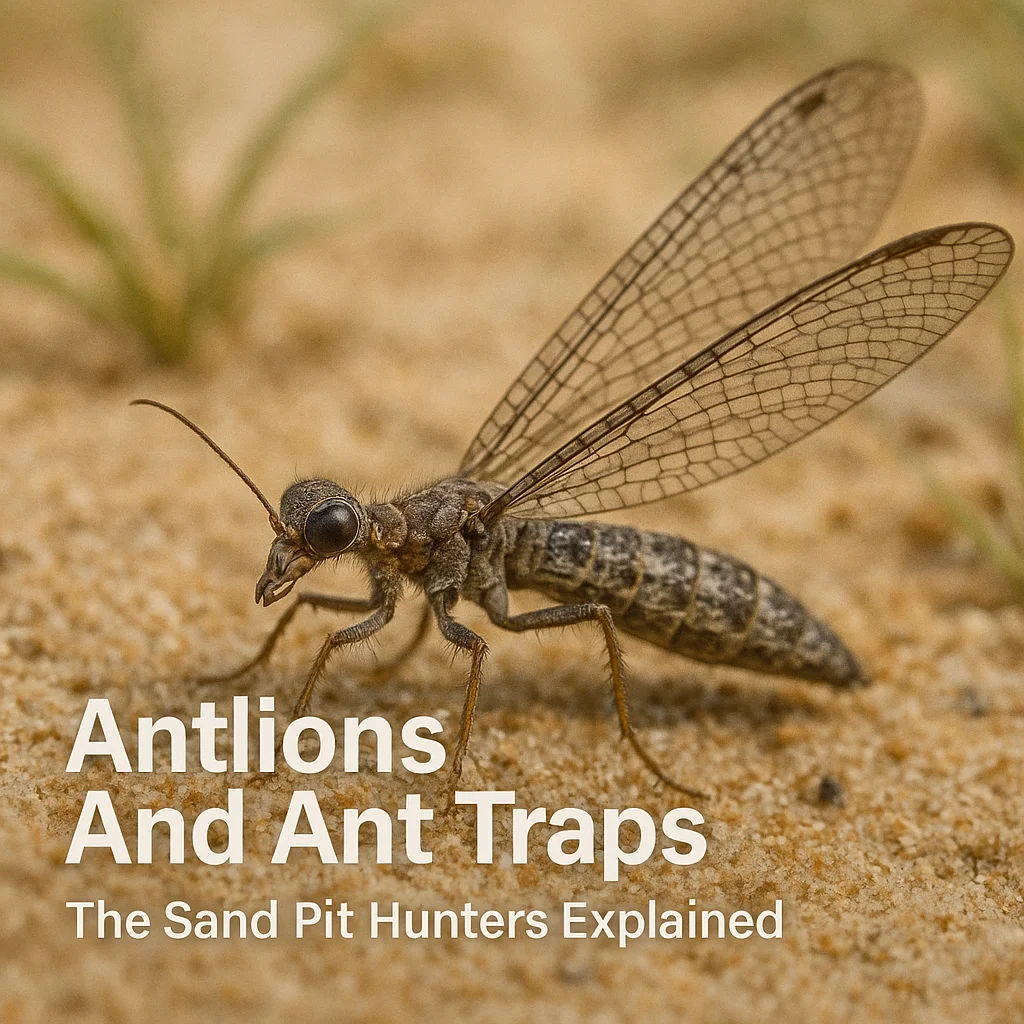
Identifying an antlion involves looking for certain distinct features, especially in their larval and adult forms. Larvae are the classic pit-builders, with robust body forms suited for digging. Adults resemble dragonflies but have notable differences:
- Body shape and silhouette: Slender bodies with long, narrow wings held tent-like over the body when at rest.
- Antennae type: Clubbed antennae, distinct from dragonflies.
- Wing features: Delicate, lace-like wings with a network of veins.
- Leg traits and movement style: Larvae have stout legs for digging; adults are weak fliers, often fluttering.
- Distinguishing look-alikes: Often mistaken for damselflies or dragonflies but with different wing resting positions.
- Top ID Tips:
- Check for pit traps in sandy soil for larvae.
- Look for the clubbed antennae in adults.
- Note the resting wing position—tent-like over the body.
- Distinguish from dragonflies by seeing if they have weaker flying abilities.
- Identify moth-like flight in adults at night.
- Observe the mottled pattern which helps with camouflage.
🧠 Basic Body Structure
As insects, antlions possess three main body segments: the head, thorax, and abdomen. Each insect also has six legs, an identifying characteristic of insects, attached to the thorax. They feature an exoskeleton, which they must molt as they grow.
Adults are adorned with two pairs of delicate wings. These wings are an integral part of their anatomy, enabling them to fly, though not very strongly. Antlions are invertebrates, meaning they lack a backbone, distinguished instead by their hard exterior shell that provides support and protection.
🌍 Habitat & Distribution
Antlions thrive in environments where sandy and loose soils are prevalent, which are ideal for their larval pit traps. Their habitats range from arid deserts to temperate forests:
- Preferred environments: Open sandy areas, dry forests, grasslands.
- Microhabitats: Under stones, leaf litter, along forest margins, and loose soil areas.
- Geographic range: Widely distributed on all continents except Antarctica, preferring warmer climates.
Changes in habitat, such as urban development or heavy vegetation, can significantly impact their presence, as they rely on specific soil conditions for their life cycle.
📅 Seasonal Appearance & Activity
Antlion larvae are typically active from late spring through summer, constructing their iconic traps. Adult antlions are mostly nocturnal, and their appearance may vary based on environmental conditions:
- Best Time to Spot It:
- Late spring to summer for adult sightings.
- Look during calm, warm nights for adult activity.
- Observe hot, dry periods for active larvae pit building.
- Watch sandy or loose soil for pits during daylight.
While some species may be active during daytime, activity generally peaks during warm, dry weather when conditions favor their pit construction and hunting.
🥚 Reproduction & Egg-Laying
Antlions exhibit unique reproductive behaviors. Mating often involves aerial displays or ground encounters, sometimes in proximity to preferred laying sites. Females deposit eggs in sandy soil, where conditions suit larval development:
While the exact number of eggs can vary between species and regions, typical egg-laying strategies involve scattering eggs, ensuring a higher chance of survival by reducing predation risks. Eggs are laid singly, guaranteeing the larvae have space to develop their infamous traps.
🌀 Metamorphosis & Life Cycle
Antlions undergo complete metamorphosis, transitioning from egg to larva, pupa, and finally, adult.
Egg: Females lay eggs in sandy environments, which hatch within a few weeks.
Larva: Antlions spend most of their life in the larval stage, creating funnel-shaped pits to trap ants and other small insects. This stage can last 1-3 years, depending on food availability and environmental conditions.
Pupa: After the larval stage, they pupate in cocoons made from sand and silk, leading to the emergence of adults in about a month.
Adult: Short-lived compared to the larval phase, adults live just a few weeks, focusing on mating and laying eggs.
🍽️ Diet & Feeding Behavior
Antlions are predators, both in their larval and adult stages:
Larvae: Primarily feed on ants and small insects that fall into their traps. They utilize piercing mandibles to inject digestive enzymes, liquefying prey tissues.
Adults: While specific feeding behaviors can vary, many adult antlions may not feed significantly, relying on stored energies conserved during the larval stage.
This demonstrates their role as predators within their ecosystem, maintaining insect populations in balance.
🦉 Predators & Defense
Antlions, despite their predatory role, have several natural enemies:
- Defense Highlights:
- Birds and reptiles often hunt adult antlions.
- Spiders and other insects prey on both larvae and adults.
- Larval sand pits act as a defensive hideaway.
- Adults rely on camouflage amidst foliage.
Defense strategies include using their larval pits for concealment and employing coloration to blend into their environment, reducing detection by predators.
👥 Social Behavior & Swarms
Antlions are typically solitary insects, focused on individual survival and reproduction:
Their solitary nature is mainly observed during the larval stage where territory for pits limits proximity to others. Swarming behavior is rare, mainly involving undirected population rises in favorable conditions.
🧭 Senses & Communication
Antlions possess sensory adaptations crucial for survival:
- Vision: Adults have compound eyes adapted for low-light conditions.
- Smell/pheromones: Play a role in locating mates and for limited communication.
- Vibration/touch: Larvae are highly sensitive to soil vibrations, detecting prey entering their pits.
Communication largely revolves around mating, with visual and chemical cues facilitating interactions.
🌱 Role in the Ecosystem
Antlions contribute significantly to their ecosystems:
- Predation: Regulate insect populations, particularly ants and other small creatures.
- Food source: Serve as prey for birds, reptiles, and other predators.
- Soil Aeration: Their digging aids in soil turnover and aeration.
Through these roles, they help maintain ecological balance and soil health, impacting both arid and semi-arid ecosystems.
📉 Population & Conservation Notes
Antlion populations generally remain stable, but local abundance may vary:
- How to Help (Low-Impact):
- Preserve sandy habitats and natural vegetation.
- Minimize pesticide use in gardens and farms.
- Maintain leaf litter and understory in forests.
- Encourage restoration of native plant communities.
While not generally threatened, habitat loss and pesticides can affect certain populations, indicating a need for mindful habitat management.
⚠️ Human Interaction & Safety
Antlions are generally harmless to humans, lacking venom or stinging capabilities. The larval bite is non-threatening:
- If handling is necessary, avoid irritation to the insect.
- For bites or skin contact, clean with soap and water.
- Consult a professional for persistent skin reactions.
Promote respectful observation, emphasizing conservation and avoidance of disturbances to natural habitats.
📌 Summary
- Antlions build sandy pits to trap prey, mainly ants.
- Identified by slender bodies and delicate, tented wings.
- Prefer sandy, loose soils in warm regions globally.
- Mating and reproduction involve sandy habitats for egg-laying.
- Undergo complete metamorphosis: egg, larva, pupa, adult.
- Feed primarily on ants and other small insects.
- Predators include birds, reptiles, and spiders.
- Play a role in pest control and soil health, but habitat loss threatens some.
- Safe to observe; minimal human impact when left undisturbed.