🕷️ Army ants: nomadic swarms explained
🧾 Quick Facts
Army ants, renowned for their aggressive foraging behavior and nomadic lifestyle, belong to several genera within the subfamily Dorylinae. These ants are a fascinating group with significant ecological roles. Here's an overview of their essential characteristics:
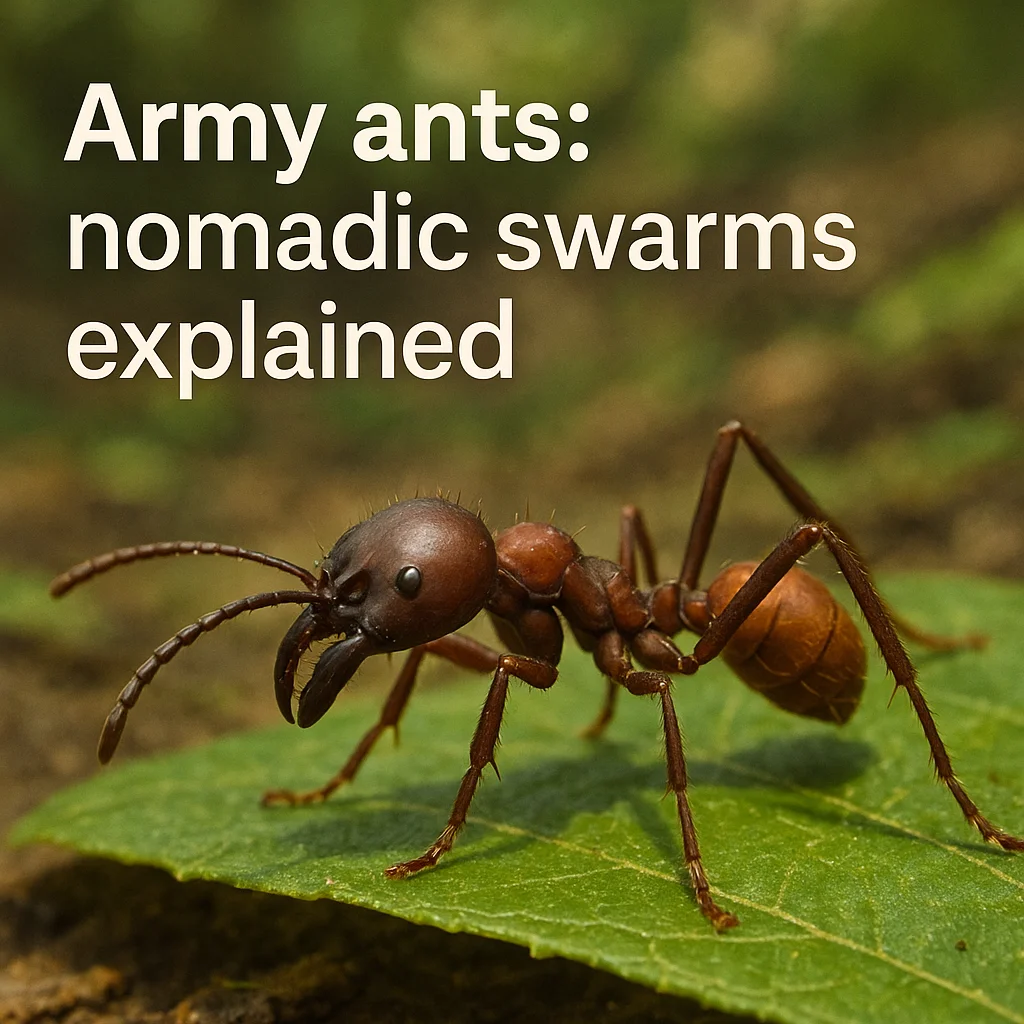
- Common names: Army ants
- Scientific name: Varies across genera such as Eciton, Dorylus, Neivamyrmex
- Insect or not: Yes, they are insects; specifically, invertebrates
- Order / family: Hymenoptera / Formicidae, subfamily Dorylinae
- Typical size range: Workers 3–12 mm, queens can be significantly larger
- Key colors/patterns: Generally black, brown, or reddish
- Activity: Mostly diurnal, can be nocturnal
- Typical habitats: Tropical forests, savannas
- Where in the world it occurs: Predominantly found in tropical regions of Central and South America, and Africa
- Seasonality: Active year-round in tropical climates
🔍 Identification
Recognizing army ants in the field involves observing their nomadic lifestyle and social structure. They have elongated bodies with a distinct head, thorax, and abdomen. Their antennae are geniculate or elbowed, characteristic of ants. Army ants lack functional wings as adults, unlike many other ant species. Their legs are built for speed and endurance, facilitating long-distance foraging.
Distinguishing them from other ants involves noting their aggressive swarming behavior and the presence of soldier ants with larger mandibles. Look-alikes include other ant species but few show the same nomadic swarming.
- Top ID Tips:
- Observe the formation of large raiding columns
- Look for soldier ants with large, powerful mandibles
- Note the absence of functional wings in adults
- Watch for their distinct aggressive behavior
- Check for their smooth and shiny exoskeleton
- Observe the evenly segmented, elongated body
🧠 Basic Body Structure
Army ants, like other insects, have a tripartite body structure composed of a head, thorax, and abdomen. They possess six legs, a standard feature of all insects. Covered by a hard exoskeleton which they must molt as they grow, they are vertebrates.
As invertebrates, they lack a backbone, which differentiates them from vertebrate animals. The queens and males of some species may possess wings, but these are typically shed after mating.
🌍 Habitat & Distribution
Army ants thrive in diverse environments but are most commonly associated with tropical forests and savannas. These habitats provide ample food resources and suitable climates for their nomadic lifestyle. Within these environments, they can be found foraging under leaf litter, logs, and fallen branches.
Geographically, they occur across tropical regions globally, including Central and South America, and parts of Africa. Changes in habitat, such as deforestation, can influence their visibility and distribution.
📅 Seasonal Appearance & Activity
Army ants are active throughout the year, particularly in tropical regions. Their activity does not vary seasonally as they adapt to the evergreen nature of their habitats. They forage mostly during the day but can be nocturnal depending on the species and environmental conditions.
- Best Time to Spot It:
- During the dry season when visibility is higher
- In the early morning or late afternoon
- Daytime during active raids
- Following extended warm periods
🥚 Reproduction & Egg-Laying
Mating in army ants typically occurs during specific nuptial flights where males and queens emerge and engage in reproductive behavior. Queens establish new colonies, and egg-laying occurs within these colonies once established. Eggs are laid in massive numbers as part of the colony's reproductive strategy.
Egg-laying can vary by genus but often involves hundreds to thousands of eggs, ensuring colony resilience and growth. Eggs are typically deposited in safe, hidden locations within the environment or protected spaces within the colony bivouac.
🌀 Metamorphosis & Life Cycle
Army ants undergo complete metamorphosis, progressing through egg, larva, pupa, and adult stages. The larval stage involves feeding on the abundance of prey brought back to the colony. During the pupal stage, they develop into adult forms.
Life stage duration varies, with egg to adult transition often occurring in weeks to months, depending on environmental conditions and species. Their diets and habitats adjust accordingly at each stage, with larvae primarily residing within the nest and adults engaging in foraging.
🍽️ Diet & Feeding Behavior
Army ants are primarily carnivorous, earning their name through aggressive predation. In their various life stages, they consume other insects and small invertebrates. With strong mandibles, they display chewing mouthparts useful for their predatory lifestyle.
As predators, they maintain ecological balance by controlling populations of other insects. Some species scavenge, incorporating dead animal matter into their diet, exploiting diverse food resources available within their environment.
🦉 Predators & Defense
Despite their fierce reputation, army ants are preyed upon by birds, amphibians, reptiles, and even other insects. Their defense strategies are robust, including coordinated swarming, large pincers in soldier ants, and, in some species, chemical defenses.
- Defense Highlights:
- Utilize large mandibles of soldier ants
- Employ collective swarming to overpower threats
- Generate alarm pheromones to organize defense
- Use the ant colony's vast numbers as deterrence
- Blend into habitats using natural coloration
👥 Social Behavior & Swarms
Army ants are highly social insects, living in large colonies organized into various roles, including workers, soldiers, and queens. The colony operates with a remarkable degree of cooperation and communication, largely using pheromones for coordination.
Swarms are triggered by the need to forage and find new resources, driven by ecological needs. The nomadic swarming occurs when overexploiting local resources and environmental cues prompt relocation.
🧭 Senses & Communication
Army ants primarily rely on keen senses of smell and touch. Pheromones play a critical role in communication, helping establish trails for foraging and alarm signals during defense. Visual acuity is less developed, aligning with their subterranean and forest floor habitats.
The use of pheromone trails is vital for maintaining organized swarms. Some species also engage in tactile communication using their antennae to convey important information to fellow colony members.
🌱 Role in the Ecosystem
Army ants contribute significantly to their ecosystems, particularly in terms of predation and scavenging. By controlling other insect populations, they maintain balance within their ecosystems. Their predation pressure can influence the behavior and distribution of prey species.
These ants engage in mutualistic relationships, often with birds who follow swarming ants to capture fleeing prey. They also influence plant ecosystems indirectly by affecting invertebrate populations and detritus decomposition.
📉 Population & Conservation Notes
Widely regarded as abundant in suitable tropical habitats, army ants are generally not considered at risk. However, habitat destruction through deforestation and agricultural expansion poses threats. Data on specific population trends are limited due to their wide distribution and varying environments.
- How to Help (Low-Impact):
- Preserve forested areas and tropical ecosystems
- Avoid using broad-spectrum pesticides
- Encourage plant diversity in habitat restoration
- Support conservation initiatives for tropical forests
⚠️ Human Interaction & Safety
While army ants can bite, they are generally not considered dangerous to humans. Bites may cause mild irritation, and in rare cases, severe reactions. It is advisable to observe them from a distance. If bitten, wash the area with soap and water, avoid scratching, and seek professional advice if a severe reaction occurs.
Respect for their role in the ecosystem is essential, promoting observation over interference and discouraging collection of wild colonies.
📌 Summary
- Identification includes observing large swarms and mandible-equipped soldiers
- Inhabit tropical forests and savannas, visible throughout the year
- Undergo complete metamorphosis with diverse dietary needs across life stages
- Primarily predatory, with a significant ecological role in controlling other insect populations
- Predators include birds and reptiles; defense through physical and chemical means
- Sociable with complex colony dynamics, exhibiting nomadic swarming behavior
- Communicate using pheromone trails and antennae
- Contribute to ecological balance and mutualistic relationships
- Considered common in many habitats, though sensitive to habitat changes
- Ensure safe, non-invasive observation around humans