🕷️ Carpenter ants: wood nesting behavior
🧾 Quick Facts
Carpenter ants are fascinating creatures known for their wood-nesting habits, often spotted in forests and urban environments across the globe. This species profile provides insight into their unique characteristics and ecological roles.
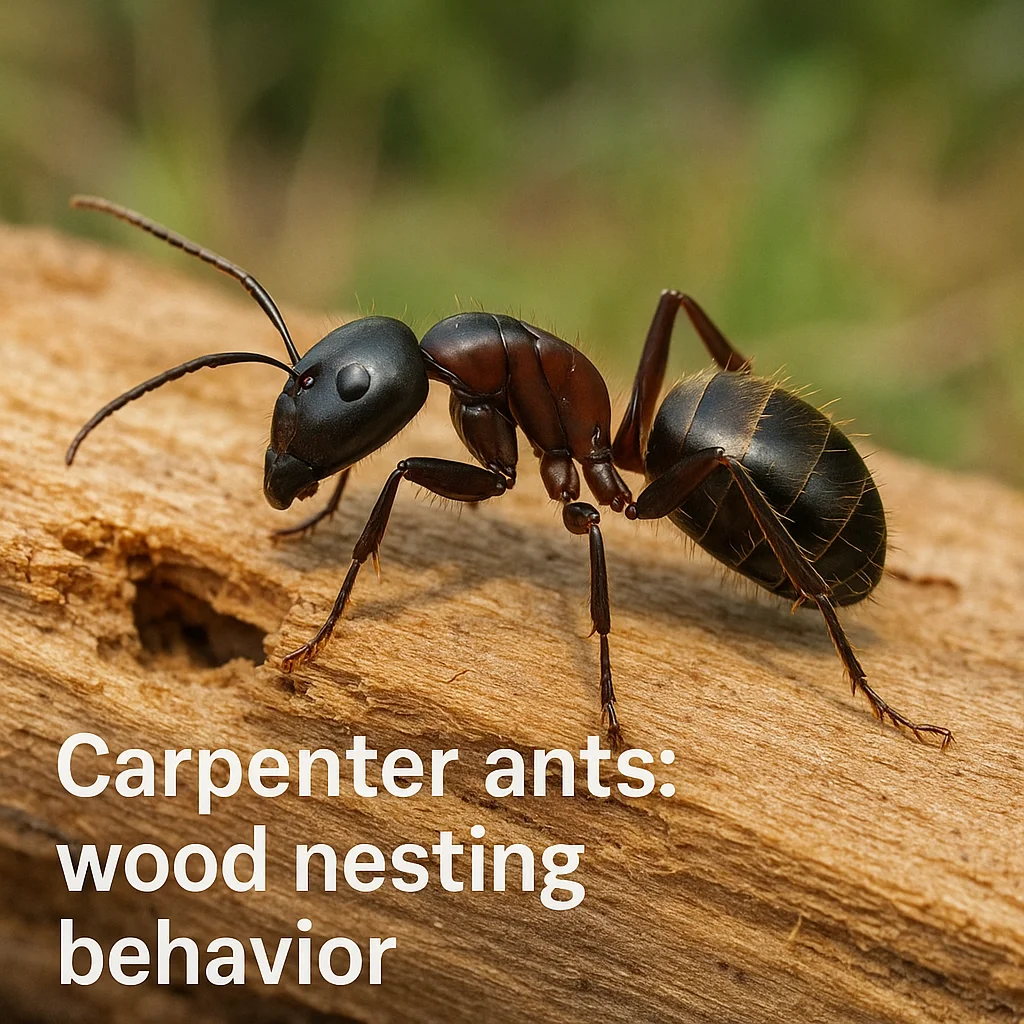
- Common names: Carpenter ants
- Scientific name: Camponotus (varies by species)
- Insect or not: Yes, they are insects and invertebrates
- Order / family: Hymenoptera / Formicidae
- Typical size range: 6 to 25 mm, varies by species
- Key colors/patterns: Generally black or bicolored with red and black
- Activity: Mostly nocturnal but sometimes diurnal
- Typical habitats: Deciduous and coniferous forests, urban settings
- Where in the world it occurs: Mostly found in North America, some in Europe, Asia, and Australia
- Seasonality: Most visible during spring and summer
🔍 Identification
Carpenter ants are easily recognized by their large, robust bodies and distinct thorax profile. Their antennae are elbowed, a typical feature of most ants. If you encounter ants with wings, it's likely a reproductive male or queen during the swarming season.
- Body shape and silhouette: Large, narrow waist between thorax and abdomen
- Antennae type: Elbowed
- Wing features: Present in reproductive individuals; two pairs with forewings larger
- Leg traits and movement style: Strong legs suited for climbing; moves swiftly
- Distinguishing look-alikes: May be confused with termites; unlike termites, carpenter ants have a pinched waist
- Top ID Tips:
- Look for large size and shiny black bodies
- Note the heart-shaped head when viewed from above
- Recognize elbowed antennae
- Spot the narrow-waisted thorax
- Distinguish by observing nocturnal activity
- Identify large colonies in wood structures
- Check for trails leading to wood shavings
- Compare with other ant species by size
- Look for winged individuals during mating season
- Use environmental context to help identify
🧠 Basic Body Structure
Carpenter ants, like all insects, have a body segmented into three main parts: head, thorax, and abdomen. They possess six legs and are characterized by their strong exoskeleton, which they must molt periodically as they grow. They are invertebrates, meaning they do not have a backbone.
🌍 Habitat & Distribution
Carpenter ants prefer temperate forests, but are versatile and can thrive in urban gardens and buildings if wood moisture levels are high. They mainly inhabit areas where they can access damp or decayed wood to create their nests. These ants are distributed across continents including North America, Europe, and parts of Asia.
Changes in habitat, such as urban expansion and deforestation, may influence their presence and behavior in a given area, making sightings more common in affected regions.
📅 Seasonal Appearance & Activity
Carpenter ants are most active and visible during the warmer months. Their activity overlaps with spring and summer, when temperatures rise, and they engage mostly after dusk.
- Best Time to Spot It:
- Late spring evenings
- Summer nights
- Warm, humid evenings
- Post-sunset when searching for food
- Peak activity after rainstorms
🥚 Reproduction & Egg-Laying
During the mating season, usually observed in spring, winged males and queens emerge en masse for nuptial flights. After mating, queens shed their wings and seek out suitable sites in damp or rotting wood to establish new colonies. Egg counts and laying frequency can vary greatly, with large colonies supporting thousands of workers.
🌀 Metamorphosis & Life Cycle
Carpenter ants undergo complete metamorphosis, transitioning from egg to larva, pupa, and finally adult:
Egg: Tiny and oval. Eggs are laid by the queen and take a few weeks to hatch.
Larva: Legless and grub-like, larvae are fed by worker ants within the nest.
Pupa: Non-feeding resting stage where transformation occurs.
Adult: Emerges from pupa; workers, males, and queens have specific roles in the colony. The entire life cycle from egg to adult can take several weeks to months depending on environmental conditions.
🍽️ Diet & Feeding Behavior
Carpenter ants are omnivorous. As adults, they primarily feed on insect honeydew, plant nectar, and fruit juices, using their strong mandibles to chew. Larvae are fed protein-rich foods in the form of small dead insects.
These ants play an important role as scavengers, helping in decomposition and pest management.
🦉 Predators & Defense
Carpenter ants have several natural enemies, including birds, spiders, and certain nocturnal mammals. They employ several defense strategies such as using formic acid as a chemical deterrent against predators and intruding species.
- Defense Highlights:
- Chemical defenses (formic acid)
- Strong mandibles for biting
- Camouflage against predators
- Quick escape into narrow spaces
- Alarm pheromones to alert colony
👥 Social Behavior & Swarms
Carpenter ants are highly social insects that live in well-organized colonies. Within these colonies, roles are divided among queens, workers, and sometimes males. Workers support the colony by foraging, feeding larvae, and expanding nests. Swarming events occur primarily for mating and establishing new colonies.
🧭 Senses & Communication
Carpenter ants rely on a combination of senses for survival. Their keen sense of smell, facilitated by their antennae, is crucial for detecting pheromone trails used in communication and navigation. They also communicate by touch and through auditory signals such as drumming within the nests.
🌱 Role in the Ecosystem
These ants are vital for the ecosystem, aiding in the natural decomposition of wood and organic matter. Their interaction with aphids and other insects can control pest populations, making them beneficial to agriculture and maintaining ecological balance.
However, they can be problematic when nesting in human structures, leading to potential damage if infestations are not managed properly.
📉 Population & Conservation Notes
Carpenter ants are generally common in appropriate habitats, although local abundance can vary based on environmental factors and human activity. Habitat loss, climate changes, and pesticide use can influence their populations, with data on global numbers being limited.
- How to Help (Low-Impact):
- Promote the growth of native plants
- Manage wood moisture levels in buildings
- Avoid unnecessary pesticide use
- Preserve natural habitats
⚠️ Human Interaction & Safety
Carpenter ants do not sting, but they can bite with their strong mandibles if disturbed. While they are not inherently dangerous, their nesting behavior can cause structural damage over time. To minimize harm, observe them respectfully in their natural environment and avoid disturbing their nests.
For any bites, it is recommended to wash the area with soap and water and to seek professional advice if there is a severe reaction.
📌 Summary
- Large, robust ants commonly found in wooded and urban settings
- Easily identified by their size, elbowed antennae, and bi-colored appearance
- Most active during the warmer months, especially at night
- Undergoes complete metamorphosis with distinct life stages
- Feeds on a diverse diet of honeydew, nectar, and other insects
- Predators include birds and spiders; uses chemical defenses
- Provides ecological benefits through decomposition and pest control
- Common but affected by human activities like deforestation and urbanization
- Respectful observation and habitat conservation are encouraged
- Potential structural pests if nesting in homes, requiring careful management