🕷️ Fire ants: sting effects and precautions
🧾 Quick Facts
Fire ants are a group of stinging ants known for their aggressive nature and painful sting. They are a widespread group with several species, most famously the Red Imported Fire Ant. Here's a quick overview:
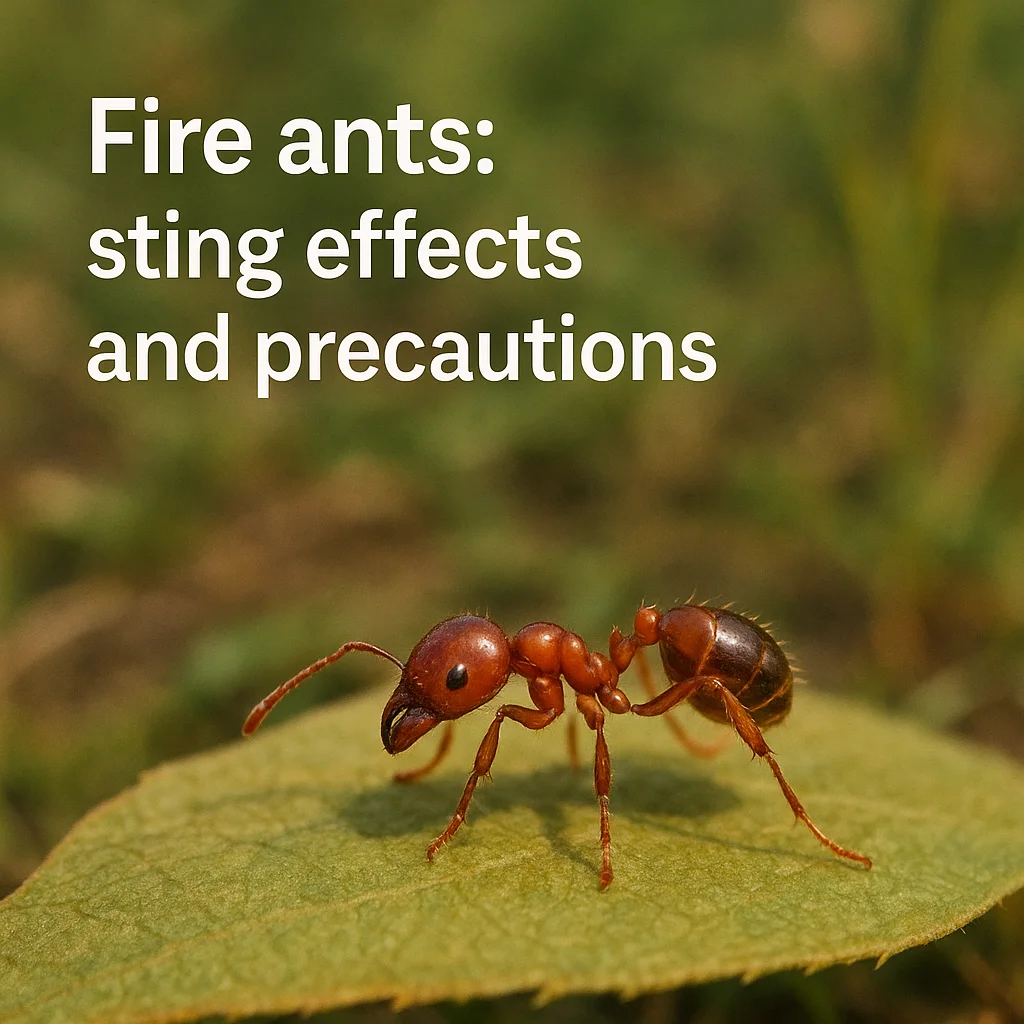
- Common names: Fire ants, Red Imported Fire Ants
- Scientific name: Varies by species (e.g., Solenopsis invicta)
- Insect: Yes, a type of ant (invertebrate)
- Order / Family: Hymenoptera / Formicidae
- Typical size range: 2.5 to 6 mm (adults)
- Key colors/patterns: Reddish-brown with darker abdomen
- Activity: Diurnal (active during the day)
- Typical habitats: Open, sunny areas with disturbed soil
- Where in the world it occurs: Mostly in the Americas and invasive in other regions like Asia and Australia
- Seasonality: Most visible during warmer months
🔍 Identification
Fire ants can be identified by their reddish-brown color with a darker abdomen. Their bodies have a segmented shape common to ants, consisting of a head, thorax, and abdomen. The antennae of fire ants are elbowed, which is a characteristic feature of ants.
Fire ants lack wings, except for reproductive individuals during specific times of the year. They have relatively short legs, which are built for rapid movement. In terms of look-alikes, fire ants may be confused with other ants but can be distinguished by their aggressive swarming behavior and painful stings.
- Top ID Tips:
- Reddish-brown coloration
- Elbowed antennae
- Aggressive behavior when disturbed
- Visible mound nests in open, sunny areas
- Painful sting when encountered
- Size variation within a single colony
- Distinct, thrifty movement on foraging trails
🧠 Basic Body Structure
Fire ants, like all insects, have a basic body structure divided into three parts: the head, thorax, and abdomen. They possess six legs, all attached to the thorax, and an exoskeleton that provides protection and reduces water loss. Being invertebrates, they do not have a backbone. Fire ants do not undergo dramatic changes like some complete metamorphosis insects do, but they do molt as they grow.
🌍 Habitat & Distribution
Fire ants prefer open, sunny environments where they can establish their nests. These ants typically inhabit disturbed soils found in urban areas, croplands, and meadows. They are notorious for building large mound nests that can spread extensively. Fire ants are native to South America but have spread to North America, Europe, Asia, and Australia, often thriving in warm, humid climates.
Changes in land use, especially those leading to disturbed soils, favor fire ant establishments, increasing their sightings in urban and rural settings where human disturbance is common.
📅 Seasonal Appearance & Activity
Fire ants are most active during warmer months, typically spring and summer, as they require warm soil to thrive. They are diurnal creatures, more active during the day when temperatures are favorable. Humidity and rainfall encourage their surface activities, such as foraging and mound building.
- Best Time to Spot It:
- Warm, sunny days
- Spring and summer months
- After rainfall during clear weather
- Daytime in sunny, open areas
🥚 Reproduction & Egg-Laying
Fire ants have a reproductive system that includes a single queen or multiple queens, depending on the colony. Mating typically occurs during the warmer months when winged males and queens take flight in a "nuptial flight." Mated queens land and establish new colonies.
Eggs are laid in the soil, within the protective environment of the nest mound. The queen can lay hundreds to thousands of eggs, with variability depending on environmental conditions and the colony's size.
🌀 Metamorphosis & Life Cycle
Fire ants undergo a complete metamorphosis, which involves the stages of egg, larva, pupa, and adult. Eggs hatch into larvae that are fed by worker ants. The larval stage is crucial for growth, lasting several weeks. After molting several times, larvae transform into pupae, which resemble adults.
Pupal stage duration can vary but is typically a few weeks before transforming into adult ants. Workers begin their duties shortly after emerging, contributing to the colony's maintenance, foraging, and defense.
🍽️ Diet & Feeding Behavior
Fire ants are omnivorous. Their diet includes proteins from insects, sugars from nectar, and fats. Workers use chewing mouthparts to consume food and carry it back to the colony, feeding the larvae and the queen.
These ants play roles as predators, feeding on insects, but can also scavenge and occasionally damage crops, making them both beneficial and a pest in agricultural settings.
🦉 Predators & Defense
Fire ants have few natural predators due to their aggressive defense mechanisms, but certain birds, reptiles, and mammals may consume them. They defend themselves with a venomous sting that is painful to both humans and animals.
Additionally, fire ants can bite and cling to prey with their mandibles while delivering stings, making them formidable attackers. Their aggression and rapid colony response to threats are key defense strategies.
- Defense Highlights:
- Venomous sting
- Aggressive swarming behavior
- Strong mandibles for biting
- Quick colony response to threats
👥 Social Behavior & Swarms
Fire ants are highly social insects with defined colony roles. This includes workers, soldiers, and reproductive males and queens. They communicate using pheromones and cooperate to build nests, forage for food, and care for young.
Massive swarming behavior can occur when the nest is disturbed, as ants quickly respond to defend their territory. Control over these swarms helps the colony to exploit available food resources more efficiently.
🧭 Senses & Communication
Fire ants rely heavily on chemical communication through pheromone trails to coordinate community tasks, such as foraging and defense. Their sense of smell is acute, allowing them to detect food and danger.
They have limited vision and depend more on touch and pheromones to navigate. Their communication is primarily through chemicals with some tactile interactions when within close proximity to each other.
🌱 Role in the Ecosystem
Fire ants play a dual role in ecosystems. They assist in controlling pest insect populations due to their predatory nature. They contribute to soil aeration by moving significant amounts of soil while constructing nests.
However, their presence can disrupt local ecosystems, impacting native species and sometimes leading to diminished biodiversity. In agriculture, they can harm crops and livestock, but also invert the soil and eat pest insects, offering mixed effects on human activities.
📉 Population & Conservation Notes
Fire ants are widely common, especially in suitable warm environments. Areas with disturbed soils often report a high presence of fire ants. While their global spread is concerning due to ecological disruption, their adaptability ensures their populations remain robust.
- How to Help (Low-Impact):
- Grow native plants to support local biodiversity
- Avoid pesticide use that can harm beneficial insects
- Preserve leaf litter and soil integrity
- Support local biodiversity efforts to maintain balanced ecosystems
⚠️ Human Interaction & Safety
Fire ants can sting, causing a painful, burning sensation that may lead to itching and swelling. These stings usually occur when nests are disturbed. While not typically life-threatening, allergic reactions are possible, so seek professional help for severe reactions.
When observing fire ants, maintain a respectful distance and refrain from disturbing their nests. Fire ants should be appreciated for their complex social structures without disrupting their natural behaviors.
📌 Summary
- Fire ants are small, reddish-brown ants with a painful sting.
- They thrive in open, disturbed soils and are invasive in many regions.
- Most active during warmer months and primarily during the day.
- Undergo complete metamorphosis: egg, larva, pupa, adult.
- Primarily omnivorous, contributing to pest control yet known as agricultural pests.
- Aggressive defenders with limited natural predators.
- Critical social insects with complex colony structures.
- Play both beneficial and disruptive roles in ecosystems.
- Populations remain common, and habitat disturbances aid their proliferation.
- Exercise caution, respect when interacting, and seek advice if severely affected by stings.