🕷️ Weaver ants: leaf nests and teamwork
🧾 Quick Facts
Weaver ants are fascinating creatures known for their remarkable nest-building skills and complex social structures. These ants are primarily found in tropical and subtropical regions, where they play a vital role in the ecosystem. Here are some quick facts about weaver ants:
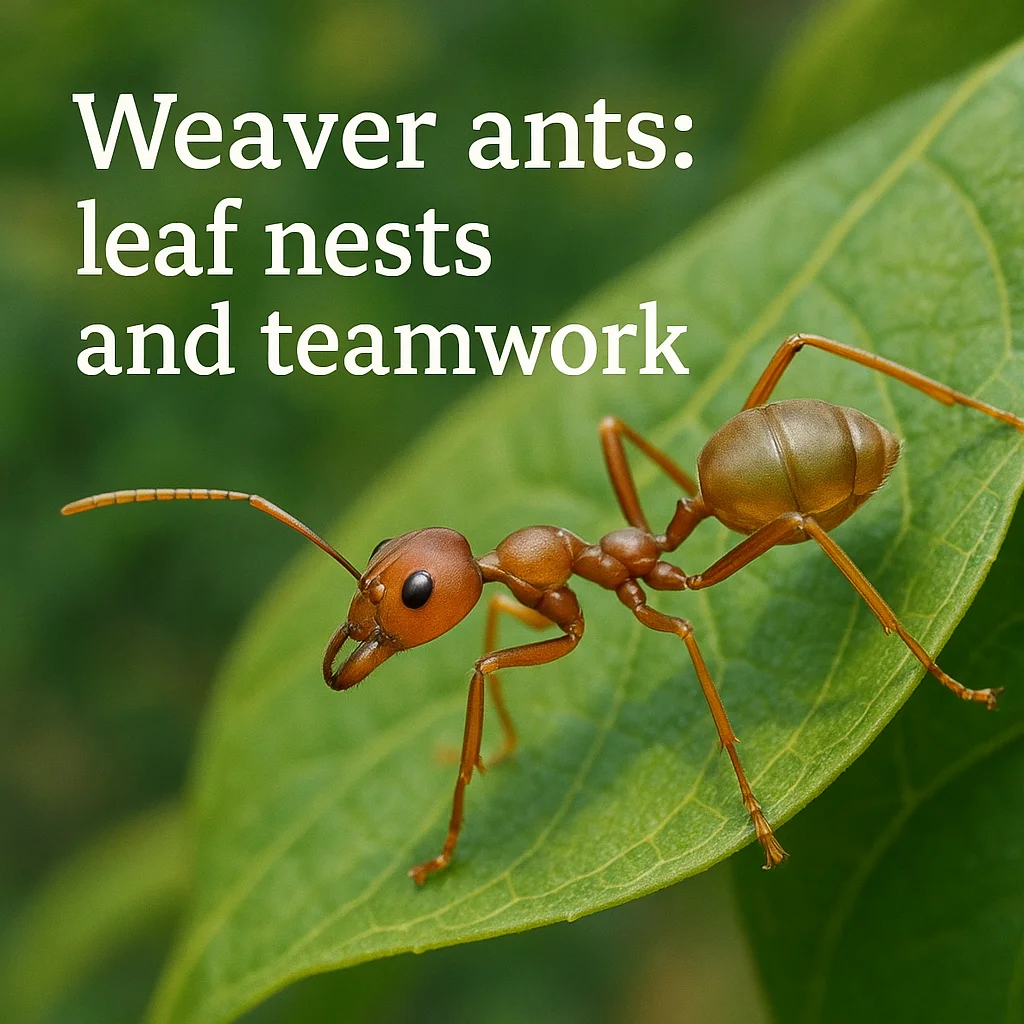
- Common names: Weaver ants, Green tree ants
- Scientific name: Oecophylla spp. (varies by region)
- Insect or not: Yes, they are insects (invertebrates)
- Order / Family: Hymenoptera / Formicidae
- Typical size range: 5–10 mm (worker ants)
- Key colors/patterns: Typically green or reddish-brown
- Activity: Diurnal (active during the day)
- Typical habitats: Forests, plantations, gardens
- Where in the world it occurs: Africa, Asia, Australia
- Seasonality: Most visible during the warmer months in their regions
🔍 Identification
Weaver ants can be recognized by their slender bodies and striking colors, which help them blend into the foliage where they live. They have elbowed antennae and strong mandibles used for both building their nests and defense. Weaver ants do not have wings as adults, unlike some other ant species. Their long legs aid their swift movement across leaves and branches. Although they might be confused with other ant species, particularly Carpenter ants, weaver ants can be distinguished by their unique nest construction behavior.
- Top ID Tips:
- Slim, elongated body shape
- Green or reddish brown coloration prevalent
- Elbowed antennae that are prominent
- Lack of wings in adult stages
- Nests constructed from leaves woven together
- Synchronized army-like movement
- Visible during the day due to diurnal habits
- Commonly forming long columns on tree branches
🧠 Basic Body Structure
Like all insects, weaver ants possess a body divided into three parts: the head, thorax, and abdomen. They have a pair of compound eyes and a set of antennae that are used for communication and sensory perception. As insects, they have six legs and their bodies are protected by a hard outer shell known as an exoskeleton. This exoskeleton does not grow with them, so they must shed it periodically in a process called molting. Weaver ants are invertebrates, meaning they lack a vertebral column or backbone.
🌍 Habitat & Distribution
Weaver ants thrive in tropical and subtropical environments, adapting well to areas with plenty of foliage such as rainforests, plantations, and even urban gardens. They often create nests by weaving together leaves with silk produced by their larvae, allowing them to exploit the canopy environment effectively. They are native to regions in Africa, Asia, and Australia, and their geographical distribution is closely tied to warm climates where they can find year-round vegetation. Habitat alterations such as deforestation can impact their population visibility significantly.
📅 Seasonal Appearance & Activity
Weaver ants are most readily observed during the warmer times of the year when they are actively foraging and maintaining their colonies. As diurnal insects, they are active during daylight, ceasing most of their activities after sunset. They are highly responsive to environmental conditions, often becoming more active after rainfall due to increased prey availability.
- Best Time to Spot It:
- During the warmest months of the year
- Daytime (diurnal activity)
- After rain showers when humidity is high
- In areas with lush vegetation and tree canopies
🥚 Reproduction & Egg-Laying
The reproductive behavior of weaver ants involves complex mating rituals typically observed during swarming events. Females (queens) leave their home colonies to mate with multiple males. After mating, a mated queen searches for a suitable location to establish a new colony. She lays eggs in woven leaf nests, initiating the birth of her new colony. The number of eggs a queen can lay varies, but queens typically invest heavily in producing a large number of worker ants to stabilize the colony initially.
🌀 Metamorphosis & Life Cycle
Weaver ants undergo complete metamorphosis, progressing through four primary stages: egg, larva, pupa, and adult. As larvae, they primarily consume liquid food regurgitated by worker ants. This stage is crucial both for growth and for collecting the silk needed for nest construction. Pupae are immobile and encased in protective cocoons until they mature into adults. The entire development process is efficient, ensuring a steady turnover of workers to maintain and expand the colony.
🍽️ Diet & Feeding Behavior
Weaver ants primarily feed on small insects and arthropods, using their strong mandibles to subdue prey. They exhibit predatory behavior, which helps control pest populations. Additionally, they tend to farm sap-sucking insects like aphids, protecting them in exchange for honeydew. This varied diet ensures their colonies are well-nourished. Their mouthparts are adapted for chewing, allowing them to efficiently process their food.
🦉 Predators & Defense
Weaver ants must be vigilant against various predators, including birds, reptiles, and certain mammal species. They have developed multiple defense strategies: their biting mandibles can deter small intruders, and they release a potent chemical spray to ward off larger attackers. The ants' synchronized group defense tactics make them formidable adversaries even for larger threats. Their ability to fabricate extended, interlinked nests further insulates them from predators.
- Defense Highlights:
- Strong mandibles for biting
- Acidic chemical sprays
- Cohesive group defense
- Networked nests for protection
- High visibility for territorial deterrence
👥 Social Behavior & Swarms
Weaver ants are highly social insects, living in structured colonies led by a queen. Colony members are categorized into roles: queens, workers, soldiers, and males. Workers and soldiers collaborate in tasks such as foraging, nest maintenance, and defense. Communication within these colonies occurs primarily through chemical signals or pheromones. Large colony operations, resembling swarms, can occur during seasonal foraging or expansion activities.
🧭 Senses & Communication
Weaver ants possess highly developed senses. Their primary mode of communication is through pheromones, allowing them to convey a wide range of messages, from alarm signals to foraging directions. Their tactile sense is also crucial, as they detect vibrations through their legs and bodies. While they rely less on visual acuity, their sense of smell is highly refined, aiding in cooperation and navigation within complex environments.
🌱 Role in the Ecosystem
Weaver ants play an essential role in their ecosystems, exerting significant influence as both predators and mutualists. By preying on insects that might otherwise damage vegetation, they act as natural pest controllers. Their mutualistic relationships with nectar-producing plants and honeydew-producing insects further cement their beneficial role. Weaver ants can impact agriculture by protecting fruit trees from herbivorous pests, showcasing their ecological and economic significance.
📉 Population & Conservation Notes
Weaver ant populations are generally stable in undisturbed habitats. They are often reported as common where suitable habitats are present, but local variations in abundance can occur due to factors like habitat alteration and pesticide use. Conservation efforts focus on maintaining healthy tree populations and minimizing pesticide exposure to protect these beneficial insects. Data on global populations remain limited, underscoring the need for further study.
- How to Help (Low-Impact):
- Plant native trees and shrubs to provide habitat
- Avoid using pesticides in garden areas
- Support conservation of tropical forests
- Educate others about the importance of weaver ants
- Leave natural leaf litter undisturbed
⚠️ Human Interaction & Safety
While weaver ants can deliver painful bites when threatened, they rarely pose serious danger to humans. It's prudent to observe them respectfully, maintaining a distance if nests are encountered. In the unlikely event of a bite, washing the area and avoiding scratching is recommended, while seeking professional advice if a severe reaction occurs. Encouraging peaceful coexistence can be an enriching experience for both people and the environment.
📌 Summary
- Recognizable by green or reddish-brown colors and large, interconnected leaf nests
- Found in tropical and subtropical forests across Asia, Africa, and Australia
- Diurnal ants, most active in warm, humid conditions
- Undergo complete metamorphosis from egg to adult
- Diet includes small insects and honeydew from aphids
- Defend colonies with potent bites and acid sprays
- Ecosystem roles as pest controllers and plant mutualists
- Population threats include habitat loss and pesticide use