🕷️ Bee life cycle: queen, worker, drone
🧾 Quick Facts
The life cycle of bees, particularly those of the honey bee, includes distinct roles: queens, workers, and drones. Understanding the various aspects of these roles and their contributions to a colony provides insight into bee ecology and biology.
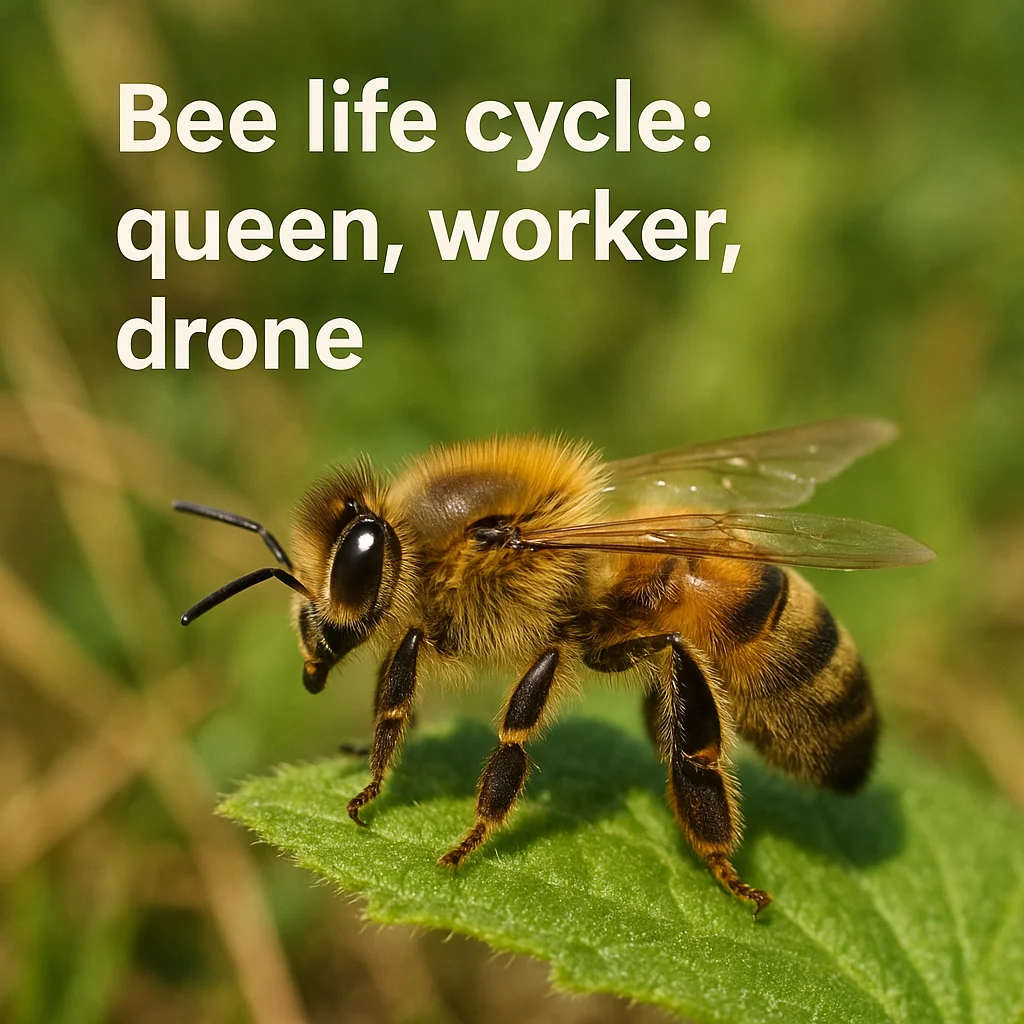
- Common names: Honey bee, Bumblebee, Carpenter bee
- Scientific name: Varies by species; e.g., Apis mellifera for the honey bee
- Insect or not: Insect, an invertebrate
- Order/family: Hymenoptera/Apisidae
- Typical size range (adult): 12 to 25 mm depending on the species
- Key colors/patterns: Yellow, black, with hairy bodies
- Activity: Diurnal (active during the day)
- Typical habitats: Gardens, woodlands, meadows, agricultural fields
- Where in the world: Globally distributed except Antarctica
- Seasonality: Most active in spring and summer months
🔍 Identification
Bees are easily recognized by their robust bodies and their distinguished roles within the hive. Identifying a bee involves observing its body shape, wing structure, and coloration.
- Body shape and silhouette: Generally oval and hairy
- Antennae type: Filiform (thread-like)
- Wing features: Membranous wings with distinct venation
- Leg traits and movement style: Spurred hind legs; they move quickly and hover during flight
- Distinguishing look-alikes: Bees can be mistaken for wasps, which have smoother bodies and a more defined waist
- Top ID Tips:
- Look for hairy bodies and pollen baskets on hind legs
- Note the rounded body shape in contrast to wasps
- Observe the flying pattern: bees have a more direct and steady flight
- Listen for a steady buzzing sound
- Check for the presence of pollen collection on legs
🧠 Basic Body Structure
Bees, like all insects, have a three-part body structure: head, thorax, and abdomen. They possess six legs and are invertebrates, meaning they lack a spinal column but have a protective exoskeleton.
Strong wings facilitate flight and pollination, while the exoskeleton helps with molting as they develop.
🌍 Habitat & Distribution
Bees are widely distributed across various habitats, from dense forests to urban gardens. They thrive best in environments abundant with flowers, as these provide essential nectar and pollen resources. Bees can be found in almost every part of the world, except for Antarctica, adapting to temperate and tropical climates.
Variations in local flora and seasonal climate conditions can alter bee populations and visibility in certain areas.
📅 Seasonal Appearance & Activity
Bees are most frequently observed during warmer months when flowers are in bloom. Their visibility peaks during spring and summer as they forage for pollen and nectar during the day. Weather conditions like temperature and rainfall impact their activity, as bees avoid flying in the rain.
- Best Time to Spot It:
- Spring through late summer for most regions
- Early morning and mid-afternoon as temperatures peak
- During dry and warm weather conditions
- Especially in gardens or fields with abundant flowering plants
🥚 Reproduction & Egg-Laying
In bee colonies, reproduction is primarily the responsibility of the queen. Once mated, she lays eggs in hexagonal cells within the hive. Eggs are carefully distributed based on the resources and needs of the colony.
The queen chooses whether to fertilize each egg: fertilized eggs develop into female bees (workers or queens), while unfertilized eggs become males (drones). Egg-laying is a continuous process adjusted to seasonal changes and food availability.
🌀 Metamorphosis & Life Cycle
Bees undergo complete metamorphosis, transitioning through four distinct life stages: egg, larva, pupa, and adult.
Egg stage: The queen lays eggs in well-prepared cells, where they remain for about three days before hatching into larvae.
Larva stage: Bee larvae are initially fed royal jelly and then transitioned to honey and pollen. This stage lasts approximately six days.
Pupa stage: Larvae spin cocoons and enter the pupation period, transforming within this protected stage over the course of about 12 days.
Adult stage: Fully developed bees emerge and assume their roles based on their gender and the colony's needs.
🍽️ Diet & Feeding Behavior
At various life stages, bees primarily consume pollen and nectar. These resources are gathered by worker bees using their proboscis, an elongated mouthpart designed for sucking liquids.
Bees serve a crucial role as pollinators, facilitating the reproduction of flowering plants as they forage. Their diet and feeding behavior underpin much of their ecological importance.
🦉 Predators & Defense
Naturally, bees face threats from predators such as birds, spiders, mammals, and amphibians. To defend themselves and their hives, many bees possess stingers and use swarm behavior as protective measures.
- Defense Highlights:
- Warning coloration and patterns to dissuade predators
- Use of stingers in defense when threatened
- Swarming to intimidate potential threats
- Building hives in inaccessible or hard-to-find locations
👥 Social Behavior & Swarms
Bees are highly social insects. They live in structured colonies, usually led by a queen and supported by workers and drones. Colony roles shape each bee's life, with strict hierarchies and communication methods.
Swarms are triggered by overcrowding or the need to expand to new locations, involving a queen and thousands of workers departing to establish a new hive.
🧭 Senses & Communication
Bees have advanced sensory abilities, including well-developed vision, smell, and the ability to sense vibrations. They communicate using various methods, like the famous "waggle dance," which conveys the location of food sources.
Pheromones released by the queen and other bees maintain colony cohesion and inform of various states such as alert or rest.
🌱 Role in the Ecosystem
Bees are vital pollinators within ecosystems, enabling plant reproduction and contributing to biodiversity. This role supports food webs and human agriculture by ensuring fruit, vegetable, and seed production.
Bees engage in mutualistic relationships with plants, often playing a role in the plant's reproductive success while obtaining necessary sustenance.
📉 Population & Conservation Notes
Bee populations experience variability based on habitat availability, pesticide exposure, and climate change. While bees are frequently found in suitable areas, their numbers are declining in places due to environmental stressors.
- How to Help (Low-Impact):
- Plant native wildflowers and blooming plants
- Avoid using pesticides in gardens and lawns
- Create bee-friendly habitats with nesting sites
- Leave areas of natural vegetation undisturbed
⚠️ Human Interaction & Safety
Bees may sting when threatened, feeling the need to defend themselves or their nests. It is advisable to observe bees respectfully, maintaining a distance to avoid provoking them. Wash any sting site and seek professional advice if symptoms persist.
📌 Summary
- Bees are identified by their round, hairy bodies
- Preferring floral habitats, they thrive in gardens and fields
- Most visible in spring and summer during the day
- Complete metamorphosis includes egg, larva, pupa, adult stages
- Essential pollinators; consume nectar and pollen
- Face predators; defend with stingers and swarm behaviors
- Key role in pollination, affecting plants and agriculture
- Populations impacted by habitat and climate changes