🕷️ Carpenter Bees Hovering Drilling And Wooden Nests
🧾 Quick Facts
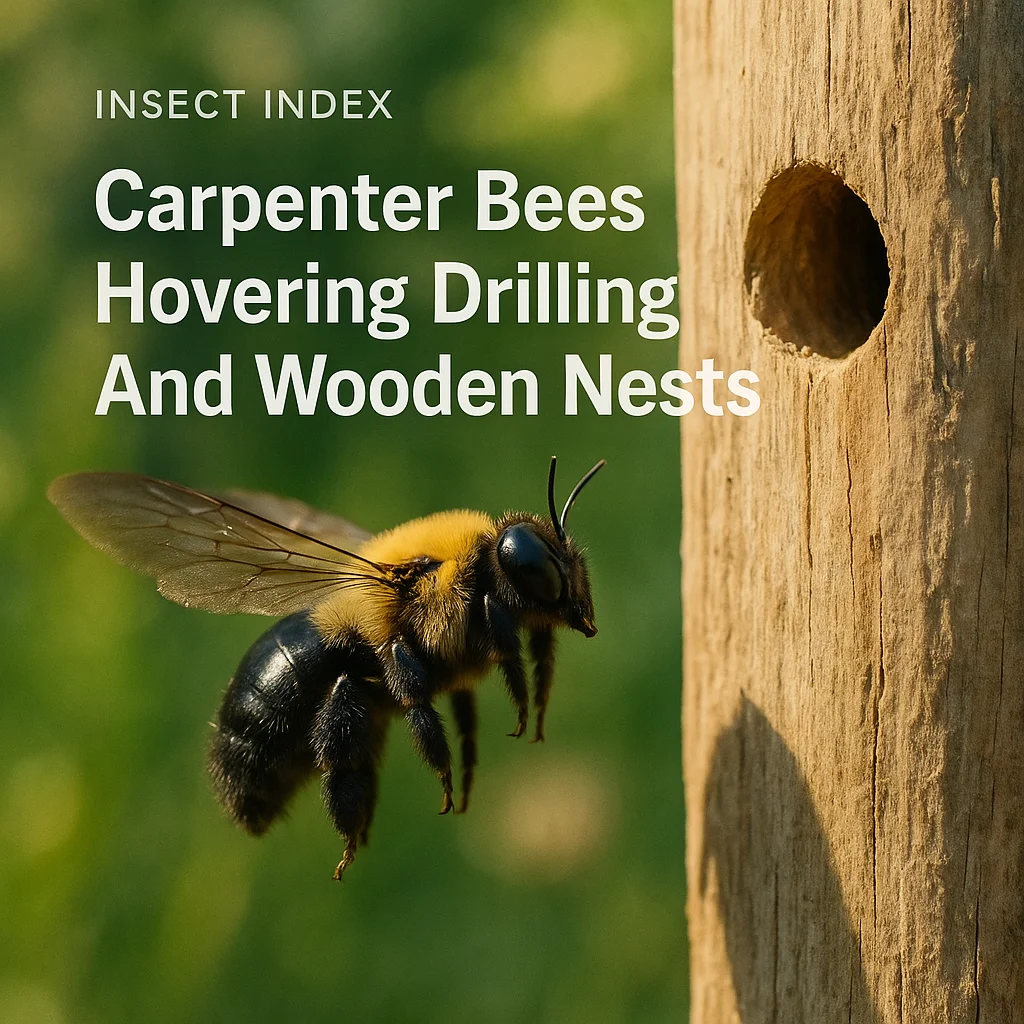
Carpenter Bees Hovering Drilling And Wooden Nests is a common reference to certain species of carpenter bees, which are known for their unique nesting behavior and tendency to hover while searching for suitable nesting sites. These bees are fascinating due to their habit of boring into wood, which provides both a home for their offspring and a source of protection.
- Common Names: Carpenter bees
- Scientific Name: Varies by species (e.g., Xylocopa spp.)
- Insect or Not: Insect; these are invertebrates
- Order/Family: Hymenoptera/Apidae
- Typical Size Range: 12 to 25 mm in length
- Key Colors/Patterns: Often black with a shiny abdomen, sometimes with yellow and black bands
- Activity: Primarily diurnal
- Typical Habitats: Gardens, fields, woodlands, urban areas with wooden structures
- Where in the World It Occurs: Found in temperate and tropical regions worldwide, notably in the Americas and Asia
- Seasonality: Most visible in spring and summer when adults are active
🔍 Identification
Carpenter bees can be recognized by their robust body and a large, shiny abdomen. Unlike bumblebees, they have a less hairy abdomen. The female carpenter bee drills into wood to create tunnels for nesting. Their antennae are medium-sized, and wings are translucent, enabling efficient flight. They might be confused with bumblebees but lack the fuzzy body and generally have different nesting habits.
- Robust, oval-shaped body with prominent abdomen
- Medium-sized, elbowed antennae typical of bees
- Translucent wings with four wings in total
- Quick, hovering flight patterns
- Lack of extensive body hair compared to bumblebees
- Tendency to hover near wooden structures
- Females have a stinger but are non-aggressive unless provoked
- Males often show territorial hovering but cannot sting
- Noisy buzzing when hovering
🧠 Basic Body Structure
Like other insects, carpenter bees have a body divided into three major parts: the head, thorax, and abdomen. They possess six legs and typically two sets of wings. As invertebrates, carpenter bees lack a backbone and possess an exoskeleton that provides structure and protection. They undergo molting as larvae, eventually emerging as winged adults.
Carpenter bees are defined by their strong mandibles, which the females use to drill into wood to create nests. Their vision is well-developed for detecting flowers and potential mates.
🌍 Habitat & Distribution
Carpenter bees prefer warm climates and are commonly found in areas with abundant wooden structures, including eaves, decks, and dead wood in natural habitats. They thrive in regions with easy access to their preferred nesting materials. In the wild, they may occupy open fields, forests, and urban gardens.
Their geographic range includes most continental areas with temperate climates, including North and South America, parts of Europe, and Asia. Climate influences their distribution; as temperatures rise or fall, their habitats might expand or contract accordingly.
📅 Seasonal Appearance & Activity
Carpenter bees are most active during the warmer months, particularly in spring and summer. Their diurnal activity makes them most visible during daylight hours when they forage for food and search for nesting sites. Weather conditions such as warmth and calm winds facilitate their activity, while inclement weather can suppress visibility.
- Best observed during bright daylight hours
- Spring and summer offer peak viewings
- Cool climates may limit visibility to warmer days
- Rainy or windy weather reduces flying activity
🥚 Reproduction & Egg-Laying
Carpenter bees exhibit a fascinating reproductive process. Mating typically involves aerial displays, and males are often seen hovering territorially. The female carpenter bee drills into wood, creating a series of tunnels or galleries. Eggs are laid within these secured structures and provided with a mixture of pollen and nectar as food provisions for the developing larvae.
The number of eggs per gallery varies but is typically a small clutch, allowing the mother to invest significant resources into each offspring.
🌀 Metamorphosis & Life Cycle
Carpenter bees undergo complete metamorphosis. The life stages include egg, larva, pupa, and adult. Eggs hatch into larvae, which feed on the pollen and nectar provided by their mother. After the larval stage, they enter the pupal stage, during which they undergo significant transformation before emerging as adults.
The developmental time varies but generally spans several weeks, with temperature affecting the speed of metamorphosis. Adults are responsible for finding new nesting sites and feeding sources.
🍽️ Diet & Feeding Behavior
Adult carpenter bees are primarily nectar-feeders and play an important role in pollination, as they move between flowers to consume nectar. Their robust mandibles are not used for feeding in adults but are important for female bees when constructing nests. Larvae consume the pollen ball left by the female bee in the nest.
Given their role as pollinators, carpenter bees are beneficial to many ecosystems, though they do not produce honey.
🦉 Predators & Defense
Carpenter bees face numerous natural predators, including birds, spiders, and certain wasps that exploit their nests. To defend themselves, these bees employ camouflage and speedy flight. Females can sting if provoked, though they are generally non-aggressive.
- Camouflage against wood surfaces
- Quick retreats into nests or sheltered areas
- Females have stingers, males do not sting
- Alert flight and vigilance to avoid predators
👥 Social Behavior & Swarms
Carpenter bees are mostly solitary, with each female establishing her own nest. Males often display territorial behavior to ward off rivals and attract females. They do not form swarms in the same way as honeybees or certain social wasps.
Social interactions center around mating encounters and competition for suitable nesting sites.
🧭 Senses & Communication
Carpenter bees have highly developed senses of vision and smell. Their compound eyes help detect motion and recognize flowers, while their sense of smell is pivotal in locating floral resources and mates. Vibrational communication is also key, especially when females drill into wood structures, which can serve as a signal to others.
While carpenter bees do not communicate with pheromones to the extent that honeybees do, their buzzing serves as an audible cue in their environment.
🌱 Role in the Ecosystem
Carpenter bees are essential pollinators for many plant species, supporting biodiversity and the production of fruits and seeds. Through their pollination activities, they contribute to the health of numerous ecosystems by assisting in plant reproduction.
Their activity also influences the structure and quality of wooden habitats, though they can be problematic if nesting in human structures.
📉 Population & Conservation Notes
In general, carpenter bee populations are stable, although they may face threats from habitat destruction and pesticide usage. Regional abundance varies widely depending on local environments and human activities.
- Preserve natural nesting areas
- Plant native flowers to support pollination
- Reduce pesticide use to protect pollinator health
- Provide artificial nests to mimic natural habitats
⚠️ Human Interaction & Safety
While female carpenter bees are capable of stinging, they are non-aggressive and usually sting only when provoked or threatened. Their role in pollination advocates for their protection rather than harm. In cases of accidental stings, wash the area gently and seek professional advice if severe reactions occur.
Respectful and non-intrusive observation is encouraged to minimize disturbance to these beneficial insects.
📌 Summary
- Recognizable by robust body and hovering behavior
- Inhabit diverse environments with wood availability
- Most active in spring and summer daylight
- Complete metamorphosis — crucial pollinators
- Role as nectar-feeders and pollinators
- Natural predators include birds and spiders
- Solitary with specific nesting habits
- Important for plant pollination ecology
- Common in regions with suitable habitats
- Promotes ecological balance, minimal human conflict