🕷️ Honeybee (Apis mellifera): colony basics
🧾 Quick Facts
The Honeybee, Apis mellifera, is one of the most well-known and widely distributed bee species with significant ecological and agricultural importance. As a social insect, they are known for living in large colonies and producing honey, making them economically valuable.
- Common Names: Honeybee, European Honeybee
- Scientific Name: Apis mellifera
- Insect or Not: Insect; a type of invertebrate
- Order/Family: Hymenoptera / Apidae
- Typical Size Range: 12-15 mm (about 0.5 inches)
- Key Colors/Patterns: Golden-brown with black bands and furry bodies
- Activity: Diurnal (active during the day)
- Typical Habitats: Meadows, gardens, orchards, forests
- Where in the World: Native to Europe, Asia, and Africa; introduced worldwide
- Seasonality: Most active in spring and summer
🔍 Identification
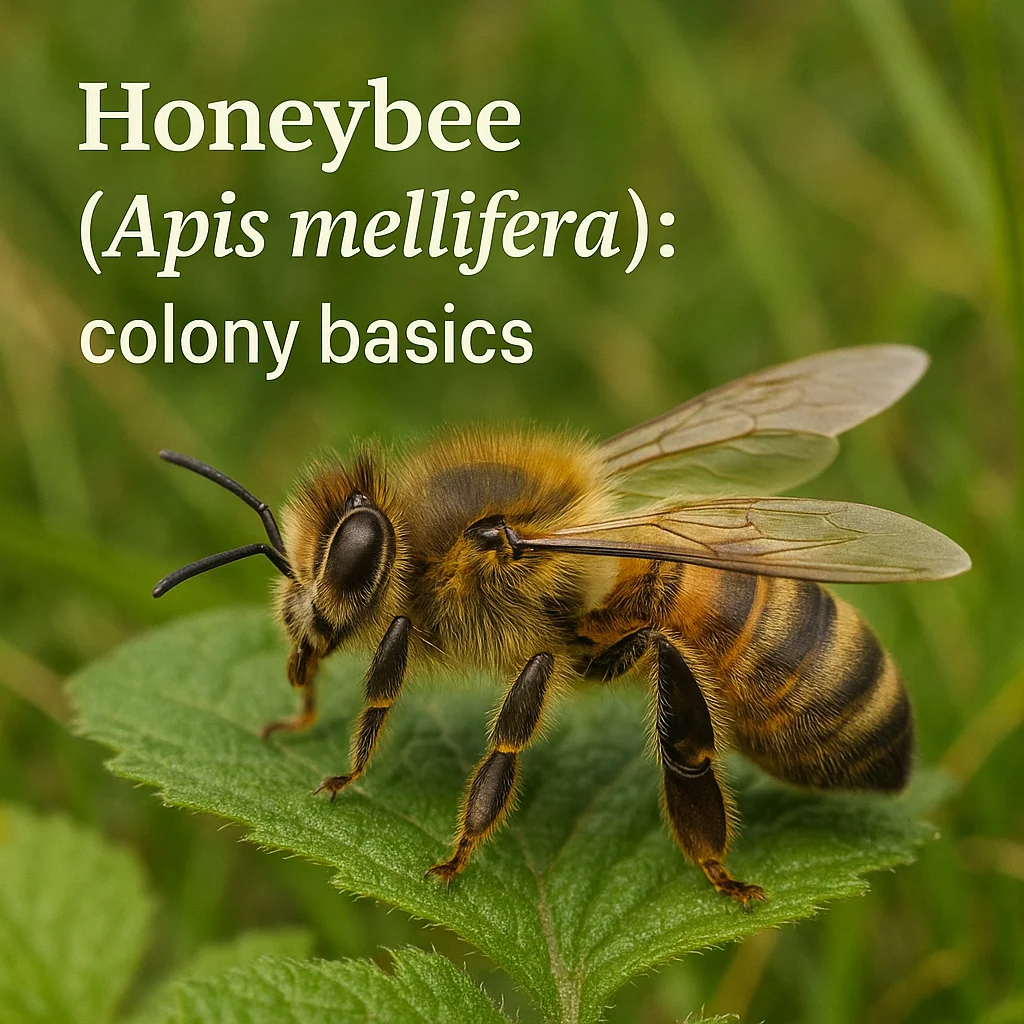
Honeybees can be easily identified in the field by their distinct body shape and coloration. They have a robust, oval-shaped body with a furry thorax and a smooth abdomen. Their antennae are short and bent. The wings are translucent with a visible vein pattern and rest on top of the abdomen. They exhibit a typical bee flight pattern, darting from flower to flower.
While they can be confused with other bees and wasps, their color, size, and body hair help distinguish them. Unlike wasps, honeybees have a more hairy appearance, aiding in pollen collection.
- Oval-shaped body with a golden-brown hue
- Black bands on the abdomen
- Furry thorax, helping in pollen collection
- Bent antennae
- Translucent wings with visible veins
- Commonly flutters between flowers in gardens and fields
- Often mistaken for wasps but have a broader and hairier body
- Tends to work in groups
🧠 Basic Body Structure
As insects, honeybees possess a segmented body divided into three main sections: the head, thorax, and abdomen. They have six legs and a pair of wings attached to the thorax. The head carries sensory organs, including compound eyes and antennae, while the thorax houses muscles for movement and flight.
Honeybees have an exoskeleton that provides structural support and protection. Unlike vertebrates, they lack a backbone, classifying them as invertebrates. Their exoskeleton is periodically molted during development stages to allow for growth.
🌍 Habitat & Distribution
Honeybees prefer environments rich in flowering plants, such as meadows, gardens, orchards, and agricultural fields. They can inhabit forests and edge habitats but thrive best where flowers are abundant. Honeybees can be found on every continent except Antarctica, thriving in temperate climates but adaptable to tropical and subtropical regions.
Changes in land use, pesticide application, and climate conditions can greatly affect honeybee populations, often leading to reduced sightings in urbanized or intensely farmed areas.
📅 Seasonal Appearance & Activity
Honeybees are primarily active during spring and summer when flowers are most abundant. They operate during daylight hours when temperatures are warmer, usually between early morning and late afternoon. Their activity decreases during rainy or overly windy weather.
- Best seen from spring to summer
- Daylight foraging, typically early morning to late afternoon
- Warmer weather increases activity
- Reduced activity during rain or high wind
- Winter activity is minimal in cold climates
🥚 Reproduction & Egg-Laying
The queen bee plays the central role in colony reproduction, laying up to 2,000 eggs per day during peak season. Mating occurs shortly after she emerges, with a single mating flight involving multiple drones. Eggs are laid in honeycomb cells within the hive, and whether they are fertilized determines if they develop into worker bees or drones.
Egg-laying requires a highly social structure within the hive, with worker bees maintaining and cleaning the cells for the new brood. The number of eggs and hatching rates can be influenced by environmental conditions and colony health.
🌀 Metamorphosis & Life Cycle
Honeybees undergo complete metamorphosis, consisting of the egg, larva, pupa, and adult stages. Larvae are fed royal jelly initially and then a diet of honey and pollen by worker bees. The larval stage lasts about 6 days, after which they spin cocoons to become pupae.
Inside the cocoon, pupae undergo significant transformation over 12 days, developing wings, legs, and body structure of the adult bee. Newly emerged adults assume roles within the hive before eventually taking on foraging duties.
🍽️ Diet & Feeding Behavior
Honeybees primarily consume nectar and pollen. Nectar serves as a carbohydrate source, while pollen provides protein, vital for brood development. They have specialized mouthparts to lap up nectar and gather pollen from flowers, playing a significant role as pollinators in ecosystems.
Adults and larvae differ in their diets: larvae initially consume royal jelly before transitioning to pollen and nectar, while adults primarily collect nectar for honey production.
🦉 Predators & Defense
Honeybees face predation from birds, mammals, wasps, and certain insects like ants. Their primary defense mechanism includes a sting, which they use when provoked or threatened. Although their sting is a deterrent, it leads to the death of the bee due to the barbed sting mechanism.
Other defense strategies include alarm pheromones that signal threats to the colony and enable coordinated defensive actions. Camouflage and swarming behavior also help deter predators.
- Defend using a venomous sting
- Release alarm pheromones upon attack
- Swarming behavior to overwhelm predators
- Camouflaged hive entrances
👥 Social Behavior & Swarms
Honeybees are highly social insects, living in intricate colonies with distinct roles: the queen, worker bees, and drones. Worker bees manage tasks such as foraging, nest cleaning, and feeding larvae, guided by complex communication methods, including the famous "waggle dance."
Swarming occurs when the colony divides, often to form a new nest, triggered by population pressures or queen rearing. Swarms typically occur in late spring, allowing optimal conditions for establishing new colonies.
🧭 Senses & Communication
Honeybees possess acute vision for recognizing flowers and hive landmarks, utilizing compound eyes to perceive rapid movements. They rely heavily on olfactory cues, detecting pheromones for communication within the hive. Pheromone signals coordinate activities and colony behavior efficiently.
The waggle dance is a renowned communication method, conveying the location of floral resources to other bees. Vibrations and tactile communication within the hive also aid in effective social coordination.
🌱 Role in the Ecosystem
Honeybees are crucial pollinators, supporting plant reproduction by facilitating the transfer of pollen between flowers. They enhance biodiversity and agricultural productivity by aiding in the fruit and seed production of countless plant species.
Their interdependence with flowering plants creates mutualistic relationships that underpin healthy ecosystems. Honeybees' pollination services are invaluable, bolstering food security through increased crop yields.
📉 Population & Conservation Notes
Honeybee populations are often abundant in local environments conducive to their lifecycle. However, declines have been reported due to habitat loss, pesticide use, and diseases, calling for conservation efforts to stabilize and support populations.
- Integrate native flowering plants into your garden
- Limit pesticide application, opting for natural alternatives
- Support local beekeepers and bee-friendly practices
- Leave natural nesting sites and wildflower patches
- Advocate for preservation of natural habitats
⚠️ Human Interaction & Safety
Honeybees generally sting only when provoked or protecting their hive. While a single sting may cause mild discomfort, it can trigger severe reactions in allergic individuals, requiring medical attention. It's advisable to stay calm and slowly distance yourself when near a bee.
Observation and appreciation of honeybees should be respectful, avoiding capturing or harming them, as they play a crucial role in pollination and ecological balance.
📌 Summary
- Identifiable by golden-brown coloration and furry thorax
- Common in meadows and gardens with flowering plants
- Active in spring and summer during daylight
- Undergo complete metamorphosis
- Diet includes nectar and pollen; essential pollinators
- Predators include birds and wasps; use stings for defense
- Social behavior with complex communication strategies
- Play a vital ecological role and face threats such as habitat loss
- Respectful observation is encouraged to protect their populations