🕷️ How bees collect pollen (pollen baskets)
🧾 Quick Facts
Bees are fascinating insects due to their unique role in ecosystems, particularly regarding their pollen collection activities. Known for their industrious nature and intricate social structures, bees are essential pollinators crucial for the survival of many plant species.
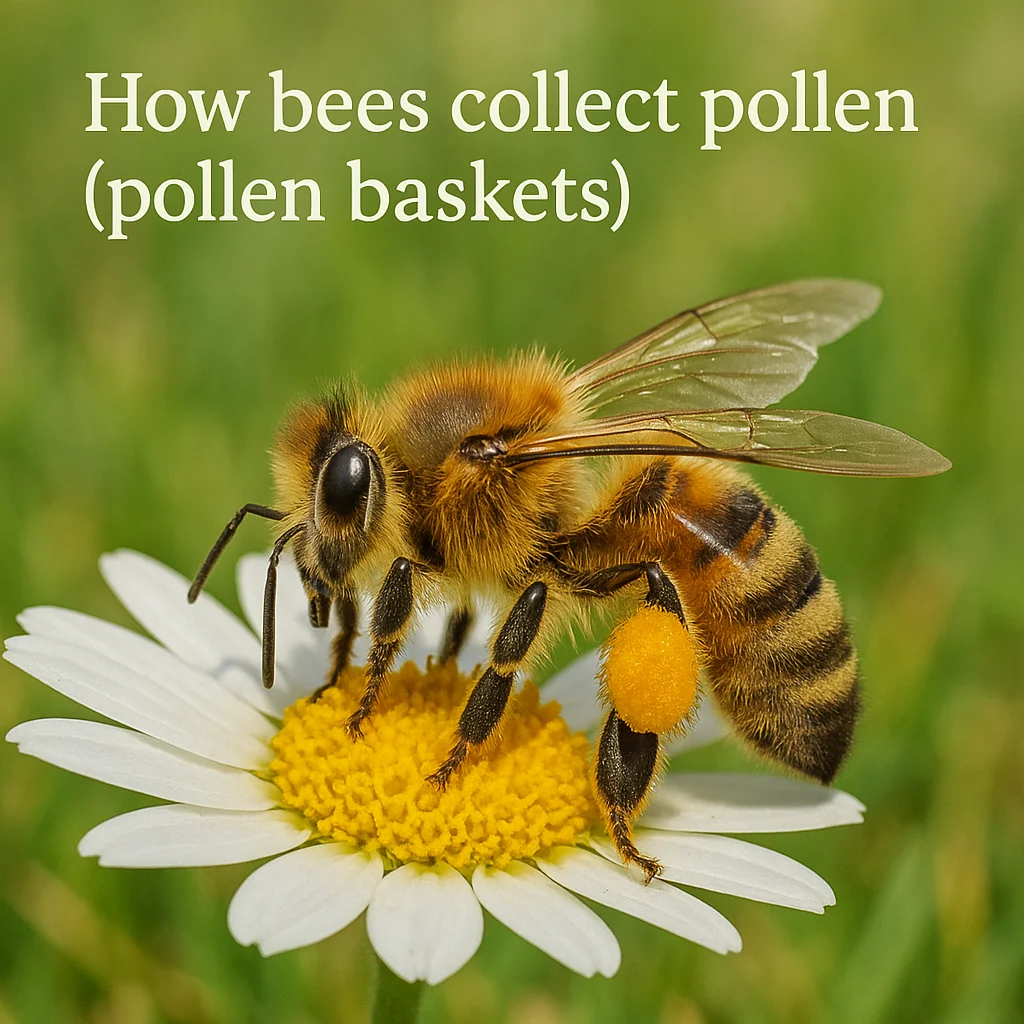
- Common names: Bees
- Scientific name: Varies by species (e.g., Apis mellifera for the common honeybee)
- Insect or not: Insect (invertebrate)
- Order / family: Hymenoptera / varies by species
- Typical size range: 8 to 20 mm (adult, varies by species)
- Key colors/patterns: Yellow and black stripes, sometimes orange, brown, or metallic tones
- Activity: Primarily diurnal
- Typical habitats: Forests, meadows, gardens, agricultural fields
- Where in the world it occurs: Worldwide, except for Antarctica
- Seasonality: Most active in spring and summer
🔍 Identification
Identifying bees involves recognizing their distinct body structure and flight characteristics. Bees have a robust, hairy body with two pairs of wings and six legs. Their hind legs often have specialized structures called pollen baskets (or corbiculae) that are used to collect pollen.
- Body shape and silhouette: Compact, with a rounded abdomen
- Antennae type: Short, elbowed
- Wing features: Two pairs, with hindwings smaller than forewings
- Leg traits and movement style: Strong legs with visible pollen baskets
- Distinguishing look-alikes and common confusion: Can be mistaken for wasps, which have less hairy bodies and no pollen baskets
- Observe the pollen baskets on hind legs
- Look for hairy bodies
- Check for striped patterns
- Note their buzzing flight pattern
- Identify by their social behavior (hives, colonies)
- Presence of stingers (not always visible)
- Feeding on flowers (collecting pollen and nectar)
🧠 Basic Body Structure
Bees are true insects with a three-part body structure: the head, thorax, and abdomen. The exoskeleton provides protection, while the wings enable flight. As invertebrates, bees do not have backbones but rather a hard external covering that they shed through molting as they grow.
Each bee has six legs, which are crucial for movement and gathering pollen. Their wings are particularly adapted for rapid and agile flight.
🌍 Habitat & Distribution
Bees inhabit diverse ecosystems, including forests, grasslands, gardens, and agricultural landscapes. They thrive in areas abundant in flowering plants that provide the nectar and pollen essential for their diets.
Their distribution is global, yet local populations vary based on environmental conditions and plant availability. Urbanization and habitat changes can affect local bee sightings significantly.
📅 Seasonal Appearance & Activity
Bees are most active during warm months when flowers are in bloom, generally from early spring to late summer. Their activity peaks in the midday sun as they prefer to forage under optimal light and temperature conditions.
- Most visible from late spring to early autumn
- Diurnal, active during daylight
- Favor sunny days over cloudy or rainy ones
- High visibility in warm, temperate climates
- Lesser activity during wet, cold weather
🥚 Reproduction & Egg-Laying
Bees generally exhibit complex mating rituals, often involving flight patterns and pheromone signals. The queen bee plays a pivotal role in reproduction within social colonies.
Eggs are typically laid within hives, nests, or in proximity to a food source. Egg-laying strategies vary, with egg totals ranging widely depending on the species and environmental conditions.
🌀 Metamorphosis & Life Cycle
Bees undergo complete metamorphosis, moving through well-defined stages: egg, larva, pupa, and adult. The larvae are fed a regimented diet primarily consisting of nectar and pollen within secure cells.
Each stage occurs within the protection of the hive or nest, with the entire development process taking several weeks, but this duration may vary with species and climate conditions.
🍽️ Diet & Feeding Behavior
Bees are primarily herbivores that feed on nectar and pollen. Their proboscis allows them to suck nectar from deep within flowers. This feeding behavior simultaneously facilitates plant pollination, making bees vital ecological players.
While adult bees focus on nectar collection, larvae consume a combination of nectar and pollen prepared by adult workers.
🦉 Predators & Defense
Bees are preyed upon by birds, spiders, and small mammals, among others. Their defense strategies include chemical signals, stingers, and collective colony defense tactics.
- Play dead or hide when threatened
- Employ collective defense through swarming
- Use stings as a defense mechanism
- Communicate danger through pheromones
👥 Social Behavior & Swarms
Bees, particularly the species that form hives, are highly social creatures that exhibit complex colony structures. Each colony comprises different roles, including workers, drones, and a queen.
Swarms typically form in response to hive overcrowding or environmental pressures, allowing colonies to establish new locations.
🧭 Senses & Communication
Bees possess acute vision and smell, with the ability to detect pheromones and navigate using visual landmarks and the sun's position. They communicate through various methods, including the well-known "waggle dance," which conveys information about food sources.
🌱 Role in the Ecosystem
Bees are indispensable for pollination, directly impacting food production and biodiversity. Their activity supports the reproduction of flowering plants, which are foundational components of many ecosystems.
Their ecological relationships are primarily mutualistic, with plants and bees benefiting from cross-pollination and nectar exchange.
📉 Population & Conservation Notes
Bee populations face significant pressures from habitat loss, pesticides, and climate change. While some bee species remain common, others are experiencing declines, highlighting the need for conservation efforts.
- Support local pollinator gardens
- Avoid pesticide use in gardens
- Leave natural leaf litter undisturbed
- Install bee-friendly habitats
⚠️ Human Interaction & Safety
Although bee stings can be painful, bees sting primarily in defense and pose little threat when left undisturbed. If stung, washing the area and applying a cold compress can help, with professional advice recommended if allergic reactions occur.
Respect for their natural role and safe observation are encouraged to minimize human impact on bee activities.
📌 Summary
- Bees are identified by their striped, hairy bodies and pollen baskets.
- They inhabit diverse areas, favoring locations rich in flowering plants.
- Best seen during warm seasons with abundant daylight.
- Display complete metamorphosis encompassing egg, larva, pupa, and adult stages.
- Mainly feed on nectar and pollen, playing crucial pollination roles.
- Defend themselves with stingers and chemical signals.
- Form intricate colonies with specialized roles and social behaviors.
- Communicate through visual cues and pheromones.
- Conservation efforts are vital for maintaining bee population health.
- Interaction with humans is generally safe if respectful observation is maintained.