🕷️ Mason Bees Gentle Spring Pollinators And Nesting Tubes
🧾 Quick Facts
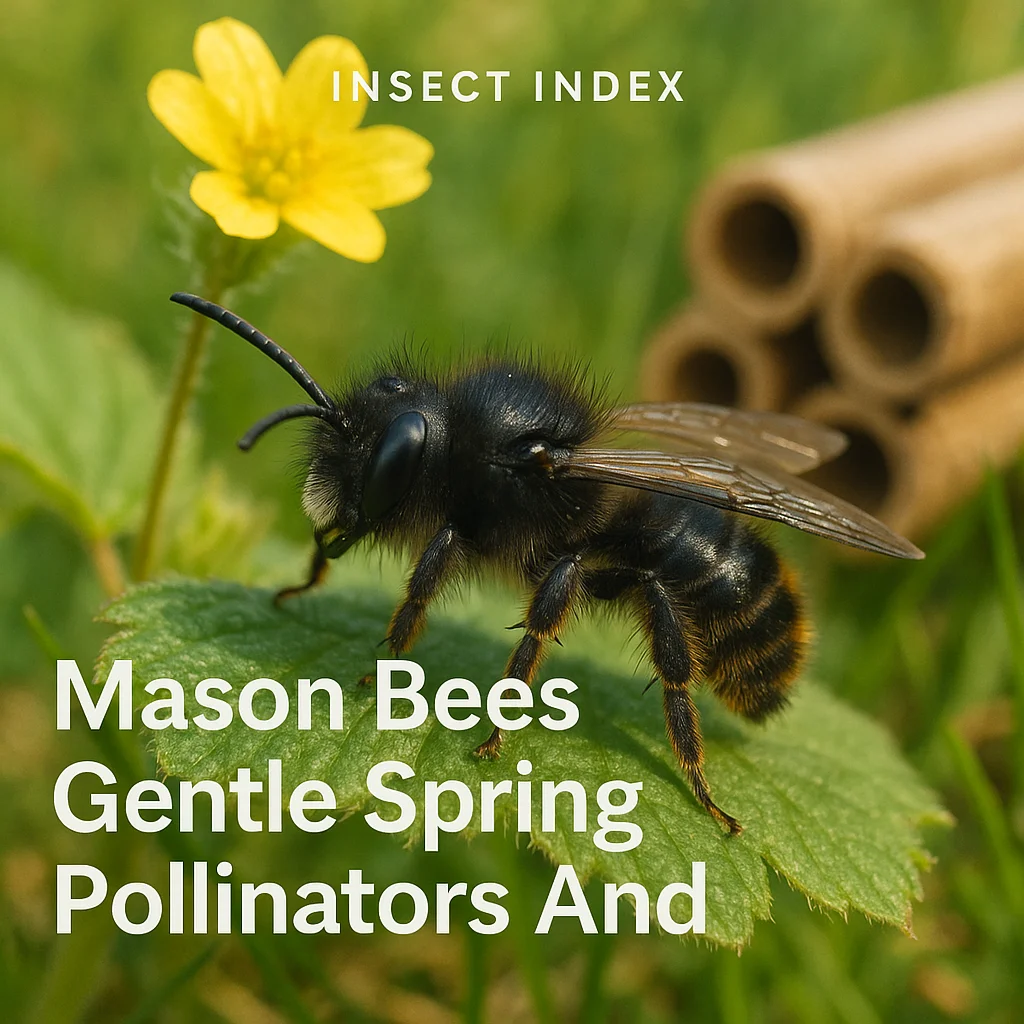
Mason bees are a fascinating group of solitary bees known for their gentle nature and essential role in pollination. They are often recognized by their nesting habits, where they utilize natural cavities or man-made nesting tubes.
- Common names: Mason bee
- Scientific name: Varies by species
- Insect: Yes, as they are invertebrates with six legs
- Order/Family: Hymenoptera/Megachilidae
- Typical size range: 0.3 to 0.75 inches (8-19 mm)
- Key colors/patterns: Metallic blue, black or green
- Activity: Daytime (diurnal)
- Typical habitats: Gardens, orchards, fields
- Where in the world: Primarily in North America, Europe, and Asia
- Seasonality: Most visible in spring and early summer
🔍 Identification
Mason bees can be recognized in the field by their robust and stout body shape, which often gives them a resemblance to flies. Their heads are broad, and they have long, segmented antennae. Their wings are typically smooth, transparent, and lie flat over their back when at rest. Unlike honeybees, mason bees have no defined yellow-black striping but rather metallic coloring.
Mason bees can be easily confused with other bee species; however, their lack of stripes and solitary nature helps differentiate them.
- Robust, stout body
- Metallic sheen, often blue or black
- Long, segmented antennae
- Wings smooth and translucent
- Often seen around early-blooming flowers
- Distinct lack of aggressive behavior
🧠 Basic Body Structure
Being insects, mason bees have a segmented body consisting of a head, thorax, and abdomen. They possess six legs and have an exoskeleton, which provides both protection and structural support. Unlike vertebrates, which have an internal skeleton, mason bees are invertebrates and do not have a backbone. Molting occurs during the larval stage as they grow, shed their exoskeleton, and eventually form wings during metamorphosis.
🌍 Habitat & Distribution
Mason bees thrive in a variety of environments, preferring places that offer abundant flowering plants, which provide pollen and nectar. Typical habitats include gardens, orchards, and fields. They are adaptable and often found in urban gardens as well. Microhabitats are typically small cavities in wood or nesting tubes provided by humans. They are widespread across North America, Europe, and parts of Asia, thriving in temperate climates.
Alterations in land use, such as urban development and agriculture, can affect where mason bees are seen, as the availability of floral resources influences their population density.
📅 Seasonal Appearance & Activity
People are most likely to spot mason bees during the spring and early summer months when flowering plants are abundant. As diurnal creatures, they are active during daylight and are most visible on warm, sunny days. Their activity is significantly reduced by rain or cool, overcast conditions.
- Spring through early summer
- Most active during warm, sunny days
- Reduced activity during rain
- Visible when flowers begin to bloom
🥚 Reproduction & Egg-Laying
Mating behavior involves males seeking out females near nesting sites. Once mated, female mason bees collect pollen and nectar, forming compact balls within nesting cavities. Eggs are laid on top of these provisions. Depending on the species, mason bees lay between 20 to 40 eggs, each in separate chambers within the chosen nesting tube or cavity. The females often seal the chamber with mud or plant material.
🌀 Metamorphosis & Life Cycle
Mason bees undergo complete metamorphosis, described as egg–larva–pupa–adult. The eggs hatch into larvae that consume the pollen provision left by the female. During the larval stage, they remain within the sealed chamber. The larva eventually pupates, undergoing transformation before emerging as an adult bee. This process occurs over several months, with most mason bees emerging as adults in spring.
The larvae are entirely dependent on the pollen and nectar provision for nutrition, whereas adult bees feed on nectar and contribute to pollination of various plants and crops.
🍽️ Diet & Feeding Behavior
Adult mason bees primarily feed on nectar from flowers, making them important pollinators. In their larval stage, they consume the pollen and nectar balls provided by the females. Unlike some other bees, mason bees do not have a social or hive structure that requires mass nectar storage. They play a crucial role as solitary pollinators in ecosystems, aiding the reproduction of many plants and crops.
🦉 Predators & Defense
Mason bees face predation from birds, spiders, and parasitic wasps. Their primary defense mechanisms include their inconspicuous behavior and use of nesting sites that are difficult for predators to access. Mason bees generally do not sting unless provoked or handled roughly, minimizing their defenses against larger predators.
- Non-aggressive nature deters many predation scenarios
- Nesting in secure, enclosed cavities
- Minimal interaction with potential threats
- Quick flight responses to escape danger
👥 Social Behavior & Swarms
Unlike social bees, mason bees are solitary animals. They do not form colonies or large groups but may be found in close proximity due to shared or suitable nesting sites and abundant feeding areas. They show limited interaction with other bees, with occasional encounters during mating.
🧭 Senses & Communication
Mason bees utilize olfactory senses to locate flowers and identify potential nesting sites with pollen. They have compound eyes that provide a broad field of vision, essential for navigation and foraging. Pheromones play a role in reproductive communication, especially to attract mates during the breeding season. However, detailed communication patterns are not as sophisticated as those found in social bees.
🌱 Role in the Ecosystem
Mason bees are highly effective pollinators, contributing significantly to the fertilization of both wild and cultivated plants. They play a critical role in maintaining biodiversity, assisting in food production, and supporting various plant species' reproductive cycles. Mutualistic relationships exist between mason bees and the plants they pollinate, with no documented negative impacts on human agriculture.
📉 Population & Conservation Notes
Mason bees are often common in regions where suitable nesting habitats and food sources are available. However, their populations can be influenced by habitat loss, pesticide use, and changes in climate. Efforts to conserve them focus on providing suitable nesting sites and reducing harmful chemical applications.
- Plant native flowers to support food sources
- Install nesting tubes in gardens
- Avoid using chemical pesticides
- Leave natural areas undisturbed as potential nesting sites
⚠️ Human Interaction & Safety
Mason bees are generally non-aggressive and do not sting unless directly provoked or threatened. Their gentle nature makes them safe to observe in gardens and natural settings. It is advisable to observe them respectfully and avoid handling them to prevent harm to the bees and potential reactions in sensitive individuals.
In case of stings, washing the area with soap and water is recommended, and professional advice should be sought if severe symptoms develop.
📌 Summary
- Mason bees are solitary, gentle pollinators, often seen in spring.
- Identified by their robust body and metallic colors.
- They inhabit regions with abundant flowers and potential nesting sites.
- Complete metamorphosis from egg to adult.
- Key diet includes nectar, role as effective pollinators.
- Predators include birds and spiders, with minimal defense strategies.
- Their population data often varies regionally.
- Important role in ecosystems as pollinators.
- Urban gardening can provide low-impact conservation assistance.