🕷️ Native bees overview: solitary bee types
🧾 Quick Facts
Solitary bees are an essential group of pollinators that include a variety of species that operate independently rather than in colonies. These bees are often more efficient than their social counterparts in pollination due to their diverse behaviors and adaptations.
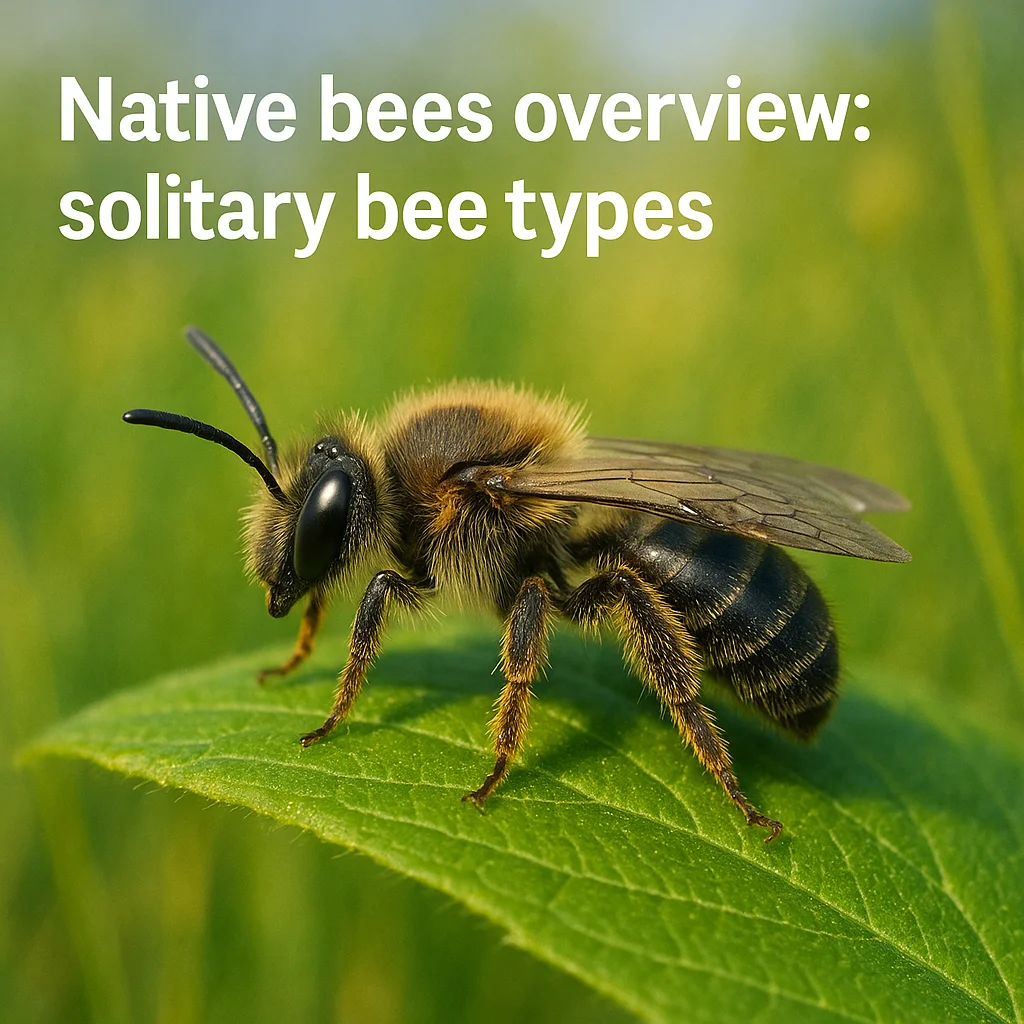
- Common names: Mason bees, Leafcutter bees, Carpenter bees
- Scientific name: Varies
- Insect or not: Invertebrate, specifically an insect
- Order / family: Order Hymenoptera, families vary (e.g., Megachilidae, Apidae)
- Typical size range (adult): 5 to 15 mm
- Key colors/patterns: Various colors including black, metallic blues, and greens
- Activity: Primarily diurnal
- Typical habitats: Gardens, meadows, forest edges
- Where in the world it occurs: Worldwide, more prevalent in temperate regions
- Seasonality: Most visible in spring and summer
🔍 Identification
Solitary bees are primarily recognized by their varied size and unique behaviors. Their bodies are often robust, and their heads can appear disproportionately larger relative to their thorax. Unlike social bees, solitary bees often carry pollen on specialized hairs on their abdomen or legs.
Antennae in solitary bees can vary from moderately to highly segmented, helping them in navigation and detecting scents. Most species feature two sets of wings, with the hindwings being smaller. The legs are adapted for digging or collecting pollen, with hind legs frequently stocked with pollen-carrying hairs.
Solitary bees may often be mistaken for small wasps due to their size and coloration. However, a close inspection reveals their hairy bodies which are less common in wasp species.
- Top ID Tips:
- Look for independent behavior, not in groups
- Diverse color patterns and metallic sheens
- Pollen-carrying hairs on legs or abdomen
- Moderate to long antennae
- Smooth, sleek body with some hairiness
- Flight patterns are often erratic
- Presence of solitary nests in mud or wood
🧠 Basic Body Structure
Solitary bees follow the typical insect body structure which comprises the head, thorax, and abdomen. They possess six legs which are crucial for pollen collection and mobility. As invertebrates, solitary bees have an exoskeleton that provides protection and structure.
Winged solitary species have membranous wings that aid in their foraging activities. Like other insects, they undergo molting as they mature through their life stages.
🌍 Habitat & Distribution
Solitary bees thrive in a wide variety of environments including gardens, forests, and meadows. They exhibit a preference for habitats where floral resources are abundant. Microhabitats such as under tree bark, within hollow stems, or existing burrows provide nesting opportunities.
They are found globally but are predominantly located in temperate regions. As adaptable creatures, solitary bees can adjust to various climatic conditions, although habitat loss can significantly influence their abundance.
📅 Seasonal Appearance & Activity
The presence of solitary bees is most pronounced in spring and summer when flowers are in bloom. They are diurnal, actively foraging during daylight. Their activities peak during warm, sunny days which facilitate pollen collection.
- Best Time to Spot It:
- Early spring bloom seasons
- Midday sunshine
- During warm, calm weather
- Near flowering plants
🥚 Reproduction & Egg-Laying
Solitary bees engage in a variety of mating behaviors, often using pheromones and visual cues to attract mates. Egg-laying occurs in protected environments such as soil, plant stems, or manmade structures like bee hotels.
Females lay multiple eggs and provision each with a pollen supply, ensuring the larvae have food upon hatching. The number of eggs can vary based on species and environmental conditions.
🌀 Metamorphosis & Life Cycle
Solitary bees undergo complete metamorphosis, involving egg, larva, pupa, and adult stages. The larvae consume stored pollen and develop within their nest.
This developmental phase lasts several weeks to months, depending on the species and environmental factors. Pupation follows, leading to the emergence of a mature adult typically in the following spring or summer.
🍽️ Diet & Feeding Behavior
Adult solitary bees feed primarily on nectar and pollen. Their mouthparts are adapted for efficient pollen collection and nectar extraction, featuring both chewing and sucking functionalities.
Larvae, provisioned with pollen, rely exclusively on this food source until they mature. Solitary bees play an integral role as pollinators, often specializing in specific flower types.
🦉 Predators & Defense
Solitary bees face predation from various animals including birds, spiders, and parasitic wasps. Their primary defense strategies include camouflage, rapid flight, and, in some species, the ability to sting.
- Defense Highlights:
- Camouflage with the environment
- Rapid, erratic flight patterns
- Use of shelter and location concealment
- Occasional use of stings for deterring threats
👥 Social Behavior & Swarms
Solitary bees, by nature, do not form swarms or colonies. Each female independently selects a nesting site and gathers resources for her offspring without cooperation from others. Mating encounters are brief and typically result in males departing after copulation.
🧭 Senses & Communication
Solitary bees rely on keen vision and olfactory senses to locate flowers and navigate their environment. Chemical signals through pheromones play a role in communication, especially in mating.
Although solitary, these bees still utilize environmental cues to effectively conduct their solitary tasks and maximize foraging efficiency.
🌱 Role in the Ecosystem
Solitary bees are critical pollinators and contribute significantly to both wild ecosystems and agricultural yields. They facilitate the reproductive processes of numerous plant species.
Their interactions with flowering plants often result in specialized mutualistic relationships, enhancing biodiversity and productivity of plant communities.
📉 Population & Conservation Notes
While solitary bees are often common, their populations can be affected by habitat loss, pesticide use, and climate changes. Conservation efforts include promoting native plant growth and reducing pesticide application to protect these vital pollinators.
- How to Help (Low-Impact):
- Plant diverse, native flowering species
- Minimize pesticide use
- Create bee-friendly gardens with nesting sites
- Leave flower stalks and leaf litter intact
⚠️ Human Interaction & Safety
Solitary bees are generally non-aggressive and pose minimal threat to humans. They may sting if provoked but are often far less defensive than social bees.
In case of stings, clean the area and avoid scratching. Seek professional advice if a severe reaction occurs. Engaging in respectful observation fosters coexistence without disrupting their natural activities.
📌 Summary
- Recognized by solitary, independent habits
- Habitats include diverse environments with flowers and nesting sites
- Visible primarily in spring and summer
- Life cycle involves complete metamorphosis
- Pollen and nectar are central to diet
- Face predators like birds and spiders
- Key pollinators in ecological and agricultural contexts
- Respectful observation is encouraged