🕷️ Asian Giant Hornet: facts and safety
🧾 Quick Facts
The Asian Giant Hornet is a fascinating yet misunderstood insect. Known for its large size and distinct coloration, it plays a crucial role in its ecosystem. Below are some quick facts to help you get acquainted with this species.
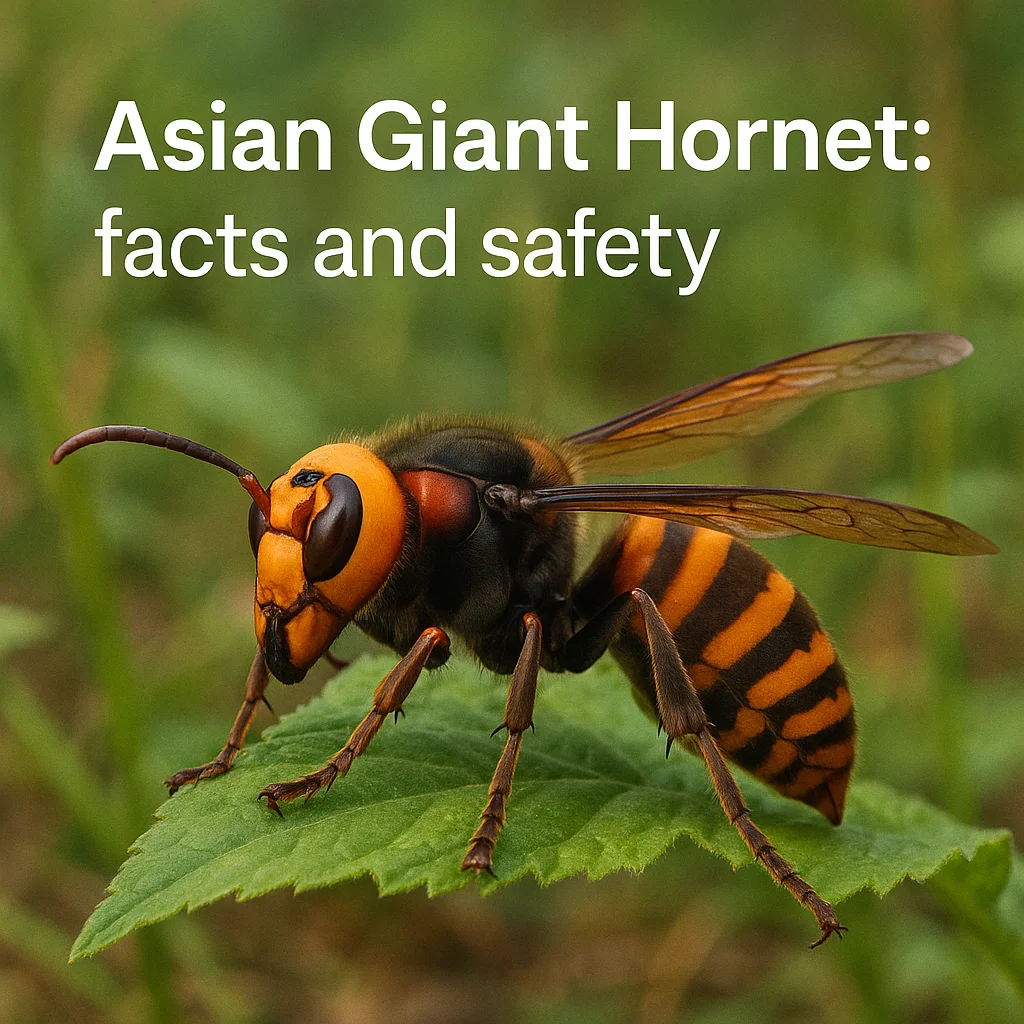
- Common Names: Asian Giant Hornet, Giant Sparrow Bee
- Scientific Name: Vespa mandarinia
- Insect: Yes, it is an invertebrate
- Order / Family: Hymenoptera / Vespidae
- Typical Size Range: 30-50 mm (1.2-2 inches) in adults
- Key Colors/Patterns: Yellow and black bands, orange head
- Activity: Diurnal (active during the day)
- Typical Habitats: Forests, low mountains, and rural areas
- Where It Occurs: Eastern Asia, particularly Japan, China, and Korea
- Seasonality: Most visible in summer and early autumn
🔍 Identification
Identifying the Asian Giant Hornet involves understanding its distinctive features. The hornet can be recognized by its large body and striking coloration.
- Body shape is elongated with a visibly segmented abdomen.
- Antennae are fairly long and bent at the base.
- Wings are clear and long, with a consistent beat when in flight.
- Legs are robust, aiding in their powerful flight and walking.
- Can be confused with other hornet species, but its size and orange head distinguish it.
- Top ID Tips:
- Large size, bigger than most other hornets
- Orange head with a prominent black eyes
- Yellow and black banded abdomen
- Clear wings visible when at rest
- Noticeable loud buzz
- Usually found near forested areas
🧠 Basic Body Structure
The body structure of the Asian Giant Hornet is characteristic of insects, with a head, thorax, and abdomen. It has six legs and a pair of antennae. The hornet’s body is protected by a hard exoskeleton, and it undergoes molting as it grows. Wings are vital for its mobility and are well-developed.
This hornet is an invertebrate, meaning it lacks a backbone and uses an exoskeleton for support.
🌍 Habitat & Distribution
The Asian Giant Hornet prefers temperate and tropical environments. It thrives in forests, particularly those with dense tree coverage and abundant resources. They can also inhabit low mountains and rural garden areas, relying on microhabitats like empty logs or tree hollows. Geographic distribution includes Eastern Asia, notably in Japan, China, and Korea. Human encroachment and land changes can influence sightings.
📅 Seasonal Appearance & Activity
The hornet is most active during warmer months. It's typically seen from late spring through early autumn, with peak visibility in summer. As a diurnal creature, it favors daylight for its activities, which include foraging and nesting. Temperature and humidity can significantly affect their activity levels.
- Best Time to Spot It:
- Summer months
- Late morning to afternoon
- Warm, sunny days
- Near flowering trees and forest edges
🥚 Reproduction & Egg-Laying
Mating behavior in Asian Giant Hornets involves courtship displays, often centered around suitable nesting sites. Once mated, queens seek protected locations to lay eggs, such as in soil or decomposed wood. Egg-laying typically occurs in small clusters, and the exact number of eggs varies depending on environmental conditions.
🌀 Metamorphosis & Life Cycle
The hornet undergoes complete metamorphosis, comprising four stages: egg, larva, pupa, and adult.
The eggs hatch into larvae, which are primarily fed a rich diet of protein from prey items brought by the worker hornets. Larval development encompasses several weeks, varying with temperature and resource availability. Pupation follows, where larvae transform into adults. Adult hornets continue the cycle by establishing new colonies or expanding existing ones.
🍽️ Diet & Feeding Behavior
Asian Giant Hornets are carnivorous at all life stages. They have robust mandibles designed for chewing prey, mainly targeting insects like bees and other small invertebrates. As adults, they're formidable predators, and they occasionally scavenge carrion. Their predation helps regulate local insect populations, indicating their role as vital ecological controllers.
🦉 Predators & Defense
Despite their size, Asian Giant Hornets have natural predators, including some birds, larger reptiles, and mammals. The hornet's defense strategies include venomous stings and aggressive behavior when threatened. They can also employ camouflage against forest backgrounds to avoid detection.
- Defense Highlights:
- Powerful sting
- Aggressive when provoked
- Effective camouflage
- Group defense in colonies
👥 Social Behavior & Swarms
Asian Giant Hornets are social insects, living in colonies led by a single queen. Workers forage and defend the nest, with communication facilitated by chemical signals and tactile interactions. There are rare circumstances where swarming occurs, typically triggered by the need to establish new colonies.
🧭 Senses & Communication
These hornets rely on acute senses to navigate and interact with their environment. Their compound eyes provide wide-angle vision, while antennae detect chemical signals (pheromones) crucial for communication. Sound and vibration also play roles in intra-colony communication, with the hornets capable of emitting warning sounds when threatened.
🌱 Role in the Ecosystem
Ecologically, Asian Giant Hornets are both predators and pollinators. Although they prey on bees, they inadvertently contribute to plant pollination while foraging. As a top insect predator, they help maintain ecological balance by controlling prey populations, which can influence agricultural landscapes positively.
📉 Population & Conservation Notes
The abundance of Asian Giant Hornets varies across regions. While not currently considered endangered, habitat loss and the use of pesticides represent looming threats. Conservation efforts emphasize maintaining natural habitats to ensure their survival.
- How to Help (Low-Impact):
- Encourage native plant growth
- Limit pesticide use
- Promote habitat restoration
- Participate in citizen science projects
⚠️ Human Interaction & Safety
The Asian Giant Hornet can sting if threatened, but it generally avoids human interaction. In case of a sting, it is advisable to wash the area and avoid scratching. Seek professional help if a severe reaction occurs. It is crucial to observe these hornets respectfully from a distance without attempting to capture or kill them.
📌 Summary
- Large, easily identifiable hornet
- Common in forests of East Asia
- Active during warm seasons
- Complete life cycle with larval and pupal stages
- Carnivorous diet, predator of small insects
- Subject to natural predation and human threats
- Essential for local ecosystems
- Known to sting when disturbed