🕷️ Hornet myths and misinformation
Hornets are often misunderstood insects surrounded by myths and misinformation. Despite being known for their sometimes aggressive behavior, hornets play a vital role in ecosystems around the world. This profile aims to dispel common myths, provide accurate information about their biology, and highlight their importance in the natural world.
🧾 Quick Facts
Hornets are a type of wasp known for their large size and social behavior. Here are some quick facts about hornets:
- Common names: Hornet, European hornet, Asian giant hornet
- Scientific name: Varies by species
- Insect or not: Yes, hornets are insects, invertebrates
- Order / family: Hymenoptera / Vespidae
- Typical size range (adult): 2 to 5 cm
- Key colors/patterns: Black, yellow, orange stripes; variations occur
- Activity: Diurnal (active during the day)
- Typical habitats: Woodlands, gardens, urban areas
- Where in the world it occurs: Europe, Asia, North America
- Seasonality: Most visible during warmer months
🔍 Identification
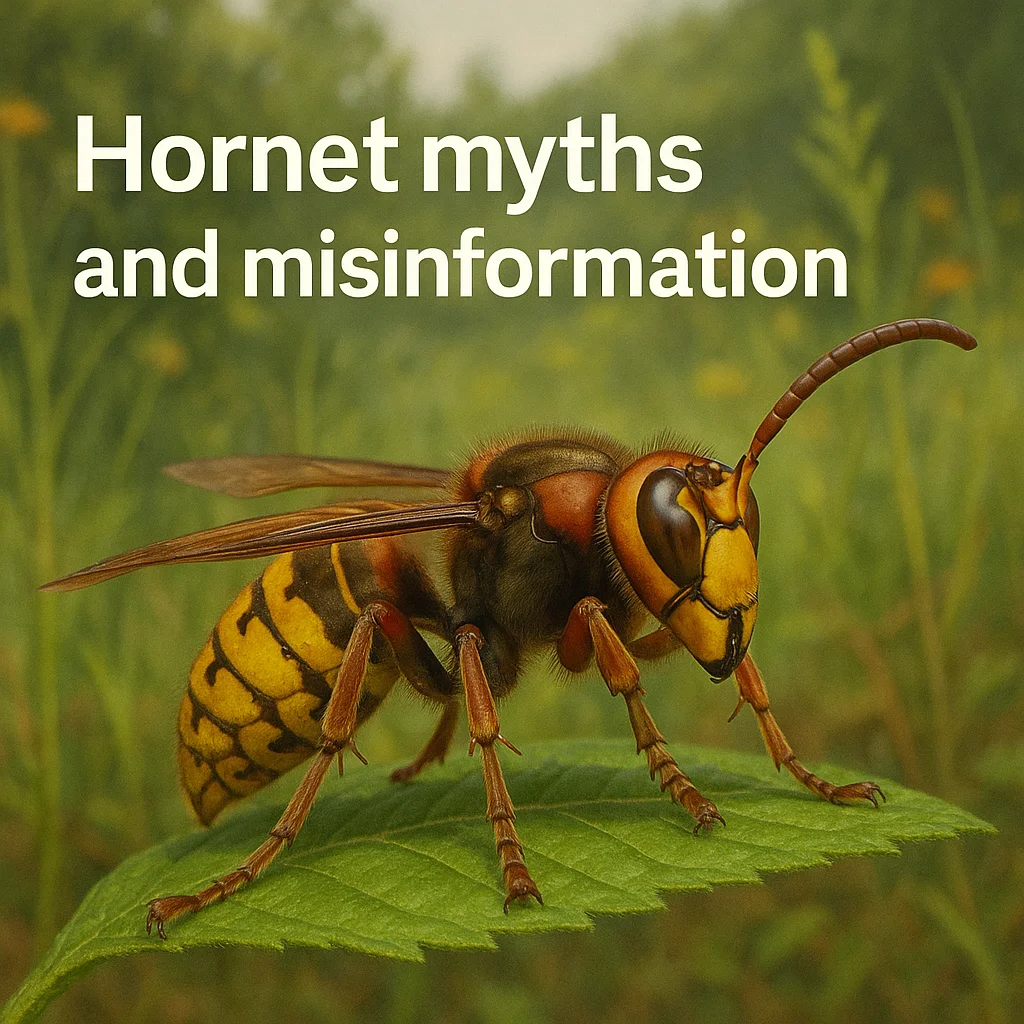
Hornets can be recognized in the field by their robust body shape and distinct coloring. They have a pronounced thorax, a well-defined abdomen with a narrow waist, and relatively thick, pointed antennae. Their wings fold longitudinally over their bodies when at rest and are typically translucent with a slight brown tint.
Their legs are long, allowing for quick movements. Hornets can be confused with other wasps, bees, or even the larger Asian giant hornet, but their large size and clear yellow and black/orange markings are distinguishing features from common wasps or bees.
- Top ID Tips:
- Look for a robust body with a narrow waist
- Notice the color pattern: black, yellow, or orange stripes
- Check for wing position: folded longitudinally at rest
- Observe the size: larger than common wasps
- Listen for a lower-pitched buzz than smaller wasps
- Spot the habitat: near trees or structures
- Avoid confusing with smaller yellowjackets or other wasps
- Look for larger colonies compared to solitary wasps
🧠 Basic Body Structure
Hornets, like all insects, have a body divided into three main parts: the head, thorax, and abdomen. Their head houses large compound eyes, a pair of antennae, and mandibles for feeding and defense. The thorax is the central section where their six legs and wings attach. Last, the abdomen concludes the body structure, often ending with a stinger used for defense.
All hornets have an exoskeleton, which provides support and protection. This rigid structure is periodically shed through molting as the hornet grows. Hornets are invertebrate creatures, meaning they do not possess a backbone.
🌍 Habitat & Distribution
Hornets prefer a mix of wooded areas and proximity to human structures. They can be found nesting in tree cavities, attics, or under roofs. Their geographic range is broad, including regions across Europe, Asia, and introduced populations in North America. Climates that provide seasonal warmth and access to moisture are ideal for hornet colonies.
Changes in habitats due to urban expansion or deforestation can affect hornet sightings, often pushing them toward more urban or suburban areas where food sources and nesting sites might be more readily available.
📅 Seasonal Appearance & Activity
Hornets are most visible during the warm spring and summer months when they are actively foraging and nesting. Being day-active insects, they carry out most of their activities during daylight, although some species may also be active during dusk. Weather patterns such as high temperatures or heavy rainfall can influence their daily activity patterns.
- Best Time to Spot It:
- Late spring through early fall
- Daytime hours, especially in sunny weather
- Moderate temperatures without heavy rain
- Near fruit trees or picnic areas
🥚 Reproduction & Egg-Laying
Hornet mating typically involves a queen and male drones. After mating, the queen looks for a protected site to start a new colony, usually in mid-spring. She begins by building a small nest and laying a series of eggs. Larvae hatch from these eggs, maturing into worker hornets that expand the nest and care for subsequent broods.
Eggs are laid in specialized cells within the nest structure. Egg-laying involves laying single eggs in these nurturing spaces, often maturing predictably unless disrupted by environmental conditions or predators.
🌀 Metamorphosis & Life Cycle
Hornets undergo complete metamorphosis which involves four distinct life stages: egg, larva, pupa, and adult.
Egg Stage: This stage lasts for several days, during which eggs develop into larvae. These eggs are typically laid in spacious cells within the nest.
Larva Stage: The larvae are fed a diet of masticated insects by worker hornets, growing within protected pupal cells. This stage lasts about two weeks.
Pupa Stage: Larvae transform into pupae. During this stage, significant physiological changes occur as pupae eventually emerge as adult hornets.
Adult Stage: Mature hornets emerge to continue the colony cycle, contributing to foraging, defense, and reproductive roles.
🍽️ Diet & Feeding Behavior
As larvae, hornets are fed a high-protein diet of other insects, which workers catch and chew. Adults primarily consume sugary liquids, such as plant nectar and fruit juices, and occasionally prey on smaller insects or scavenge.
Hornets possess strong mandibles for capturing and processing food, and their diet plays a significant role in pest control by reducing populations of agricultural pests.
🦉 Predators & Defense
Hornets face predation from various birds, larger insects like mantids, and mammals. Defense mechanisms include powerful stings, producing painful deterrents through venom injection. They may also rely on flight for evasion and aggressive group defense when colonies are under threat.
- Defense Highlights:
- Use of venomous stinger
- Aggressive defense of the nest
- Flight to escape predators
- Warning coloration as a deterrent
👥 Social Behavior & Swarms
Hornets are social insects living in colonies. A colony is typically composed of a queen, workers, and drones, each with distinct roles. The social hierarchy encourages complex communication and cooperative behavior. Workers build and maintain the nest, forage for food, and care for young hornets. Drones primarily serve reproductive purposes during mating seasons.
Swarms may occur when new queens and drones embark on mating flights, a natural process that extends their species range and genetic diversity.
🧭 Senses & Communication
Hornets rely heavily on their senses for survival, employing vision primarily to locate and navigate to food sources. Their antennae are vital for detecting chemical signals and pheromones, crucial to social communication and colony coordination.
Communication in hornets involves pheromone trails that guide other members to resources, as well as movement and vibration signals interpreted through complex social behaviors within the colony.
🌱 Role in the Ecosystem
Hornets contribute significantly to ecological balance primarily through pest control, preying on numerous insects considered agricultural nuisances. Additionally, their search for nectar can inadvertently aid in pollinating garden plants.
Their presence affects birds and mammals as a food resource, and they participate as both predator and prey within their ecosystems. Hornets neither form strong mutualistic nor heavily parasitic relationships but integrate subtly yet effectively into biodiversity networks.
📉 Population & Conservation Notes
Hornet populations generally remain stable but can be locally influenced by environmental changes such as habitat loss, urbanization, pesticides, and climate variations. Local abundance may vary in response to these factors, with some regions reporting frequent sightings where suitable habitats exist.
- How to Help (Low-Impact):
- Plant native flowering plants
- Minimize pesticide use
- Allow natural garden development (wildflower corners)
- Retain old trees and deadwood that support nests
⚠️ Human Interaction & Safety
Hornets can sting, but typically only do so when provoked or protecting their nest. Their sting is painful due to venom. If stung, it is advised to wash the affected area with soap and water, avoid scratching, and seek professional advice if a severe reaction occurs.
For safe encounters, respect hornet nests by observing from a distance and avoid disturbing colonies. Collecting live specimens is discouraged to preserve local populations.
📌 Summary
- Readily identified by their large size and characteristic coloring
- Inhabit woodlands and urban areas with accessible nesting sites
- Most active in warmer months, during daylight
- Undergo complete metamorphosis from egg to adult
- Feed on nectar as adults; larvae fed insects by workers
- Defend colonies aggressively with venomous stings
- Provide pest control and minor pollination services
- Hornet presence can be affected by human activity and environmental changes