🕷️ Hornets overview: what makes a hornet
🧾 Quick Facts
Hornets are fascinating and often misunderstood insects. Though they share characteristics with other wasps and bees, hornets have distinct features that set them apart. Here is an overview of their key traits:
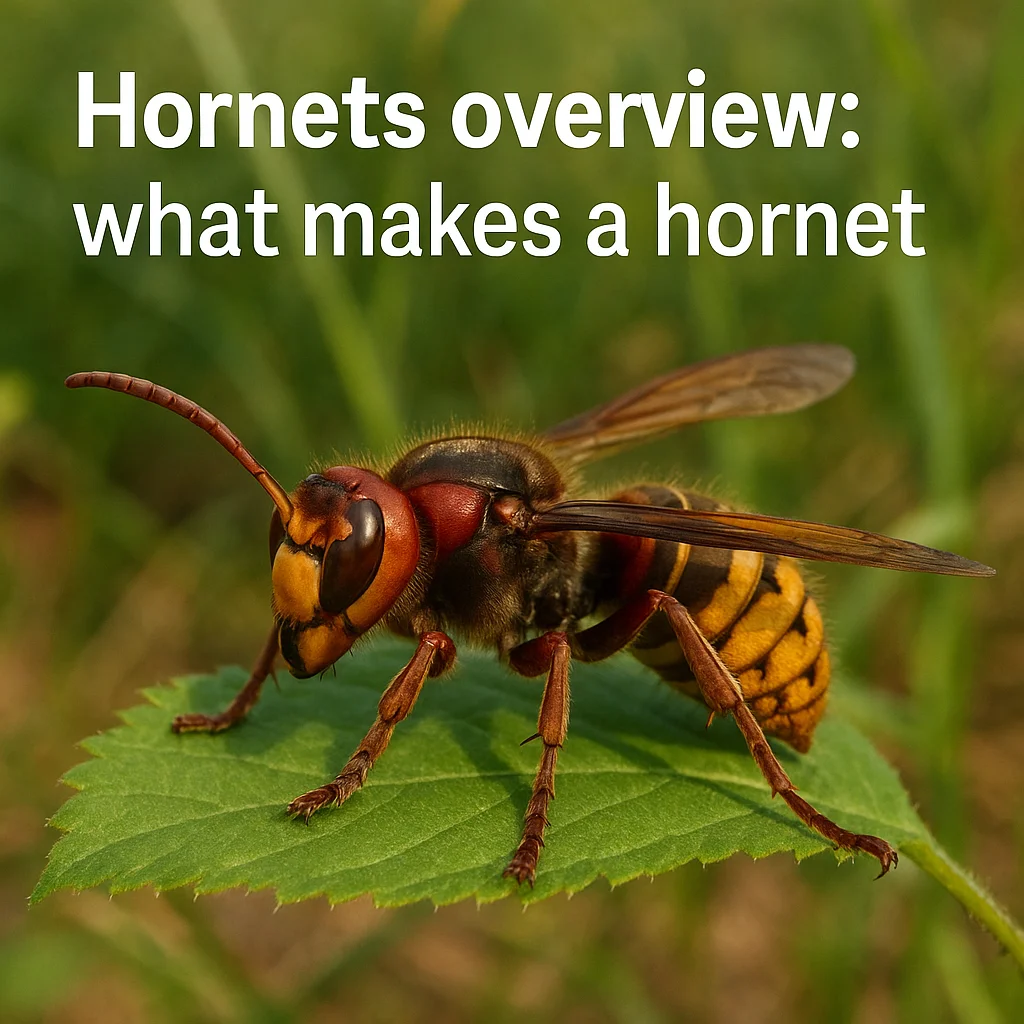
- Common names: Hornet
- Scientific name: Varies depending on the species
- Insect or not: Yes, hornets are insects and belong to the invertebrate category
- Order / family: Hymenoptera / Vespidae
- Typical size range: 2 to 3.5 cm (about 0.8 to 1.4 inches) in length for adults
- Key colors/patterns: Typically black and yellow, though some species may have reddish or brownish hues
- Activity: Primarily diurnal (active during the day)
- Typical habitats: Woodlands, forests, urban areas with gardens
- Where in the world it occurs: Primarily in temperate and tropical regions of Asia, Europe, and North America
- Seasonality: Most visible from late spring to early autumn
🔍 Identification
Identifying hornets in the field requires recognizing certain physical traits:
- Hornets have robust and elongated bodies, making them appear larger than most wasps.
- Their antennae are typically straight and slightly thicker than other wasps’ antennae.
- They possess two pairs of wings, with the front pair larger than the hind pair.
- Their legs are relatively long and slender, aiding in their swift movement.
- Common look-alikes include certain wasp species and large bees, but hornets are generally larger and lack the hairy body of bees.
- Top ID Tips:
- Look for a larger, robust body.
- Notice the distinct black and yellow patterns.
- Observe the smooth, not fuzzy, body surface.
- Check the long, slender legs.
- Pay attention to diurnal activity.
- Note the straight, slightly thick antennae.
🧠 Basic Body Structure
Hornets, like other insects, are composed of three main body segments: the head, thorax, and abdomen. They possess six legs as is typical for insects, and this number distinguishes them from arachnids, which have eight legs. An exoskeleton covers their body, providing protection and structure. Hornets undergo periodic molting to grow, shedding their exoskeleton. Their wings enable flight and are crucial for foraging and defense. As invertebrates, hornets lack a backbone, instead relying on their exoskeleton for support.
🌍 Habitat & Distribution
Hornets favor diverse habitats. They are commonly found in woodlands, forests, and suburban areas with gardens. They are adaptable and can nest in tree cavities, under eaves, or within hollow structures. Their geographical range includes temperate and tropical regions across Asia, Europe, and North America. Climate plays a significant role in their distribution, with hornets favoring warmer regions, although they can survive in cooler areas during milder seasons. Habitat alteration can influence sightings, with urbanization sometimes increasing their presence due to food availability and nesting opportunities.
📅 Seasonal Appearance & Activity
The seasonal appearance of hornets largely depends on local climates. Generally, adult hornets are most active and visible from late spring through early autumn. As diurnal insects, they are primarily active during the day, particularly when temperatures are moderate. Weather conditions, such as temperature and humidity, influence their activity, with hornets being less active during cooler or extremely wet conditions.
- Best Time to Spot It:
- Late spring to early autumn
- Warm, sunny days
- Daytime hours
- Avoid rainy periods
🥚 Reproduction & Egg-Laying
The reproductive behavior of hornets involves complex social structures within colonies. Queens are the fertile females responsible for laying eggs. Courting behaviors vary but often involve specific pheromones. Hornets typically lay eggs in nests constructed from chewed plant fibers and saliva, creating a paper-like material. Egg-laying sites are often elevated in trees or under constructed structures, providing a safe environment for developing larvae. Egg count can vary by species and availability of resources, but generally, a queen can lay hundreds to thousands of eggs during her lifespan.
🌀 Metamorphosis & Life Cycle
Hornets undergo complete metamorphosis, transitioning through four distinct stages: egg, larva, pupa, and adult.
Eggs hatch into larvae, which are voracious feeders, relying on workers to provide them with pre-chewed food. This larval stage lasts about 5-10 days, depending on environmental conditions.
Following the larval stage, they enter the pupal stage, forming a protective cocoon. Pupal development duration can vary but typically takes 2 weeks, leading to the emergence of adult hornets ready to take on specific roles within the colony.
🍽️ Diet & Feeding Behavior
Hornets primarily feed on a variety of protein-rich insects like caterpillars and flies, playing a pivotal role as predators. Their strong mandibles serve as effective tools for capturing prey and handling food. In the adult stage, they also consume sugary substances such as nectar, tree sap, and fruit. These feeding habits make them important contributors to natural pest control and pollination indirectly.
🦉 Predators & Defense
Hornets face various natural predators including birds, reptiles, amphibians, and mammals. To protect themselves and their colonies, hornets employ strategies such as nesting in hard-to-reach areas and displaying aggressive behaviors when threatened. They possess a potent sting used as a defense mechanism. Although normally non-aggressive, they may sting if provoked. Camouflage and speedy retreats also aid in their defense.
- Defense Highlights:
- Nesting in secluded places
- Stinging when threatened
- Aggressive display to deter predators
- Use of camouflage and speed
👥 Social Behavior & Swarms
Hornets are social insects, living in colonies with a clear division of labor. Each colony has a queen, workers, and males (drones). Workers, all sterile females, maintain the nest, forage for food, and care for the young. The social structure relies heavily on chemical and tactile communication for coordination. Swarming is primarily a reproductive behavior where new queens and males leave the nest to mate and establish new colonies.
🧭 Senses & Communication
Hornets possess acute senses aiding in survival and communication. Their compound eyes provide a wide field of view essential for detecting movement. Olfactory receptors on their antennae detect pheromones, vital for colony communication and foraging. Physical touch and vibration also play roles in interaction with nestmates. While not known for sound-based communication, they rely on chemical and tactile signals for effective colony cohesion.
🌱 Role in the Ecosystem
Hornets play an integral ecological role. As predators, they control populations of other insects, which helps maintain ecological balance. Indirectly, they contribute to pollination. Additionally, they serve as prey for larger animals, embedding themselves within the food web. Their presence in ecosystems can also highlight environmental health, as they require specific conditions to thrive. Hornets have mixed impacts on human activities, providing pest control benefits while occasionally regarded as pests due to painful stings or nest invasions.
📉 Population & Conservation Notes
Hornet populations vary with most species being common in suitable habitats. However, some populations experience decline due to habitat loss, pesticide use, and climate change effects. Conservation efforts focus on habitat preservation and reducing pesticide exposure.
- How to Help (Low-Impact):
- Plant native flowers
- Minimize pesticide use
- Protect woodland and garden habitats
- Leave natural nesting sites undisturbed
⚠️ Human Interaction & Safety
Hornets, like many wasps, can sting, especially when their nest is threatened. Stings can be painful but are rarely dangerous unless one has allergies. General first-aid involves washing the sting area and applying a cold pack; for severe reactions, seek professional advice. Observing hornets from a distance and respecting their space minimizes risks. Collecting specimens from the wild is discouraged to protect their role in the ecosystem.
📌 Summary
- Hornets are large social insects with a robust body and black and yellow patterns.
- They thrive in temperate and tropical regions, favoring habitats like woodlands and gardens.
- Most active from late spring to autumn, they are diurnal creatures.
- Complete metamorphosis with distinct life stages: egg, larva, pupa, adult.
- Prey on insects, contributing to pest control; indirectly aid pollination.
- Face predation from birds and mammals, with defense mechanisms including stings.
- Critical ecological role, balancing ecosystems; mixed interactions with humans.
- Consider conservation efforts due to threats like habitat loss and pesticides.