🕷️ What attracts hornets (food & smells)
Hornets are notorious for their presence in outdoor spaces, often drawing attention due to their size and the painful nature of their sting. Understanding what attracts hornets, both in terms of food and smells, can help mitigate unwanted encounters and foster a respectful coexistence with these unique insects.
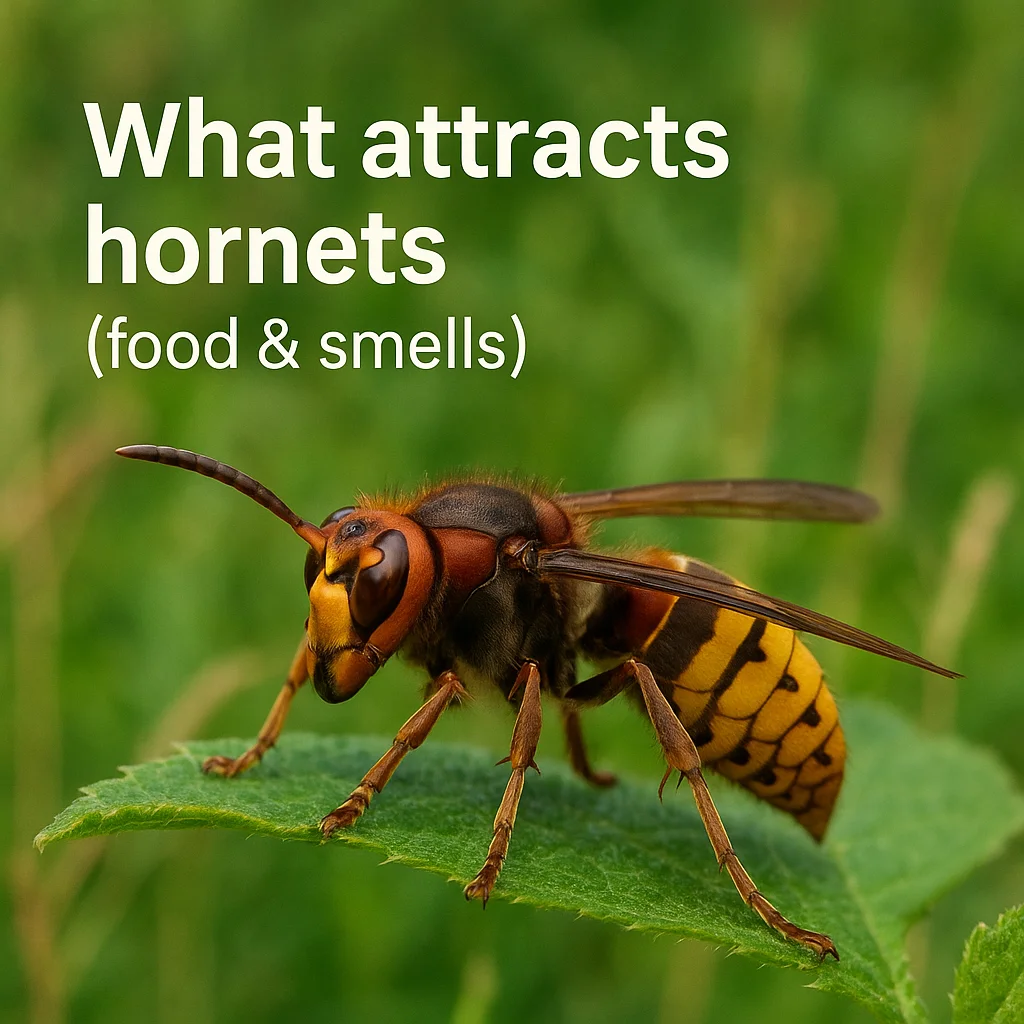
🧾 Quick Facts
Hornets belong to the insect order Hymenoptera and are a type of wasp. They are easily recognizable and known for their social behavior.
- Common names: Hornet, European hornet, Asian giant hornet
- Scientific name: Varies (e.g., Vespa crabro, Vespa mandarinia)
- Insect or not: Insect, invertebrate
- Order / Family: Hymenoptera / Vespidae
- Typical size range: 2–5 cm (0.8–2 inches)
- Key colors/patterns: Black and yellow or orange bands
- Activity: Diurnal (active during the day)
- Typical habitats: Forests, gardens, urban areas
- Where in the world it occurs: Europe, Asia, North America
- Seasonality: Late spring to early autumn
🔍 Identification
Recognizing a hornet in the field involves noting its robust body, distinct color patterns, and behavioral cues. Despite their intimidating appearance, hornets are less aggressive than other wasps unless provoked.
- Body shape and silhouette: Sturdy, with a large head and thorax
- Antennae type: Bent, segmented
- Wing features: Membranous with a prominent venation pattern
- Leg traits and movement style: Long legs, noticeable during flight
- Distinguishing look-alikes and common confusion: Larger and more robust than common wasps
🧠 Basic Body Structure
Hornets, like all insects, have a three-part body plan consisting of a head, thorax, and abdomen. They possess six legs, two pairs of wings (front and hind), and an exoskeleton, which they molt as they grow. As invertebrates, hornets lack a backbone, relying instead on their exoskeleton for support and protection.
🌍 Habitat & Distribution
Hornets thrive in diverse environments ranging from forests and urban gardens to grasslands. They often nest in sheltered locations such as tree hollows or under eaves. The geographic distribution of hornets includes Europe, Asia, and parts of North America. Habitat changes, such as urbanization, can affect hornet populations by providing alternative nesting sites or altering food availability.
📅 Seasonal Appearance & Activity
Hornets are most visible from late spring to early autumn when they build and maintain their nests. They are diurnal, actively foraging during daylight hours. Weather conditions such as warmth and humidity influence their activity levels.
- Best Time to Spot It
- Late spring in temperate regions
- Warm, sunny days
- Near flowering plants and food sources
🥚 Reproduction & Egg-Laying
Hornet reproduction involves a queen establishing a new colony by laying eggs in early spring. Eggs are typically laid in a paper-like nest constructed from chewed wood fibers. The queen initially cares for the larvae, but worker hornets take over as the colony grows.
🌀 Metamorphosis & Life Cycle
Hornets undergo complete metamorphosis, progressing through egg, larva, pupa, and adult stages. Each stage serves a unique purpose, with larvae feeding on protein-rich diets, often provided by workers. The pupal stage, a transition phase, leads to the emergence of adult hornets capable of foraging and colony maintenance.
🍽️ Diet & Feeding Behavior
Hornet larvae consume protein sources, including other insects, which worker hornets hunt. Adult hornets primarily feed on nectar, sap, and fruits. Hornets have powerful mandibles for chewing and are considered predators due to their insect hunting behavior, playing a role in pest population control.
🦉 Predators & Defense
Hornets have several natural enemies, including birds, reptiles, and other predatory insects. Their defense strategies are robust: they possess a painful sting, use chemical signals to coordinate attacks, and can rely on physical barriers like their exoskeleton for protection.
- Defense Highlights:
- Painful sting
- Group defense tactics
- Alarm pheromones
- Strong exoskeleton
👥 Social Behavior & Swarms
Hornets are highly social insects that live in structured colonies with specific roles. Workers maintain the nest and forage for food, while the queen focuses on reproduction. Communication within the colony occurs through chemical signals and pheromones. Swarming behavior is typical when colonies are establishing or relocating.
🧭 Senses & Communication
Hornets rely heavily on their keen sense of smell for communication, using pheromones to signal danger or locate mates. Their compound eyes provide excellent vision for navigation and prey detection. Hornets are also sensitive to vibrations, which play a role in intruder detection and defense activation.
🌱 Role in the Ecosystem
Hornets play a significant role in ecosystems as predators and pollinators. By controlling pest populations, they contribute to agricultural health. Additionally, their interactions with plants through pollination and sap-feeding help maintain ecological balance. However, hornets can be problematic in some agricultural settings if they compete with human interests.
📉 Population & Conservation Notes
Hornet populations are often locally abundant in suitable habitats but face threats from habitat destruction, pesticide use, and climate change. Conservation efforts focus on habitat preservation and minimizing environmental pollution.
- How to Help (Low-Impact):
- Planting native flora
- Reducing pesticide usage
- Encouraging natural predators
- Providing nesting sites
⚠️ Human Interaction & Safety
Hornets will only sting if they feel threatened. To reduce the risk of stings, maintaining a respectful distance from nests and avoiding abrupt movements is recommended. For those with severe reactions to stings, seeking professional medical advice is essential. Observing hornets from a safe distance can be both intriguing and educational.
📌 Summary
- Hornets are large, social, black and yellow/orange wasps.
- Common in forests and gardens across Europe, Asia, and North America.
- Most active in warm months during daylight hours.
- Undergo complete metamorphosis with a predatory larval stage.
- Hornet adults feed primarily on nectar and fruit juices.
- Natural enemies include birds and predatory insects.
- Important for pest control and occasional pollination.
- Encounters can be minimized with habitat awareness and careful observation.