🕷️ When Hornets Are Most Defensive (Season)
🧾 Quick Facts
Hornets belong to the family Vespidae and are known for their large size and potent stings. Their defensive behavior is notably heightened during certain seasons, primarily due to their breeding cycle and nest protection instincts. Below are some quick facts about hornets:
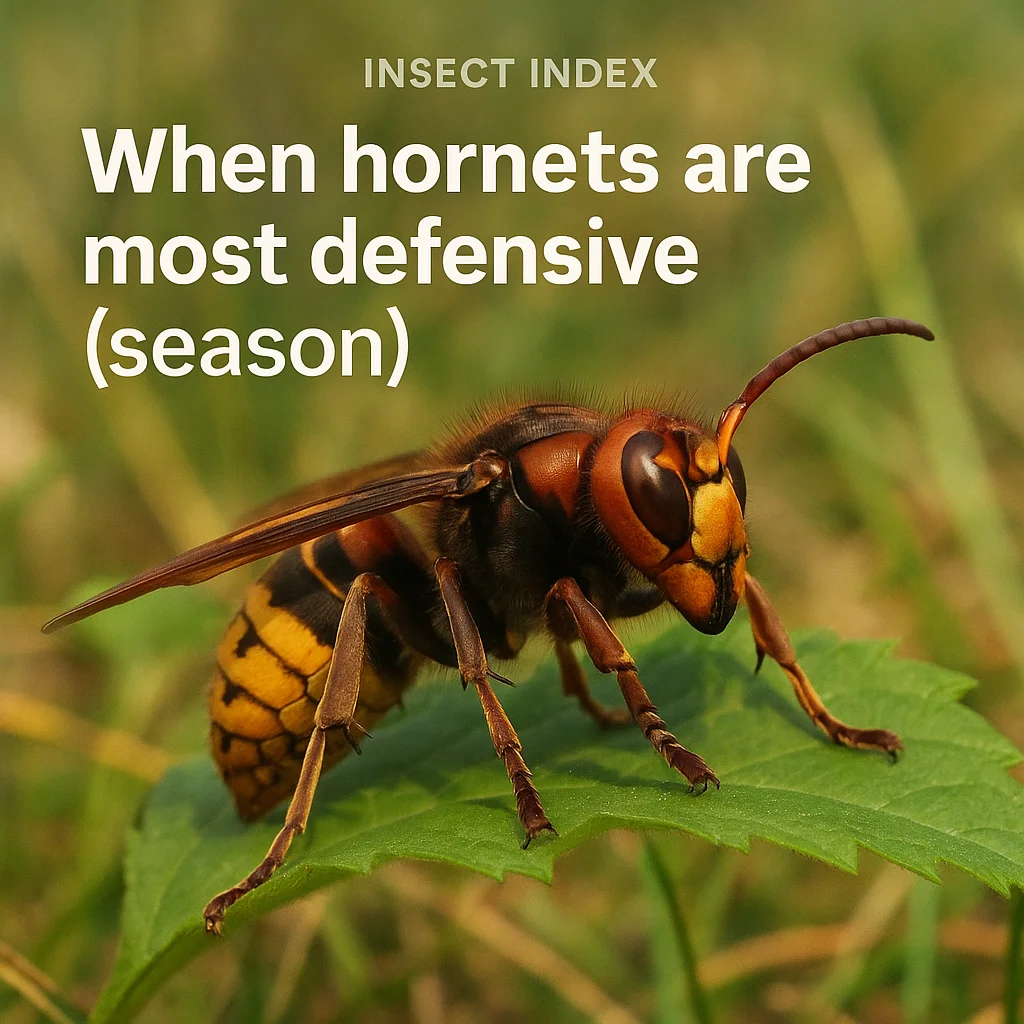
- Common names: Hornets
- Scientific name: Vespula spp., Vespa spp. (varies)
- Insect or not: Yes, they are invertebrate insects.
- Order / family: Hymenoptera / Vespidae
- Typical size range: 2-5 cm
- Key colors/patterns: Usually yellow, black, orange, or brown with striped abdomen patterns
- Activity: Day (diurnal)
- Typical habitats: Forest edges, meadows, gardens, urban areas
- Where in the world it occurs: Mostly temperate and tropical regions worldwide
- Seasonality: Most active and noticeable in late spring through fall
🔍 Identification
Hornets are easily recognized in the field by their robust body shape, sizeable angular head, and striking color patterns.
- Body shape and silhouette: Large, stocky insects with a narrow waist connecting the thorax and abdomen.
- Antennae type: Geniculate (elbowed), helping distinguish them from similar species.
- Wing features: Two pairs of transparent wings; the forewings are typically larger and prominent in flight.
- Leg traits and movement style: Strong legs, usually seen clinging to vertical surfaces or hovering in the air.
- Distinguishing look-alikes: Often confused with yellowjackets or paper wasps but usually larger and more robust.
- Top ID Tips:
- Look for the narrow waist and elbowed antennae.
- Note the size; hornets are significantly larger than most wasps.
- Watch for their bustling activity around nests.
- Check for distinctive striped abdomens.
- They exhibit aggressive behavior near nests.
- Listen for their loud buzzing sounds indicating their proximity.
🧠 Basic Body Structure
Hornets possess a typical insect anatomy comprising a head, thorax, and abdomen. They have six legs and two pairs of wings. Their rigid exoskeleton provides protection and support, requiring periodic molting for growth. Being invertebrate, they lack a backbone, a common trait among insects.
🌍 Habitat & Distribution
Hornets favor environments that offer both shelter and food. They can be found in woodlands, grasslands, and gardens, sometimes nesting in the eaves of buildings or underground. Their range includes temperate and tropical regions across Europe, Asia, and North America. Sightings are influenced by local habitat conditions, with more frequent occurrences in areas rich in flowering plants and trees.
📅 Seasonal Appearance & Activity
Hornets are most visible from late spring through autumn, corresponding with their life cycle stages and environmental conditions. They are primarily diurnal and exhibit heightened activity during warm, sunny weather. Their presence may fluctuate with changes in temperature and precipitation.
- Best Time to Spot It:
- Late spring when nests are actively being built.
- High summer as colony populations peak.
- Early fall during last foraging activities.
- Warm, sunny days are optimal for observation.
🥚 Reproduction & Egg-Laying
Hornets engage in complex mating behaviors, with queens often selecting mates based on territorial dominance. Once mated, queens lay eggs in secure locations, such as within nests or cavities. Egg production varies, with several dozen eggs per cycle common. Precise numbers depend on environmental factors and colony size.
🌀 Metamorphosis & Life Cycle
Hornets undergo complete metamorphosis, progressing through egg, larva, pupa, and adult stages. Eggs hatch into larvae, which remain within the nest where they are fed a protein-rich diet by adult caretakers, including insects and other small prey. Once sufficiently developed, larvae enter the pupal stage, undergoing transformation into adults. This cycle can last several weeks to months, varying by species and environmental conditions.
🍽️ Diet & Feeding Behavior
Hornets are predatory, feeding on other insects, such as flies and caterpillars, which they capture using their mandibles. Their diet is crucial for larval development, with adults consuming plant nectar and fruit as additional energy sources. Hornets play an essential role in pest control, maintaining insect populations balanced within ecosystems.
🦉 Predators & Defense
Natural predators of hornets include birds, rodents, and larger insects. Hornets employ various defense strategies, including stinging with venom that deters attackers. They also make use of their robust exoskeleton and potential for high-speed flight for evasive purposes.
- Defense Highlights:
- Venomous stings as a primary deterrent.
- Swarming attackers when nests are threatened.
- Camouflaged nests to prevent detection.
- High-speed flight to escape predators.
👥 Social Behavior & Swarms
Hornets are highly social insects, forming large colonies characterized by complex social structures. Each colony comprises a queen, workers, and drones, with distinct roles related to reproduction, foraging, and defense. They display cooperative behaviors, such as constructing intricate nests and communicating through pheromones to coordinate activities.
🧭 Senses & Communication
Hornets rely heavily on their acute senses of smell and sight for navigation and communication. Pheromones play a crucial role in signaling danger, marking food trails, and maintaining colony cohesion. Although not particularly vocal, hornets are adept at communicating through body language and chemical signals.
🌱 Role in the Ecosystem
Hornets are vital to ecosystems as predators and as contributors to pollination. By preying on pest insects, they help control populations that might otherwise harm crops or native plants. Their interactions with plants assist in pollination, albeit less prominently than bees. Additionally, hornets act as forage for various predators, integrating into complex ecological food webs.
📉 Population & Conservation Notes
Hornet populations are typically stable, and they are common in suitable habitats. However, threats such as habitat loss, pesticide use, and climate change could impact local populations. Conservation efforts may focus on maintaining natural habitats and promoting biodiversity to support ecological balance.
- How to Help (Low-Impact):
- Plant native flowers and shrubs to provide food sources.
- Avoid the use of chemical pesticides.
- Respect natural habitats and limit disturbances.
- Leave fallen leaves to provide ecosystem benefits.
⚠️ Human Interaction & Safety
While hornets can sting when provoked, they are generally non-aggressive unless disturbed. To minimize risks, observe hornets from a safe distance and avoid provoking nests. In case of stings, it is advisable to wash the area, refrain from scratching, and seek professional medical advice if a severe reaction occurs. Observing hornets respectfully contributes to harmonious human-insect coexistence.
📌 Summary
- Recognizable by their size and striped patterns.
- Found in diverse habitats across temperate and tropical regions.
- Most active in warmer months, peaking in summer.
- Complete metamorphosis with distinct life stages.
- Predatory diet crucial for ecosystem balance.
- Equip defense mechanisms, including stings and swarming.
- Social insects with organized colony structures.
- Contribution to pest control and limited pollination.
- Stable populations with some regional conservation concerns.
- Advocate respectful observation and environmental stewardship.