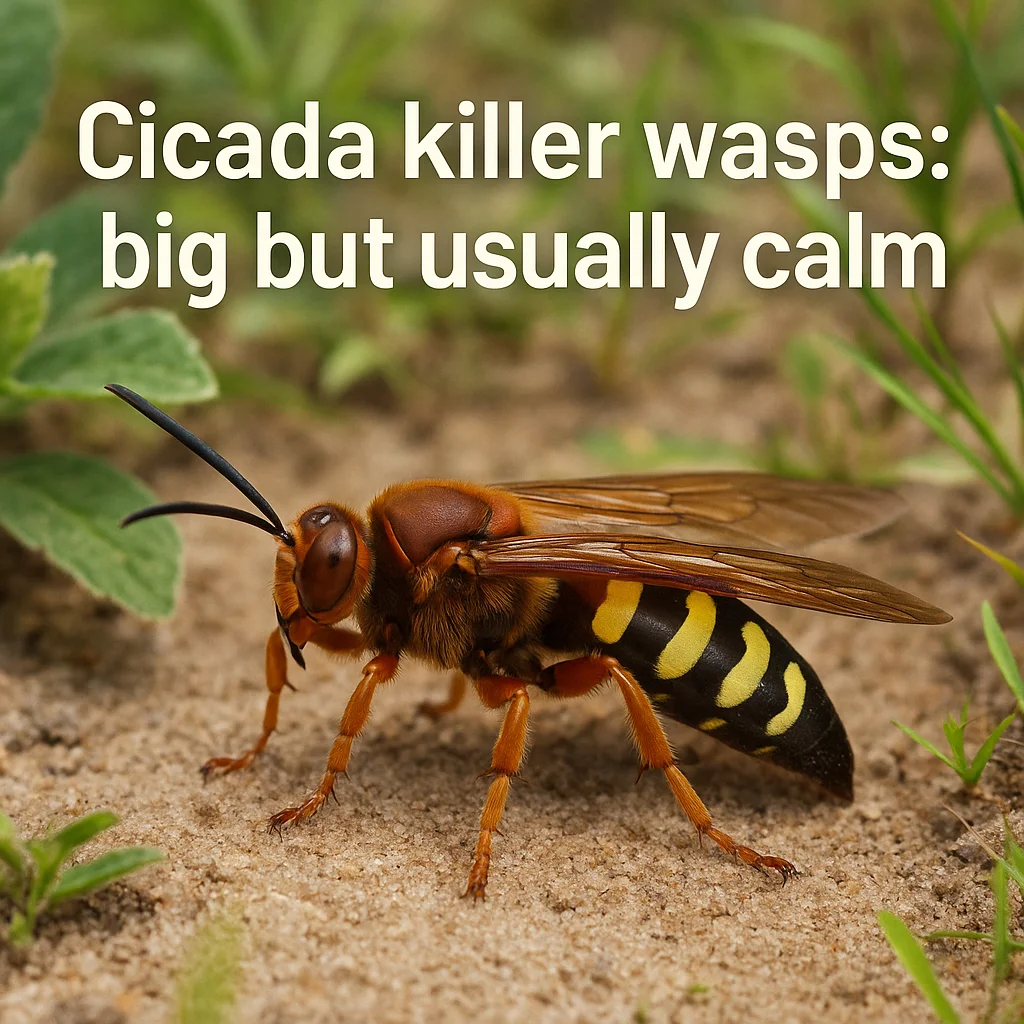
🕷️ Cicada killer wasps: big but usually calm
🧾 Quick Facts
Cicada killer wasps are fascinating members of the insect world, known for their impressive size and seemingly intimidating name. Despite their large and fearsome appearance, these wasps are generally non-aggressive and focus more on completing their life cycle rather than bothering humans.
- Common names: Cicada killer wasp
- Scientific name: Sphecius speciosus (varies based on the region)
- Insect or not: Insect, an invertebrate
- Order / family: Hymenoptera / Sphecidae
- Typical size range: 1.5 to 2 inches (3.8 to 5 cm)
- Key colors/patterns: Black abdomen with yellow markings, rust-colored head and thorax
- Activity: Diurnal
- Typical habitats: Sandy patches, loose soil, gardens
- Where in the world it occurs: North America, primarily the eastern United States
- Seasonality: Summer months, typically July to September
🔍 Identification
The cicada killer wasp can be recognized by its large and robust body. It features long antennae, large wings that are transparent with a slightly orange hue, and a sizeable abdomen with distinct yellow bands. The flight is smooth, but it can be erratic when close to the ground.
Despite common confusion with hornets or other wasps, its particular behavior and habitat differentiate it. Unlike social wasps, it tends to be solitary.
- Black and yellow banded abdomen
- Rust-colored head
- Large transparent wings
- Prefers sandy or loose soil for burrowing
- Non-aggressive demeanor
- Distinctive in size compared to other wasps
- Smooth flying pattern
- Ground-level hovering as it searches for cicadas
- Burrows in loose soil
🧠 Basic Body Structure
Cicada killer wasps, being insects, have the typical body structure divided into three main parts: the head, thorax, and abdomen. They possess six legs that enable powerful digging and walking. The hard exoskeleton provides protection and support, while the capacity to molt allows them to grow. Their wings allow for capable flight, aiding in the search for cicadas and mates. As with all insects, they are invertebrates, meaning they lack an internal skeleton or spine.
🌍 Habitat & Distribution
Cicada killer wasps prefer environments where they can easily burrow such as sandy soils, loose soil areas, and garden beds. Native to the eastern United States, their range can overlap somewhat into adjacent regions. As they like warmer climates, these wasps are frequently seen during hot summers. Urban and suburban gardens or areas with ample direct sunlight provide these wasps with optimal conditions.
With environmental changes, such as urban development, sightings may become less frequent if suitable burrowing soil becomes scarce.
📅 Seasonal Appearance & Activity
The cicada killer wasp is primarily active during the summer months, with their emergence synchronized to the presence of their cicada prey. Typically diurnal, these wasps are likely spotted during warm, sunny days which facilitate their predation and reproductive activities.
- Most visible mid-summer (July to August)
- Active during hot days
- Prefers sunny weather
- Daytime visibility
- Common in warm climates
🥚 Reproduction & Egg-Laying
Reproductive behaviors of cicada killer wasps include courtship flights and male competition for females. Females engage in the solitary construction of burrows in sandy soil where they lay their eggs. Each egg is carefully placed inside a burrow alongside a paralyzed cicada, ensuring the larva has food upon hatching. Egg-laying strategies show variance; females may lay numerous eggs depending on cicada availability and soil conditions.
🌀 Metamorphosis & Life Cycle
Cicada killer wasps undergo complete metamorphosis, consisting of four distinct stages: egg, larva, pupa, and adult. After the female lays eggs in her burrow, new larvae hatch and feed on the stored cicada. This provides them with nourishment through their larval stage.
The pupal stage occurs within the burrow, eventually resulting in the emergence of the adult wasp the following season. Environmental factors may affect the duration of each stage, with temperature and soil conditions playing significant roles. Adults primarily focus on reproduction and extending their lineage.
🍽️ Diet & Feeding Behavior
Adult cicada killer wasps are known to feed on nectar and other plant juices, which provides them with essential energy. In contrast, larvae rely exclusively on the provisioned cicada captured by their mother. Their diet highlights their role as both predators, due to their reliance on cicadas, and pollinators through occasional nectar feeding habits.
🦉 Predators & Defense
Cicada killer wasps face threats from various bird species, small mammals, and other insect predators like parasitic wasps that may target their eggs or larvae. Despite their daunting size, they rely on certain defense strategies such as burrowing and their substantial appearance. While they can sting, females generally reserve it for immobilizing prey and defense only when directly threatened.
- Physical presence as a deterrent
- Stinging capability, though rarely used on humans
- Burrowing to protect young
- Camouflaged nesting sites
👥 Social Behavior & Swarms
As solitary wasps, cicada killer wasps do not form social colonies or exhibit swarming behavior. Each female independently selects nesting sites, constructs burrows, and provisions them without assistance. Encounters between individuals primarily occur during mating events or when males establish territories temporarily.
🧭 Senses & Communication
These wasps employ acute vision to locate prey and mates, relying heavily on visual cues. Their sense of smell also plays a crucial role in communication and interaction, including recognizing suitable nesting sites and potential mates. Although less documented in sound communication, vibrations may contribute to their perception of nearby threats or disturbances.
🌱 Role in the Ecosystem
Cicada killer wasps fulfill essential ecological roles. By preying on cicadas, they help regulate cicada populations, thus affecting certain plant dynamics indirectly. Additionally, while seeking nectar, they perform some level of pollination. Their existence underscores a balance between predation and energy acquisition within their ecosystems.
📉 Population & Conservation Notes
In general, cicada killer wasps are commonly observed in suitable environments across their range. However, specific population levels can vary due to habitat changes, pesticide use, and climate alterations impacting their breeding sites. While not listed as endangered, habitat conservation can support their life cycles by preserving nesting grounds.
- Plant native flowers to support nectar sources
- Minimize pesticide use, especially during active months
- Preserve sandy soil areas for nesting
- Engage in community awareness of wasp roles
⚠️ Human Interaction & Safety
Though large and formidable, cicada killer wasps pose little threat to humans. Their stings are rare and typically occur when handled or severely disturbed. Respectful observation from a distance avoids confrontation. Encouraging awareness about their non-aggressive nature can improve coexistence.
General first-aid guidelines if stung include washing the area, applying a cold compress, and seeking professional advice if there is a severe reaction.
📌 Summary
- Identify by large size, banded abdomen, and rust-colored head
- Favored habitats include sunny gardens with loose soil
- Sightings peak in hot summer months
- Life cycle involves complete metamorphosis with solitary breeding
- Nectar feeders and cicada predators
- Natural defenses include burrows and substantial size
- Integral in controlling cicada populations
- Non-aggressive, minimal human threat