🕷️ How wasps hunt caterpillars and spiders
🧾 Quick Facts
Wasps are fascinating insects known for their diverse hunting techniques, particularly their predation on caterpillars and spiders. Various species exhibit unique behaviors and adaptations to capture their prey effectively.
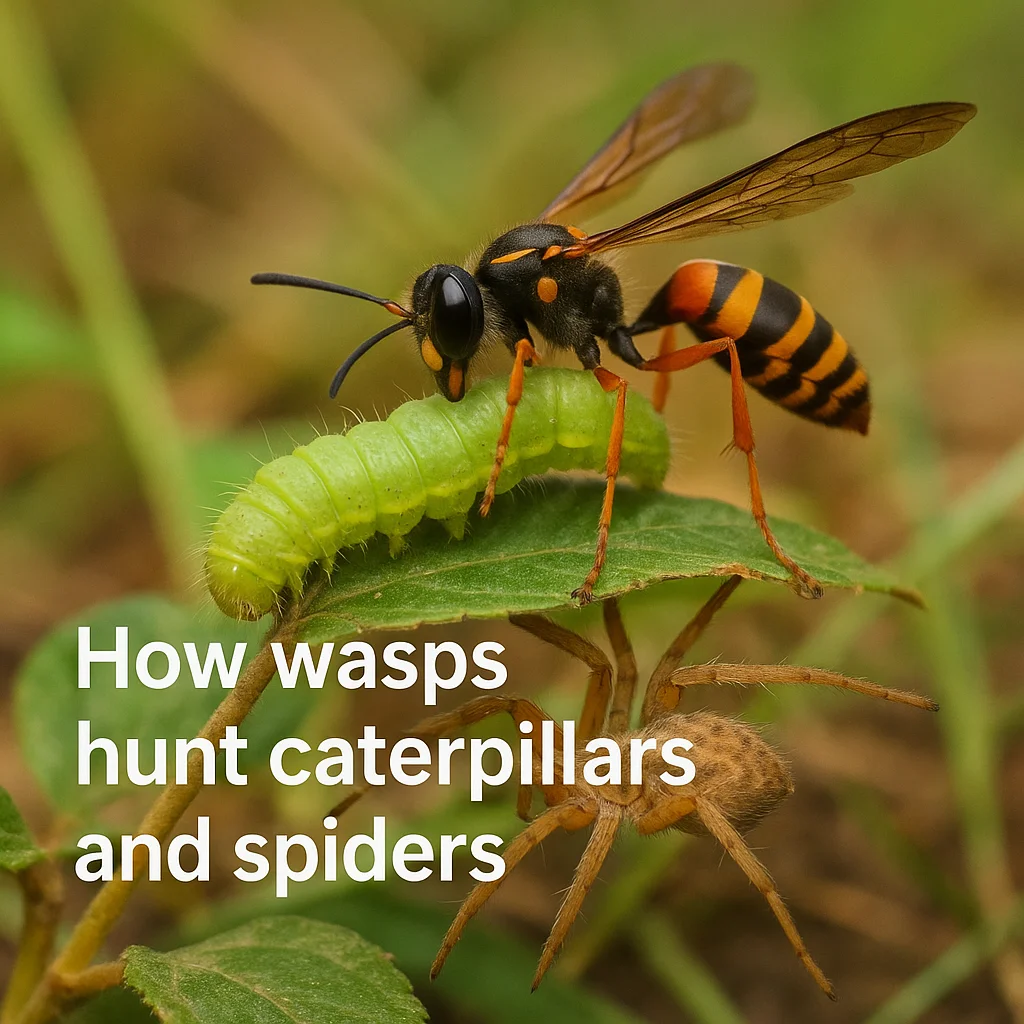
- Common names: Hunting wasps, digger wasps, spider wasps
- Scientific name: Varies by species
- Insect or not: Insect (an invertebrate)
- Order / family: Hymenoptera; families include Pompilidae, Sphecidae
- Typical size range (adult): 10 to 40 mm
- Key colors/patterns: Often yellow and black, sometimes metallic blue or reddish
- Activity: Primarily diurnal
- Typical habitats: Forests, grasslands, gardens, urban areas
- Where in the world it occurs: Worldwide, predominantly in temperate and tropical regions
- Seasonality: Most active in spring and summer
🔍 Identification
Wasps that hunt caterpillars and spiders can be identified through several distinctive features and behaviors that set them apart from other insects.
- Body shape and silhouette: Slim waist (petiole), elongated body
- Antennae type: Long and sometimes filamentous
- Wing features: Two pairs of clear wings; the forewings larger than the hindwings
- Leg traits and movement style: Long legs adapted for grasping and fast movement
- Distinguishing look-alikes: Can be confused with bees, but lack pollen baskets and are usually less hairy
- Long, slender waist
- Clear wings with visible veins
- More active during the day
- Often seen carrying prey such as caterpillars or spiders
- Lack prominent hair found on bees
- Typical yellow and black warning colors
- Seen hovering near flowers or searching foliage
- Distinctive buzzing sound, different from bees
🧠 Basic Body Structure
Understanding the basic anatomy of wasps is crucial for appreciating their hunting prowess. All wasps are invertebrates, meaning they lack a spinal column.
The wasp's body is divided into three main parts: the head, thorax, and abdomen. Each part plays a vital role in their daily functions. Wasps have six legs attached to their thorax, affording them effective mobility.
The external skeleton, or exoskeleton, provides protection and support, crucial during molting when wasps transition between growth stages. Wings, found on the thorax, allow for flight and are essential in the pursuit of prey.
🌍 Habitat & Distribution
Wasps are remarkably adaptable and inhabit various environments, from dense forests and expansive grasslands to urban gardens and woodlands. They often reside in areas rich in vegetation where prey, such as caterpillars and spiders, is abundant.
Microhabitats like under bark, within leaf litter, and around flower beds serve as both hunting grounds and nesting sites. Geographically, wasps are found on all continents except Antarctica, thriving in both temperate and tropical climates. Changes in habitat due to human activity can influence their distribution and local abundance.
📅 Seasonal Appearance & Activity
Wasps are most visible during the warmer months, with activity peaking in spring and summer. As diurnal creatures, they are primarily active during daylight hours when temperatures are conducive for flight and hunting. Weather conditions such as rain or extreme temperatures can impact their activity levels.
- Visible primarily in spring and summer
- Active during warm, sunny days
- Peak activity in late morning to afternoon
- Less active in rain and cold weather
- Best spotted in temperate climates
🥚 Reproduction & Egg-Laying
Wasps exhibit a variety of reproductive strategies, usually amorously engaging in courtesies like aerial displays or pheromonal signals to attract mates. Once mating is successful, females embark on the crucial task of egg-laying.
Eggs are often laid within or on their prey – mainly caterpillars or spiders, providing a ready food source for the emerging larvae. The number of eggs laid at a time can vary, with some species placing a single egg per prey item and others laying multiple eggs depending on species-specific behaviors and prey availability.
🌀 Metamorphosis & Life Cycle
Wasps undergo complete metamorphosis, which includes four stages: egg, larva, pupa, and adult. This process allows them to adapt to different ecological niches at each life stage.
The larval stage involves a rapid growth phase, during which they consume the host caterpillar or spider. After sufficient growth, they enter the pupal stage, undergoing a transformation within a protective cocoon. The duration of these stages varies by species and environmental conditions.
Upon emerging as adults, they will resume hunting and, depending on their sex, the cycle of reproduction.
🍽️ Diet & Feeding Behavior
Wasps are primarily predatory and play a significant role in controlling pest populations. During the larval stage, they feed on captured prey, like caterpillars or spiders, which are often immobilized or paralyzed by the adult wasp's sting.
Adults typically consume nectar from flowers, which provides energy for their active lifestyle, though they may also consume some protein derived from prey. Their mouthparts are adapted for both sucking and chewing, enabling them to derive sustenance effectively.
🦉 Predators & Defense
Wasps have their own set of natural enemies, including birds, larger insects, amphibians, and spiders. Despite these predators, wasps possess various defense mechanisms to deter predation.
- Camouflage: Colors and patterns for blending into surroundings
- Chemicals: Venom used for defense and subduing prey
- Agility: Quick, erratic flight patterns
- Sound: Audible buzzing can serve as a deterrent
- Armor: Tough exoskeleton reduces vulnerability
👥 Social Behavior & Swarms
Most wasps hunting caterpillars and spiders are solitary rather than social insects. Each female typically independently establishes her territory and nest, where she hunts and raises her young.
Solitary wasps focus on acquiring prey for their offspring, returning to the nest only for egg-laying and care. Interactions with conspecifics are generally limited to mating encounters or territorial disputes.
🧭 Senses & Communication
Wasps are equipped with acute vision, which aids in locating prey and navigating their environment. They rely on a combination of sight, smell, vibration detection, and sometimes sound to communicate or convey information.
Pheromones play a key role in mating and territory marking, while vibrations can signal an intruder or potential mate. These communication methods are critical both for successful hunting and reproductive efficiency.
🌱 Role in the Ecosystem
Wasps are integral to ecological balance through pest control, particularly with caterpillars and spiders. By keeping these populations in check, they contribute to healthier plants and crops.
Additionally, while feeding on nectar, they inadvertently aid in pollination, supporting plant diversity. Their interactions with numerous species foster a dynamic network of mutual and competitive relationships.
📉 Population & Conservation Notes
Wasps are often common and stable in their natural habitats, though specific populations may be affected by habitat destruction, pesticide use, and climate changes. Local abundance tends to vary based on ecological conditions and human impact.
- Plant native flora to support habitats
- Avoid using harmful pesticides in gardens
- Maintain natural ecological features like leaf litter
- Support conservation efforts in urban planning
⚠️ Human Interaction & Safety
Wasps may sting if threatened, largely utilizing their sting as a defensive measure. If stung, it's advised to wash the area, avoid scratching, and seek professional advice if a severe allergic reaction occurs.
Observing without disturbing them contributes to conservation efforts, allowing these adept hunters to fulfill their ecological roles.
📌 Summary
- Identifiable by slim waist and clear wings
- Inhabit diverse ecosystems worldwide
- Most active in spring and summer
- Undergo complete metamorphosis
- Prey on caterpillars and spiders
- Serves as key pest controllers
- Solitary with rare swarm formation
- Sensitivity to pheromones and vibrations
- Population influenced by human activity
- Observe respectfully to avoid stings