🕷️ Mud daubers: solitary hunters
🧾 Quick Facts
Mud daubers are fascinating solitary wasps known for their unique nesting behavior and their role as predators of other insects. Here are some quick facts about these intriguingly industrious wasps.
- Common Names: Mud daubers, Dirt daubers
- Scientific Name: Varies (major genera include Sceliphron, Trypoxylon, and Chalybion)
- Insect or Not: Yes, they are insects, classified as invertebrates.
- Order / Family: Hymenoptera / Sphecidae
- Typical Size Range: 1 to 1.5 inches (25 to 38 mm) long
- Key Colors/Patterns: Black, blue-black, yellow, or black with yellow markings
- Activity: Diurnal
- Typical Habitats: Woodland edges, gardens, urban structures
- Where in the World: Found globally, particularly in temperate and tropical regions
- Seasonality: Most active in spring and summer
🔍 Identification
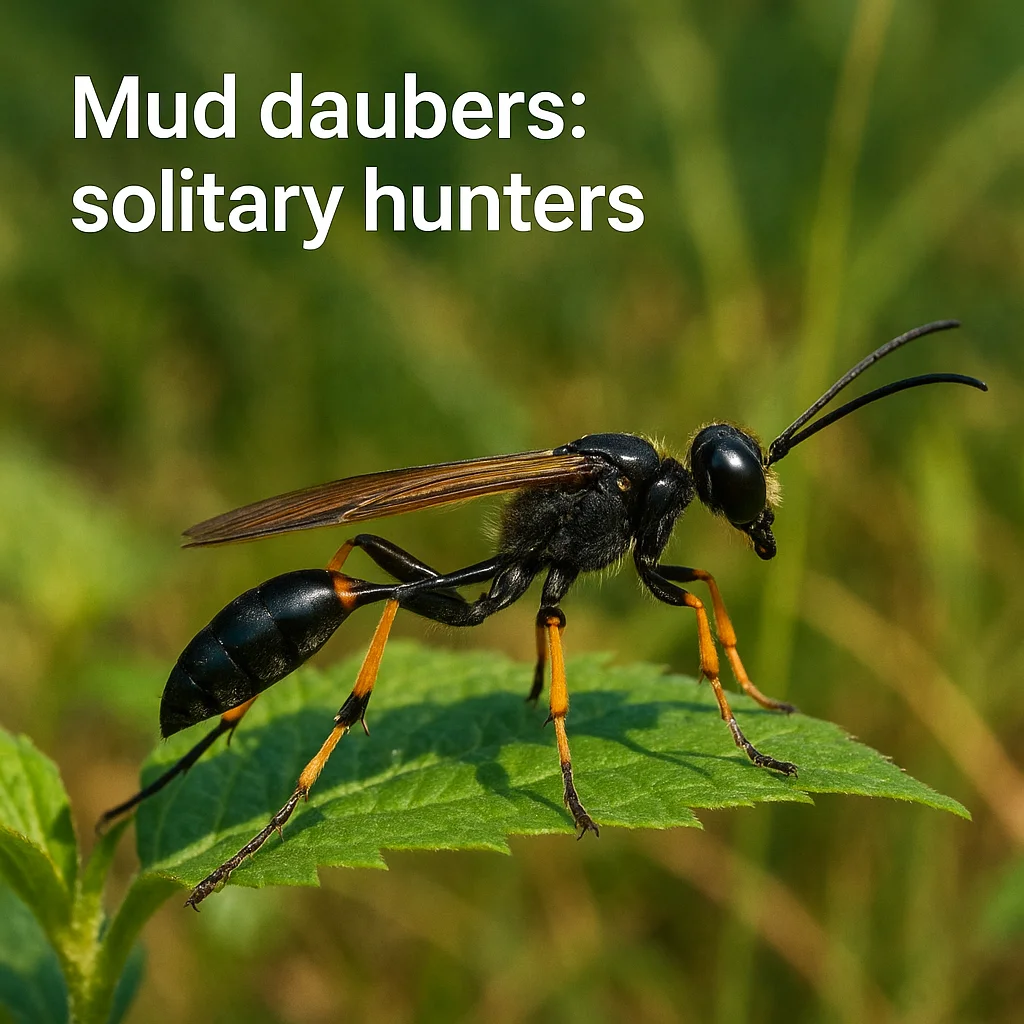
Mud daubers can be identified by their distinctive elongated body and narrow, thread-like waist (petiole) that connects the thorax and abdomen. Their wings are typically narrow and may appear smoky or translucent. Antennae are filiform, and the legs are long and slender, aiding their graceful flight.
While they may resemble other wasp species, mud daubers can typically be distinguished by their nesting behavior and lack of aggressive behavior towards humans.
- Top ID Tips:
- Elongated, slender body
- Narrow, thread-like waist
- Black or black-and-yellow coloration
- Non-aggressive nature
- Distinctive mud nest structures
- Long, slender legs
🧠 Basic Body Structure
Mud daubers, like all insects, possess three primary body sections: the head, thorax, and abdomen. They have six legs attached to the thorax and an exoskeleton composed of a hard outer shell. As they grow, mud daubers undergo molting, shedding their exoskeleton to allow for further expansion. With transparent wings capable of rapid motion, they are adept fliers.
As invertebrates, mud daubers lack a backbone, a characteristic shared by insects and many other animal groups.
🌍 Habitat & Distribution
Mud daubers are highly adaptable and can be found in various habitats, including forests, grasslands, wetlands, and urban areas. They frequently establish their nests under eaves, on walls, or in outbuildings. Their geographic range is extensive, occurring across multiple continents, particularly in regions with warm or temperate climates.
Changes in local habitat, such as urban development, can influence the availability of nesting sites and mud dauber visibility, making natural structures less available for nest building.
📅 Seasonal Appearance & Activity
Mud daubers are most active during the warmer months, typically from spring through late summer. Being diurnal, they are commonly observed during daylight hours, favoring warm, sunny conditions. Cooler temperatures and inclement weather can reduce their activity levels, making them less visible.
- Best Time to Spot It:
- Spring through late summer
- Warm, sunny days
- Mid-morning to late afternoon
- Near constructed nests
🥚 Reproduction & Egg-Laying
Mud daubers engage in a simple courtship process, often with males displaying patrol behavior to protect favorable sites. Females lay eggs in individual mud cells within their nests, each provisioned with paralyzed spiders or insects that serve as food for the developing larvae.
The egg count per nest cell varies, with the female dedicating significant attention to ensuring her offspring's nutrition and safety, sealing each cell once provisioning is complete.
🌀 Metamorphosis & Life Cycle
Mud daubers undergo complete metamorphosis, transitioning through distinct egg, larva, pupa, and adult stages.
The eggs hatch into larvae that feed voraciously on the stored prey within the mud cell. This stage can last from a week to several weeks, depending on environmental conditions. Once sated, the larvae enter the pupal stage, during which they undergo significant transformation, ultimately emerging as adults.
Adults typically live a few weeks to several months, during which time they focus on reproduction and ensuring generational continuity.
🍽️ Diet & Feeding Behavior
As adults, mud daubers primarily consume nectar, as their feeding morphology is better suited for liquid diets. Their role as predators is most visible through their larvae, which prey on spiders and other small arthropods captured and paralyzed by the female adult.
Mud daubers utilize chewing mouthparts, adeptly adapted for collecting and processing both prey for larvae and nectar for adult sustenance.
🦉 Predators & Defense
Mud daubers face predation from birds, reptiles, and spiders. Despite having a sting, they rarely use it in defense against larger predators and are not aggressive towards humans.
Their primary defense mechanism involves creating inaccessible nests for their constructing cells, either through altitude or complexity.
- Defense Highlights:
- Mud nests for protection
- Non-aggressive temperament
- Camouflage due to coloration
- Speedy escapes
👥 Social Behavior & Swarms
Mud daubers are solitary insects. Unlike social wasps, they do not form colonies or swarms; each female independently constructs her nest, rears her young, and provisions each mud cell without assistance from others of her species.
Males may temporarily share hunting territories, but no long-term social structures exist within mud dauber groups.
🧭 Senses & Communication
Mud daubers possess acute vision, aiding them in locating prey and favorable nesting sites. They rely on chemical cues for mating and minor territorial disputes and use limited sound and vibration for intragender communication.
Although they lack complex communication methods like those found in ants or bees, their solitary nature and environmental sensitivity negate the need for extensive communication.
🌱 Role in the Ecosystem
Mud daubers play a crucial role in controlling spider and insect populations, contributing to ecological pest control. Their presence promotes balanced ecosystems in gardens and natural habitats. While serving as predators, they are also prey, maintaining the food web's complexity.
Although not major pollinators, their sporadic nectar feeding does facilitate some incidental pollination.
📉 Population & Conservation Notes
Mud daubers are generally common in suitable environments, thriving in areas with abundant resources for nesting and feeding. However, changes such as habitat loss and pesticide use can pose challenges.
- How to Help (Low-Impact):
- Plant native flowering species
- Avoid using pesticides
- Provide natural mud sources for nests
- Maintain structural diversity in gardens
⚠️ Human Interaction & Safety
Mud daubers are not aggressive and are unlikely to sting unless provoked. Their sting is mild compared to social wasps. In case of a sting, clean the area and apply a soothing lotion. Seek professional advice if a severe reaction occurs.
Observation from a respectful distance is encouraged, and collecting them or disturbing their nests is discouraged.
📌 Summary
- Identifiable by slender body and thread-like waist
- Habitat: global; woods, gardens, urban areas
- Active: primarily spring to summer
- Lifecycle: complete metamorphosis
- Diet: adults - nectar; larvae - spiders
- Predators: birds, reptiles, spiders
- Ecology: pest control and incidental pollination
- Human: mild sting, generally non-aggressive