🕷️ Wasp look-alikes: hoverflies vs wasps
🧾 Quick Facts
Wasp look-alikes are fascinating insects often caught in a case of mistaken identity. One of the most interesting comparisons arises between hoverflies, which mimic the appearance of wasps. These insects belong to different orders and families but share similar habitats and behaviors.
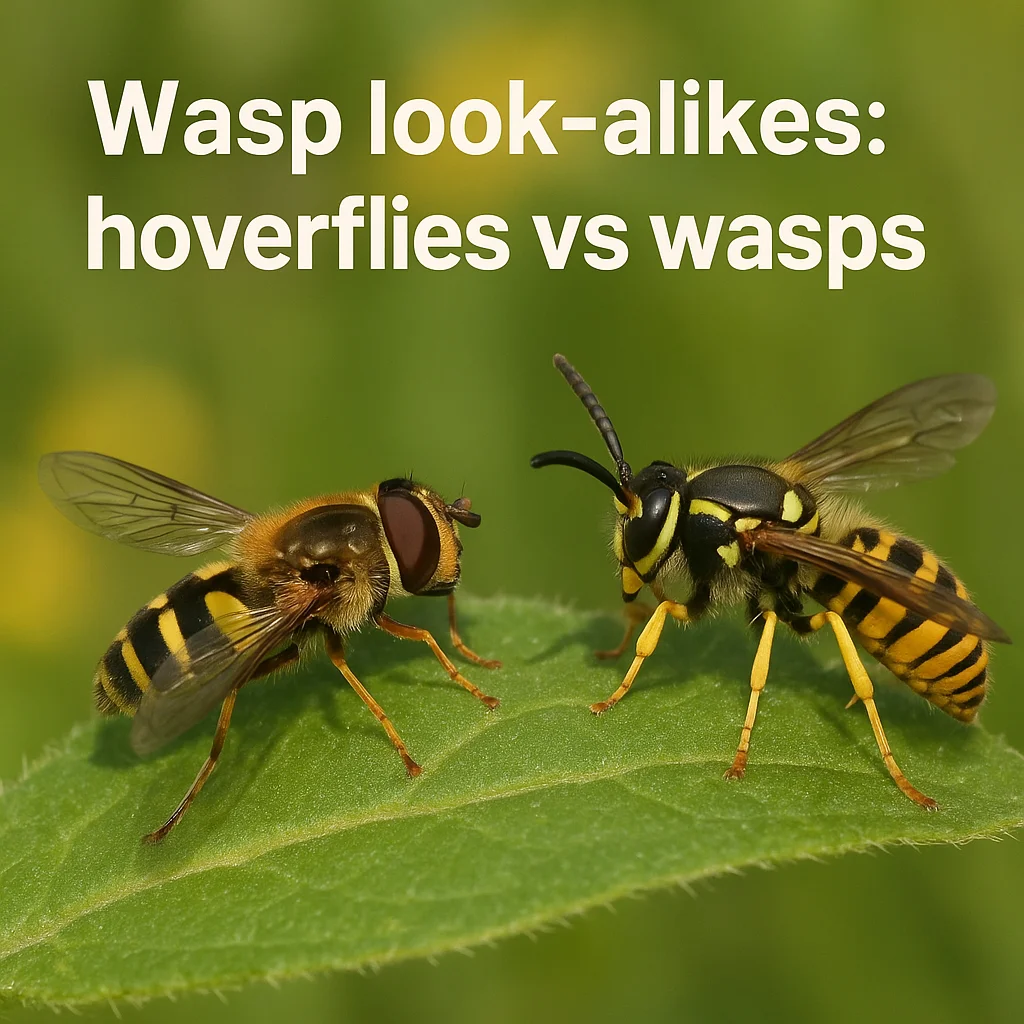
- Common names: Hoverflies, Flower flies, Wasp look-alikes
- Scientific name: Varies, generally Syrphidae for hoverflies
- Insect or not: Yes, both hoverflies and wasps are insects, which are invertebrates
- Order / family: Hoverflies belong to Diptera (Syrphidae), while wasps are part of Hymenoptera
- Typical size range: 5-15 mm for hoverflies, varies for wasps depending on species
- Key colors/patterns: Yellow, black, with distinct banding for mimicry
- Activity: Diurnal
- Typical habitats: Gardens, meadows, forests, urban areas
- Where in the world it occurs: Widely distributed globally
- Seasonality: Most visible during spring and summer months
🔍 Identification
Identifying hoverflies and wasps in the wild can be a fun and educational challenge. Despite their similar appearances, a closer look can reveal significant differences. Hoverflies generally have a more compact body shape and lack the narrow 'waist' typical of wasps. Their wings rest flat against their back when at rest, contrasted with the wasps' characteristic folded pairs. Hoverflies also have shorter antennae without the length and flexibility seen in most wasp species. They are often seen hovering with a rapid back-and-forth movement, while wasps exhibit a more deliberate and angular flight path.
- Compact body shape without the narrow 'waist'
- Short antennae compared to wasps
- Wings rest flat against their back
- Hover with rapid back-and-forth movement
- No stinger, unlike many wasps
- Visual mimicry with yellow and black banding
- Hoverflies are more attracted to flowers; wasps may also hunt
- Hoverflies produce a single pair of wings, while wasps have two pairs
- Hoverflies have a more consistent vein pattern in wings
- Lacking the distinctive aggressive behavior often seen in wasps
🧠 Basic Body Structure
Both hoverflies and wasps are segmented into the head, thorax, and abdomen, characteristic of the insect body plan. Each insect possesses six legs. Hoverflies, as members of the order Diptera, have only one pair of wings, whereas wasps in the order Hymenoptera possess two pairs. The exoskeleton of both insects provides protection and structural support, with periodic molting allowing for growth. As invertebrates, neither possesses a spinal column, which is a defining feature of vertebrates.
🌍 Habitat & Distribution
Hoverflies and wasps thrive across various environments, from lush gardens and meadows brimming with flowers to dense forests. Urban areas also attract these insects, providing plentiful flower beds and trees. Geographic distribution of both groups is global, although specific species may show preferences for temperate or tropical climates. Changes in habitat, such as urbanization, can influence the visibility of these insects, as they adapt to new flower sources and nesting sites.
📅 Seasonal Appearance & Activity
Hoverflies and wasps are most active during the warmer months, with their presence peaking from spring through summer. Daylight hours find both groups busy, as they are diurnal insects. They are generally weather-sensitive, preferring mild, dry conditions. Rain and colder temperatures may reduce their visibility as they take shelter.
- Most active from spring to late summer
- Best seen on warm, sunny days
- Lesser activity during rainy or windy conditions
- Dawn and late afternoon can be productive times to observe
- Noticeably less abundant in cooler months
🥚 Reproduction & Egg-Laying
The courtship of hoverflies typically involves aerial displays, with males hovering near flowers to attract females. Eggs are usually deposited on plant leaves or stems, offering immediate food sources for the emerging larvae. Egg-laying strategies vary across species, with hoverflies laying anywhere from a dozen to hundreds of eggs based on environmental conditions and the species' range.
🌀 Metamorphosis & Life Cycle
Hoverflies undergo complete metamorphosis, transitioning through four life stages: egg, larva, pupa, and adult. After hatching, larvae tend to feed on aphids and other soft-bodied insects, making them important biological control agents. Larval stages last anywhere from days to several weeks. Subsequently, the pupal stage is spent in a protective cocoon before emerging as a fully developed adult, ready to partake in pollination and mimicry.
🍽️ Diet & Feeding Behavior
Hoverfly larvae often consume aphids and small insects, displaying predatory behavior. Adult hoverflies exhibit nectar and pollen feeding habits, making their mouthparts—specifically adapted for sucking—integral to their role as pollinators. In contrast, wasps exhibit more generalized feeding behaviors, with some adults consuming nectar while others hunt insects to feed their larvae.
🦉 Predators & Defense
Hoverflies and wasps face numerous natural predators, including birds, spiders, and reptiles. Hoverflies employ mimicry as a primary defense strategy, with their wasp-like appearance often deterring potential predators who avoid stings. However, hoverflies are harmless and do not possess stingers. Wasps, however, may use their sting as a direct defense mechanism against threats.
- Mimicry that deters predators by resembling wasps
- Pertinent speed and agility in flight to escape danger
- Hoverflies do not sting, reducing aggression risk
- Wasps may rely on a deterrent sting for defense
👥 Social Behavior & Swarms
Most hoverfly species are solitary, engaging primarily in interactions necessary for mating. Wasps exhibit a wider range of social behavior. Although many wasps are solitary, eusocial species, such as paper wasps or hornets, live in colonies featuring a queen and a cooperative hierarchy, with division of labor among workers.
🧭 Senses & Communication
Hoverflies utilize acute vision to locate flowers and mates, with some species demonstrating color preferences. Chemical communication, through pheromones, plays a significant role in mating and territorial behaviors for wasps. Though not as pronounced in hoverflies, limited chemical signaling may still occur.
🌱 Role in the Ecosystem
Hoverflies play a vital role in pollination, visiting multiple flowers and facilitating the transfer of pollen. Their larvae contribute to natural pest control by preying on aphids. Wasps also help manage pest populations, benefiting agricultural environments. While both insects fulfill these roles, wasps may unwittingly create challenges for humans due to their defensive stings.
📉 Population & Conservation Notes
Both hoverfly and wasp populations fluctuate based on habitat alterations, pesticide use, and climatic conditions. Hoverflies are generally seen as common in suitable habitats. In some locales, conservation efforts focus on habitat preservation and encouraging natural pest control. Supporting diverse flowering plants and minimizing pesticide use can aid hoverfly populations.
- Encourage native flowering plants in gardens
- Minimize pesticide application
- Provide nesting habitats
- Promote biodiversity by reducing lawn area
⚠️ Human Interaction & Safety
Hoverflies are harmless, posing no threat to humans, and do not sting. They can be safely observed, admired for their mimicry and pollination. Wasps may sting if they perceive a threat, necessitating caution around nests and during outdoor activities. Should a person experience a sting, basic first-aid includes washing the area and avoiding scratching. Seeking professional advice is recommended in case of severe reactions.
📌 Summary
- Hoverflies mimic wasps but are harmless and beneficial pollinators.
- Typical habitats include gardens and meadows across the world.
- Active mainly during the warmer months and daylight hours.
- Undergo complete metamorphosis; larvae feed on small insects.
- Hoverflies aid in pest control and pollination; wasps can sting and hunt pests.
- Mimicry is a key hoverfly defense; wasps rely on stingers.
- They contribute positively to ecosystems, especially in pollination.
- Population health varies with habitat changes and pesticide use.
- Time spent observing these insects can enhance garden biodiversity.