🕷️ Carrion Beetles Silphidae Nature's Cleanup Crew
🧾 Quick Facts
Carrion beetles, also known as Silphidae, play a crucial role in nature by aiding in the decomposition of dead organisms, hence their nickname, "Nature's Cleanup Crew." Here are some quick facts about these fascinating beetles:
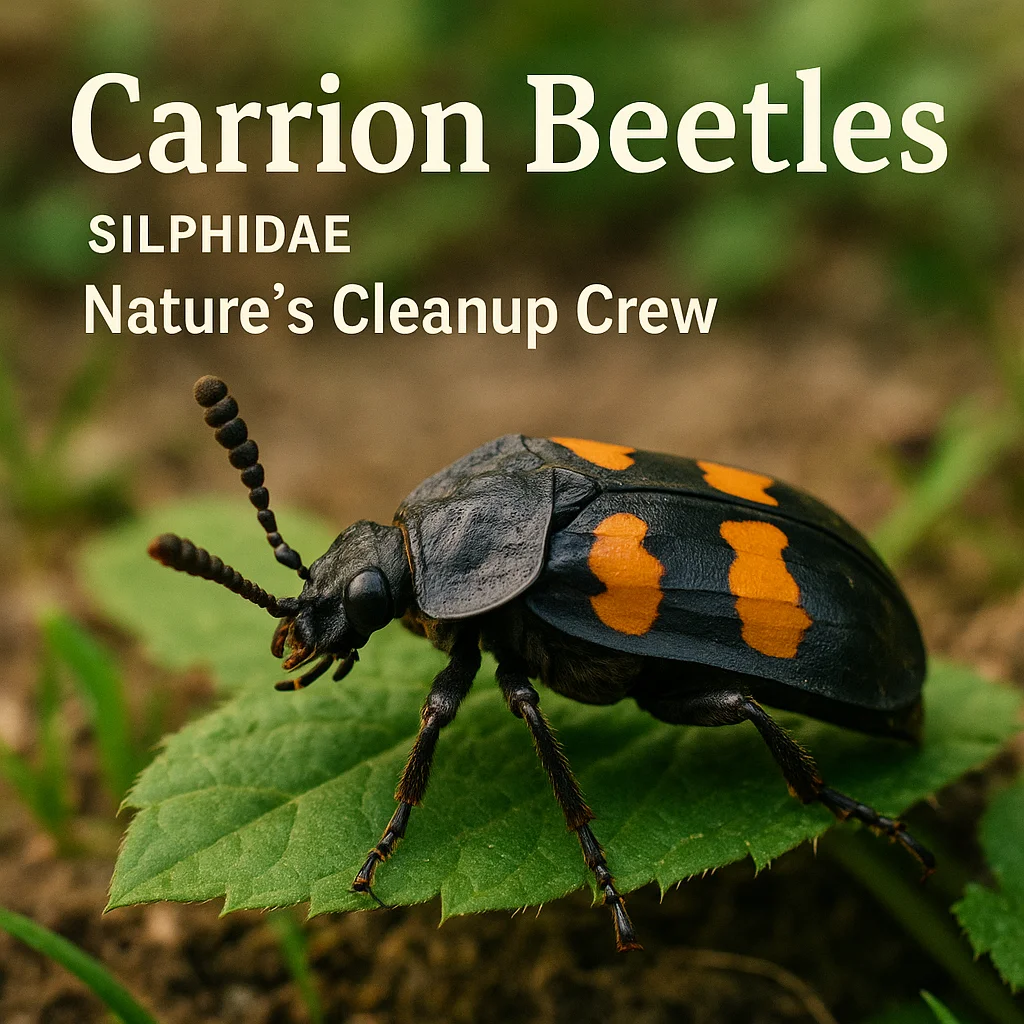
- Common names: Carrion beetles, Burying beetles
- Scientific name: Silphidae (family); varies by species
- Insect or not: Yes, they are insects and part of the invertebrate group
- Order / family: Coleoptera (order); Silphidae (family)
- Typical size range (adult): 1 to 3 cm in length
- Key colors/patterns: Black, orange, or yellow with distinct pattern markings
- Activity: Primarily nocturnal
- Typical habitats: Forests, fields, and gardens where decomposing matter is present
- Where in the world it occurs: Found worldwide, except in extreme polar regions
- Seasonality: Most active in spring and summer months when temperatures are mild
🔍 Identification
Carrion beetles can be recognized by their distinct body shape, resembling an elongated oval. Their antennae are typically club-shaped, aiding in their identification. They possess strong wings covered by elytra, the hard wing-cases, which sport unique color patterns. Their legs are adapted for efficient movement across various terrains, and they often exhibit a shuffle-like movement rather than swift scurrying. It's essential to differentiate carrion beetles from other beetles by observing their habitat and diet.
- Oval, elongated body shape
- Club-shaped antennae
- Colorful elytra with distinct markings
- Robust legs with a shuffling movement
- Presence near decomposing organic matter
🧠 Basic Body Structure
The body of a carrion beetle, like all insects, is divided into three fundamental parts: the head, thorax, and abdomen. These beetles have six legs, true to their classification as insects. The exoskeleton provides protection and support. Carrion beetles experience molting during development, shedding their exoskeleton as they grow. Most possess wings, with hardened coverings called elytra that shield the flight wings beneath. As invertebrates, they lack an inside skeleton.
🌍 Habitat & Distribution
Carrion beetles are versatile and occupy various habitats, including forests, grasslands, wetlands, and even urban gardens. They favor environments with abundant decaying organic material, such as leaf litter, under logs, and in burrows. These beetles have a broad geographic range and can be found on all continents except Antarctica. Climate change and habitat destruction can significantly influence their abundance, shifting local populations.
📅 Seasonal Appearance & Activity
Carrion beetles are most visible during warmer months, often emerging with the onset of spring's warmth and remaining active through summer. As nocturnal creatures, they are typically observed at night. Their activity levels increase after rain when humidity aids in food availability. Cooler temperatures and high precipitation won't deter them, but consistent unfavorable weather can reduce sightings.
- Most active during spring and summer
- Primarily nocturnal
- Often seen after a rain shower
- Warm, mild nights are ideal for spotting
🥚 Reproduction & Egg-Laying
Carrion beetles have intriguing reproductive behaviors, often involving intricate courtship rituals where males may offer food to females. Eggs are typically laid in or near decomposing matter, ensuring food availability for larvae. The number of eggs varies, with some species laying dozens, while others may lay a few hundred. This variation is often influenced by environmental conditions and food resources.
🌀 Metamorphosis & Life Cycle
Carrion beetles undergo complete metamorphosis, progressing through the stages of egg, larva, pupa, and adult. As larvae, they are voracious eaters, consuming decaying animals while developing. They remain in this stage for a few weeks to several months, depending on species and environmental conditions. Pupation then leads to the adult stage, where they seek out new decaying matter to continue the cycle. Adults generally live for several months, closing the loop by facilitating the decomposition of organic material.
🍽️ Diet & Feeding Behavior
Primarily scavengers, carrion beetles play a significant role in the decomposition process by feeding on dead animals. They possess chewing mouthparts designed to process decaying organic matter, helping recycle nutrients back into the ecosystem. As larvae and adults, they rely on scavenged carcasses, sometimes also consuming maggots found in their feeding grounds, thus exhibiting predatory behavior.
🦉 Predators & Defense
Carrion beetles face predation from various creatures, including birds, mammals, reptiles, and insects. Their primary defense mechanisms include their robust exoskeleton, which provides a sturdy barrier against physical attacks, and their distinct coloration, which can offer camouflage among leaf litter. Some species also emit chemicals that deter predators, leveraging foul-smelling secretions when threatened.
- Camouflage with environment
- Thick, protective exoskeleton
- Foul-smelling defensive secretions
- Erratic movement to evade capture
👥 Social Behavior & Swarms
While carrion beetles are largely solitary outside of mating and reproduction, some species demonstrate temporary cooperation. For instance, pairs may work together to move and bury carcasses to provide a secluded environment for offspring. Swarming behavior isn't typical for carrion beetles, as their life cycle is closely tied to ecological availability of resources rather than seasonal migrations.
🧭 Senses & Communication
Carrion beetles rely heavily on their sense of smell, utilizing keen olfactory senses to locate food sources from impressive distances. They communicate through chemical signals, particularly pheromones, which play a role in finding mates and signaling territory. Visual cues are less significant due to their nocturnal nature, while tactile sensing helps navigate their environment and assess potential food sources.
🌱 Role in the Ecosystem
Carrion beetles are integral to the ecosystem for their role in decomposing animal carcasses, facilitating nutrient cycling, and maintaining sanitation in their habitats. By breaking down organic matter, they help control fly populations by competing for the same resources. While not direct pollinators, their activity can influence plant growth by enriching soils in their vicinity.
📉 Population & Conservation Notes
The population status of carrion beetles varies globally. In areas with healthy, undisturbed habitats, they are often abundant. However, urban expansion, pesticide use, and habitat degradation can negatively impact populations. As a group, they face threats from changing landscapes, though specific species may be more vulnerable than others. Conservation efforts can include habitat preservation and mindful use of chemicals.
- Preserve natural leaf litter and fallen logs
- Avoid using pesticides near known habitats
- Encourage sustainable land use practices
- Support policies that conserve natural habitats
⚠️ Human Interaction & Safety
Carrion beetles generally pose no threat to humans as they do not bite or sting. Observing them in their natural environment should be done respectfully, avoiding both collection and disturbance. In the unlikely event of handling, washing the area thoroughly is advised, with medical attention sought only if unusual irritation occurs.
📌 Summary
- Distinct oval shape with colorful elytra
- Nocturnal and often found in decomposing environments
- Plays a key role in nutrient cycling
- Undergo complete metamorphosis with larval scavenging
- Defenses include camouflage and chemical secretions
- Rely on sense of smell for communication and food detection
- Human interactions are safe; observe without collecting
- Population health is tied to habitat quality and availability