🕷️ Diving Beetles Dytiscidae Underwater Air Bubbles Explained
🧾 Quick Facts
Diving beetles, belonging to the family Dytiscidae, are renowned for their aquatic lifestyle and unique respiratory adaptations. Here are some essential facts about this fascinating group:
- Common names: Diving beetles
- Scientific name: Dytiscidae (family name)
- Insect or not: Yes, they are invertebrates
- Order / family: Coleoptera / Dytiscidae
- Typical size range (adult): 1 to 4 cm in length
- Key colors/patterns: Mostly black or dark brown, some with yellow or greenish markings
- Activity: Primarily nocturnal
- Typical habitats: Still freshwater bodies such as ponds, lakes, and marshes
- Where in the world it occurs: Global distribution, including temperate and tropical regions
- Seasonality: Most active during spring and summer
🔍 Identification
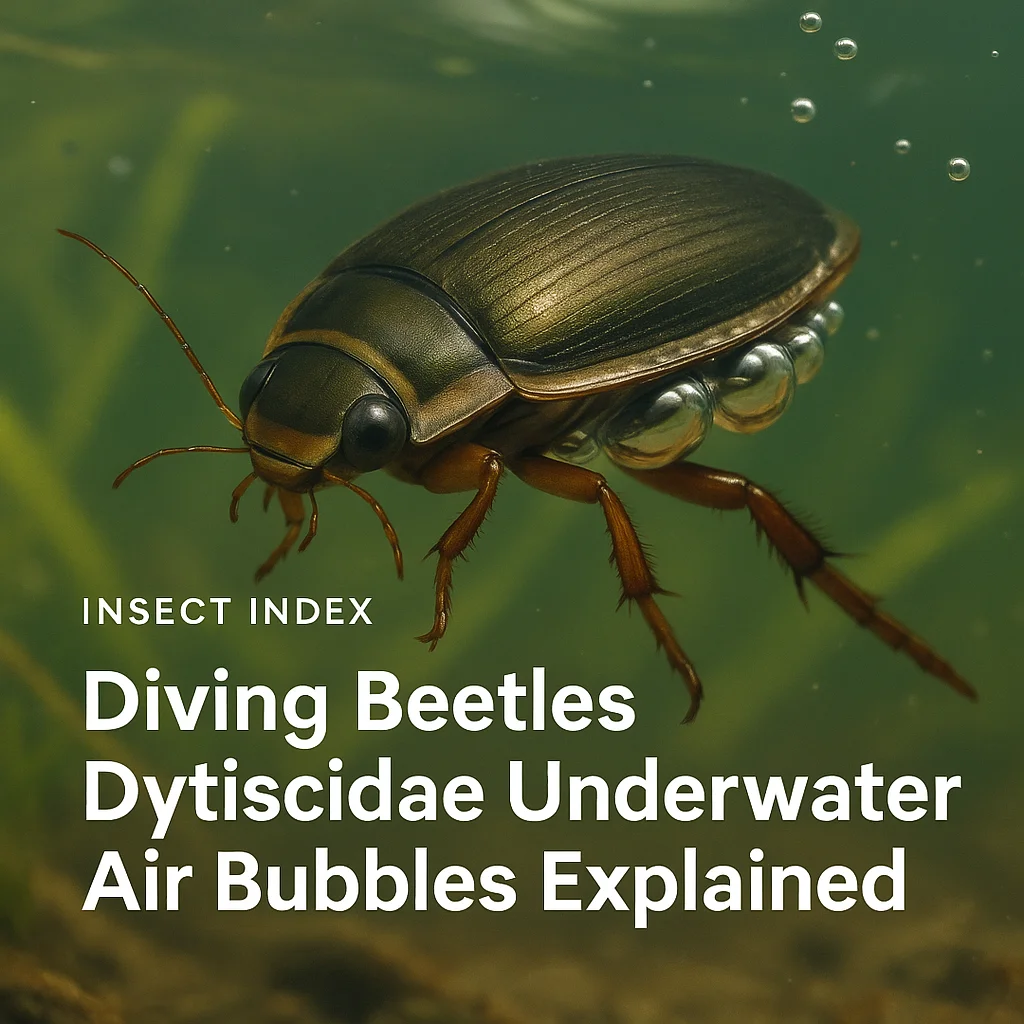
Diving beetles are easy to spot once you know what to look for. Their streamlined, oval body allows for efficient swimming. Antennae are filiform, functioning well under water. They possess well-developed elytra for protection during diving.
Their hindlegs are wide and fringed with hairs, aiding in swimming. Look-alikes such as whirligig beetles (Gyrinidae) can be distinguished by their more rounded bodies.
- Oval, streamlined body shape
- Filiform antennae
- Hard, protective elytra
- Broad, hair-fringed hindlegs
- Water-treading movement
- Distinguishable from rounded whirligig beetles
🧠 Basic Body Structure
As insects, diving beetles have a tripartite body: head, thorax, and abdomen. They possess six legs, with hindlegs adapted for swimming. Their exoskeleton provides protection and support, and they undergo molting as they grow.
Diving beetles are invertebrates, meaning they lack a backbone. Instead, they rely on their exoskeleton for structural support.
🌍 Habitat & Distribution
Diving beetles thrive in aquatic environments, particularly in still or slow-moving freshwater areas. They can be found in ponds, lakes, marshes, and sometimes in calmer streams. They often inhabit microhabitats under water vegetation or debris at the water's edge.
Their global distribution includes a variety of climates, being widespread across temperate and tropical regions. Habitat changes such as pollution or water drainage can impact their visibility and abundance.
📅 Seasonal Appearance & Activity
Diving beetles are most often observed in warmer months, predominantly in spring and summer when water temperatures are favorable. They are nocturnal, hence most active during the night.
Rainy seasons or high humidity can increase their activity as they rely heavily on water bodies.
- Spring and summer visibility
- Preference for warm nights
- Increased activity post-rain
- Higher visibility in humid conditions
🥚 Reproduction & Egg-Laying
Mating behavior in diving beetles often involves courtship displays and may include battles between males. Females lay eggs in spring or early summer, attaching them to aquatic plants or submerged debris.
Egg quantity varies, but females can lay hundreds of eggs throughout the breeding season, securing the species' continuation in suitable habitats.
🌀 Metamorphosis & Life Cycle
Diving beetles undergo complete metamorphosis, transitioning from egg to larva, then pupa, and finally to adult.
Larvae, known as water tigers, are aggressive predators, equipped with strong mandibles. They consume aquatic insects and small fish, residing underwater for weeks. Pupation occurs in moist soil near water, lasting several days before emerging as adults.
🍽️ Diet & Feeding Behavior
Diving beetles are predatory both as larvae and adults. Adults have chewing mouthparts, ideal for consuming other insects, small amphibians, or fish. In their larval stage, they use piercing-sucking mouthparts to subdue and ingest prey fluid.
These beetles play a crucial role in controlling aquatic insect populations and thus help maintain ecological balance in their habitats.
🦉 Predators & Defense
Natural predators of diving beetles include birds, amphibians, and larger aquatic insects. Their primary defense strategies involve camouflage, rapid diving, and releasing a smelly fluid to deter predators.
- Rapid diving and swimming
- Camouflage within aquatic vegetation
- Secretion of deterrent fluid
- Speed in escaping predators
👥 Social Behavior & Swarms
Generally solitary, diving beetles do not exhibit cooperative behavior. They may be seen in groups around rich feeding grounds or optimal habitats but do not form structured colonies or swarms.
Encounters are mostly centered around feeding opportunities and mating periods.
🧭 Senses & Communication
Diving beetles rely on acute chemical senses to detect food and mates, utilizing pheromones for communication. Their vision supports navigation and hunting in the water, while tactile sense aids them in maneuvering through aquatic vegetation.
They do not rely heavily on sound-based communication, unlike some other insect groups.
🌱 Role in the Ecosystem
Diving beetles are pivotal in their ecosystems as predators, helping manage insect populations and contributing to aquatic food web dynamics. They participate in decomposition by feeding on dead matter.
While beneficial to ecosystems, their presence signals healthy water conditions, yet high numbers might indicate ecological imbalance in some cases.
📉 Population & Conservation Notes
Diving beetles are commonly found in suitable habitats and are not currently endangered. However, pollution, climate change, and habitat destruction threaten localized populations. Awareness and conservation efforts are essential to preserve natural water bodies they inhabit.
- Maintain clean aquatic habitats
- Minimize pesticide use near water bodies
- Encourage native plant growth on water edges
- Support conservation initiatives for wetlands
⚠️ Human Interaction & Safety
Generally harmless to humans, diving beetles do not bite or sting unless handled roughly, which may cause defensive behavior. When observing them in nature, respect their space and habitat.
If skin irritation occurs after handling, wash the area with soap and water, and seek professional help if the reaction is severe.
📌 Summary
- Identifiable by oval, streamlined bodies
- Common in freshwater environments globally
- Mostly seen during warm spring and summer nights
- Undergo complete metamorphosis
- Serve as aquatic predators and population controllers
- Preyed upon by birds and amphibians; use speed and camouflage for defense
- Indicators of healthy aquatic ecosystems
- Important to protect their habitats from pollution and destruction