🕷️ Firefly Larvae The Glowing Predators You Rarely See
🧾 Quick Facts
The firefly larvae, commonly referred to as "glowworms" in some regions, are captivating creatures that display bioluminescence. Despite their association with warm summer nights, the larvae are less often seen, engaging in their lives out of human spotlight while playing a crucial ecological role.
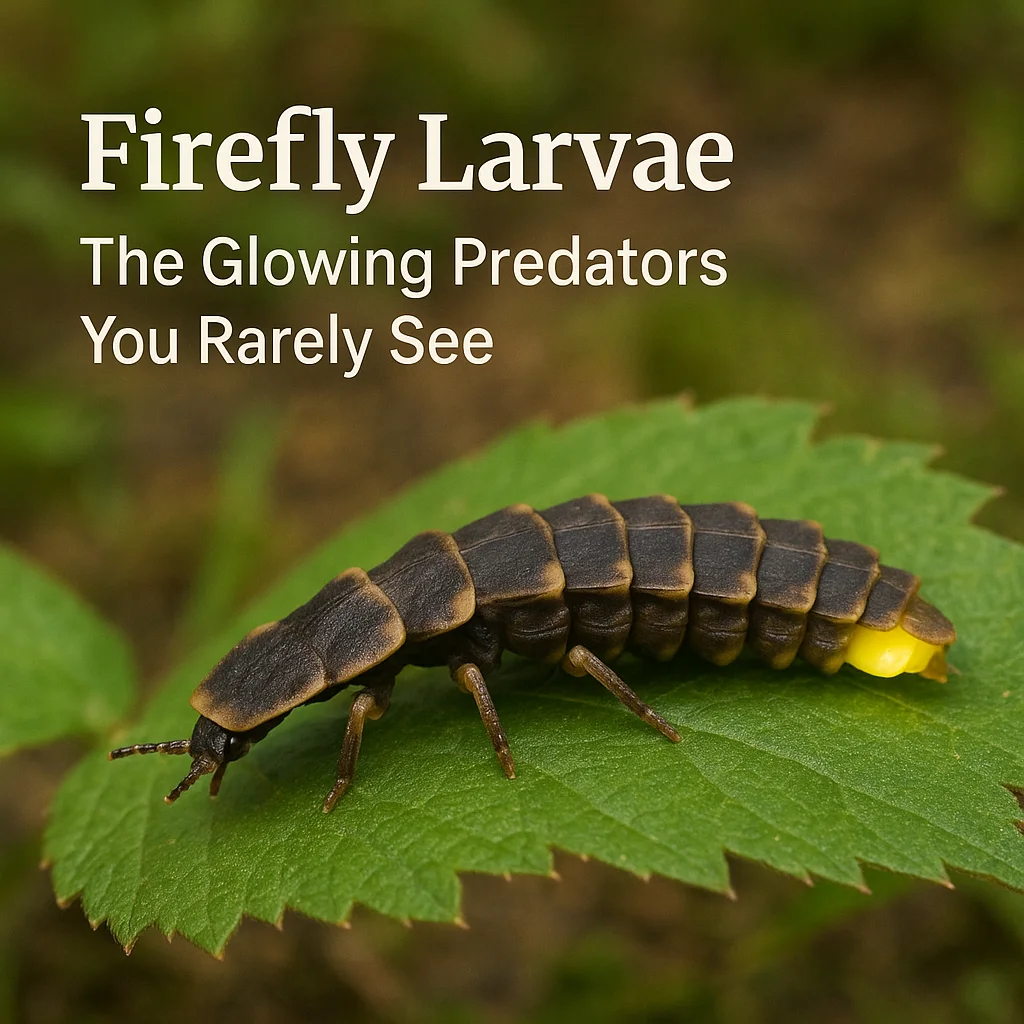
- Common names: Glowworm, Lightning Bug Larvae
- Scientific name: Varies by genera
- Insect or not: Yes, it is an insect
- Order / Family: Coleoptera / Lampyridae
- Typical size range: 5–20 mm (larvae)
- Key colors/patterns: Brown, black with pale, sometimes yellowish bioluminescent spots
- Activity: Primarily nocturnal
- Typical habitats: Forests, grasslands, wetlands, gardens
- Where in the world it occurs: Temperate and tropical regions worldwide
- Seasonality: Generally active in spring to summer months
🔍 Identification
Firefly larvae can be recognized by their elongated, flattened bodies and bioluminescent properties. Their head is typically well-defined, with noticeable antennae. Although they do not have wings like adult fireflies, their unique gait and glowing characteristics make them identifiable.
- Body shape and silhouette: Elongated, slightly flattened with distinct glow-emitting sections
- Antennae type: Short and sensitive, used primarily for navigation
- Wing features: Absent as larvae
- Leg traits and movement style: Six small legs that allow slow, deliberate movement
- Distinguishing look-alikes: Unlike similar looking larvae, firefly larvae are luminescent
- Top ID Tips:
- Look for bioluminescent, soft-bodied larvae
- Check for a flattened, elongated shape with multiple segments
- Observe the habitat—often found in moist environments
- Notice the lack of wings and presence of six small legs
- Pay attention to movement—slow and deliberate
- Look for glow, especially in dim conditions
🧠 Basic Body Structure
Firefly larvae, like all insects, consist of three main body parts: the head, the thorax, and the abdomen. As invertebrates, they lack a vertebral column and possess an exoskeleton, which they periodically molt as they grow. Unlike adults, they lack wings and are more adapted to a terrestrial or aquatic environment depending on the species.
This lack of wings differentiates them from their adult counterparts, who rely heavily on their wings for mating displays and dispersal.
🌍 Habitat & Distribution
Firefly larvae thrive in moist, warm habitats where they can easily access prey such as snails, worms, and other small invertebrates. Common habitats include damp forests, grasslands adjacent to water bodies, urban gardens, and wetland areas. Their geographic range is vast, encompassing temperate and tropical zones across the globe, from the Americas to Asia and Europe.
Changes in local habitat conditions due to deforestation, pollution, and urban sprawl can significantly impact their visibility and survival.
📅 Seasonal Appearance & Activity
The larvae are primarily active during the night and are mostly encountered from late spring through summer. Their activity may coincide with cooler and damper weather patterns, which align with the conditions that support their hunting behavior and minimize desiccation risk.
- Best Time to Spot It:
- Late spring and early summer
- Nights with high humidity
- After rain showers
- In the early hours of darkness
🥚 Reproduction & Egg-Laying
While much of the mating behavior is observed in adult fireflies, larvae result from the fertilized eggs laid by females. Adult females engage in light-signaling as part of their courtship before laying eggs in moist areas like soil, wood, or leaf litter. Egg deposition is often strategic, targeting damp substrates where larvae can find immediate nourishment.
The number of eggs can vary significantly by species, making detailed fertility data less uniform across various regions.
🌀 Metamorphosis & Life Cycle
Firefly larvae undergo complete metamorphosis, meaning their life cycle includes four distinct stages: egg, larva, pupa, and adult.
As larvae, they are carnivorous, feeding on other small, soft-bodied invertebrates. The larval stage can last anywhere from several weeks to months, based largely on environmental conditions and species. During this phase, they live in concealed environments to optimize prey capture and growth opportunities.
After sufficient growth, the larvae pupate into adult fireflies, a transformation lasting a few weeks. The adult stage is predominantly focused on reproduction and can last until the end of summer or early fall.
🍽️ Diet & Feeding Behavior
In their larval stage, fireflies are primarily predators. Equipped with specialized mandibles, they consume soft-bodied small insects, slugs, and snails, often injecting a paralyzing digestive enzyme that allows them to consume prey from the inside. This predatory role makes them vital in controlling pest populations.
🦉 Predators & Defense
Firefly larvae face threats from a variety of natural predators, including birds, frogs, spiders, and small mammals. However, they have evolved a number of interesting defense mechanisms. Besides camouflage and nocturnal habits, the bioluminescence of firefly larvae is suggested to be more than just a lure. It may serve as a warning to predators of their chemical defenses and unpalatability.
- Defense Highlights:
- Bioluminescent warning signals
- Toxic chemical release when threatened
- Camouflage in ground debris
- Nocturnal activity to avoid diurnal predators
👥 Social Behavior & Swarms
Firefly larvae are largely solitary, focusing on hunting more than communal living. They exhibit limited social behavior beyond necessary breeding interactions as adults.
There are no known swarm behaviors in firefly larvae, unlike their adult counterparts that may congregate en masse during mating displays.
🧭 Senses & Communication
Firefly larvae employ basic sensory tools to navigate and hunt. Their vision, though adapted for low-light, pairs with a sense of touch and chemical detection to locate prey. Communication among larvae is minimal, but the luminescent displays likely broadcast their presence to potential mates and predators alike.
🌱 Role in the Ecosystem
Firefly larvae play an important role within their ecosystems, primarily through pest control. By preying on soft-bodied invertebrates, they help regulate populations that could otherwise become problematic for plant growth or agriculture. Their bioluminescence may also serve as a visual spectacle that enhances nighttime ecological interactions.
📉 Population & Conservation Notes
Firefly larvae populations are reported as common in habitats that support their ecological needs. However, certain species face challenges due to habitat disruption, light pollution, chemical use, and climate change impacts. Protective measures can enhance local biodiversity and support their presence.
- How to Help (Low-Impact):
- Plant native vegetation around your area
- Avoid the use of pesticides in gardens and lawns
- Preserve natural wetland and wooded areas
- Minimize artificial night lighting
⚠️ Human Interaction & Safety
Firefly larvae do not pose significant threats to humans and are generally not considered harmful. They do not bite or sting when encountered and can be enjoyed respectfully and from a distance. It’s important to leave them undisturbed in their natural habitat to promote ecological balance.
📌 Summary
- Firefly larvae are bioluminescent nighttime predators.
- Found worldwide in diverse wet habitats.
- Active primarily at night in spring and summer.
- Undergo complete metamorphosis with distinct life stages.
- Feed on other small invertebrates as larvae.
- Preyed upon by birds, mammals, amphibians.
- Contribute to pest control as young predators.
- Not harmful to humans; enjoy observing respectfully.