🕷️ Jewel Beetle Larvae Flatheaded Borers And Tree Damage Signs
🧾 Quick Facts
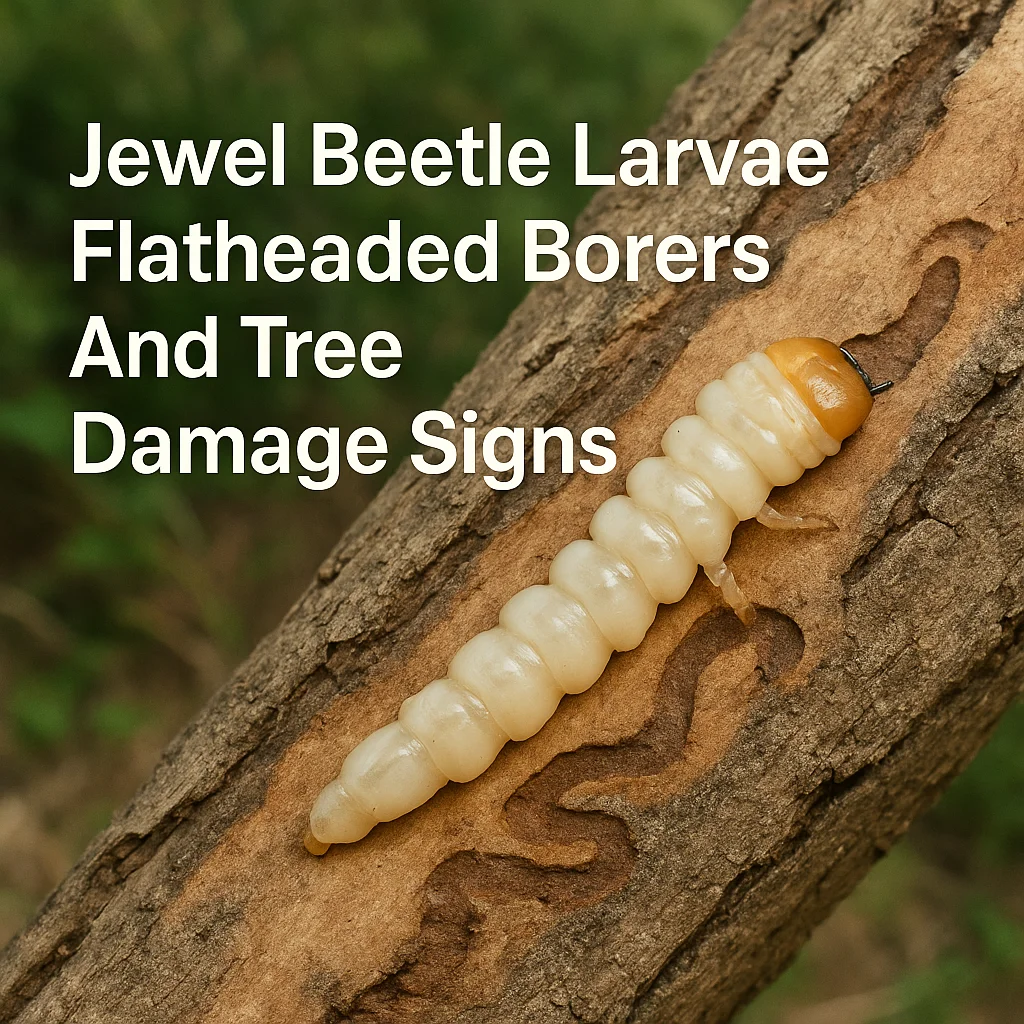
The Jewel Beetle larvae, commonly known as flatheaded borers, are fascinating creatures noted for their impact on trees and recognition in the field of entomology. They belong to the family Buprestidae, and their larvae are notorious for burrowing into wood, often causing noticeable tree damage.
- Common Names: Jewel Beetle Larvae, Flatheaded Borers
- Scientific Name: Varies
- Insect or Not: Insect (an invertebrate)
- Order / Family: Coleoptera / Buprestidae
- Typical Size Range: Adults range from 3 to 100 millimeters
- Key Colors/Patterns: Metallic hues, often iridescent
- Activity: Primarily diurnal
- Typical Habitats: Forests, gardens, woodlands
- Where in the World: Mostly worldwide, notably in temperate and tropical regions
- Seasonality: Most active from late spring to early fall
🔍 Identification
Identifying Jewel Beetle larvae, especially the flatheaded borers, involves understanding their unique body shape and characteristics. Adult Jewel Beetles have elongated, flattened bodies that are often brilliantly colored. Their heads are typically broad with filamentous or serrate antennae. Larvae are pale, legless, and have a distinct flattened head region.
- Body: Elongated, flattened, metallic
- Antennae: Serrate or filamentous
- Wings: Hardened forewings (elytra) cover softer hindwings
- Legs: Well-developed; adults have six legs
- Movement: Larvae crawl, adults are adept flyers
- Common Confusion: Often mistaken for other beetles due to coloration
- Distinctive iridescent colors
- Flat-headed larvae
- Metallic, elongated adult bodies
- Serrate or filamentous antennae
- Found under bark or in damaged wood
- Wood boring signs on trees
🧠 Basic Body Structure
As insects, Jewel Beetles have a standard body structure divided into three main parts: head, thorax, and abdomen. They possess six legs attached to the thorax. These beetles have an exoskeleton, providing protection and support. Larval stages molt as they grow, ultimately transitioning from larva to adult in a complete metamorphosis.
They are invertebrates, meaning they lack a vertebral column or spine, a characteristic feature of insects.
🌍 Habitat & Distribution
Jewel Beetles, including their larvae, thrive in diverse environments but are commonly found in forests and woodlands where they can easily access their primary food source—wood. Other habitats include gardens and urban areas rich with trees.
Their geographic range is extensive, covering continents like North America, Europe, Asia, and parts of Australia and Africa, predominantly in temperate and tropical climates. The presence of host trees largely dictates their distribution, making habitat changes pivotal in influencing their sightings.
📅 Seasonal Appearance & Activity
Adult Jewel Beetles are most visible during the warm months. As diurnal insects, they are typically active during the daylight hours, particularly in sunny weather conditions.
- Best Time: Late spring to early fall
- Diurnal activity
- Warm and sunny conditions encourage appearance
- Common in temperate and tropical climates
🥚 Reproduction & Egg-Laying
The reproduction behaviors of Jewel Beetle larvae are regionally variable, though most species exhibit rituals involving pheromonal signals and courtship displays. Females generally deposit eggs in tree bark or cracks of stressed or dying trees, ensuring larvae have immediate access to food upon hatching. Egg-laying can vary with environmental conditions and tree availability.
🌀 Metamorphosis & Life Cycle
Jewel Beetles undergo complete metamorphosis, progressing through egg, larval, pupal, and adult stages.
Egg Stage: Eggs are laid in bark crevices, hatching within weeks during favorable conditions.
Larva Stage: Emerging larvae, known as flatheaded borers, tunnel into the wood, causing significant structural damage to trees. This stage can last months to several years, depending on species and climate.
Pupa Stage: Larvae create chambers within the wood to pupate, eventually transforming into adults.
Adult Stage: Adults emerge when temperatures rise, primarily feeding on foliage before repeating the life cycle.
🍽️ Diet & Feeding Behavior
The dietary habits of Jewel Beetles change throughout their lifecycle. As larvae, they primarily feed on wood, boring intricate channels and often causing substantial damage to trees. In contrast, adult beetles feed on the foliage, pollen, and nectar of host plants using chewing mouthparts. They fulfill roles as herbivores and occasionally act as pollinators.
🦉 Predators & Defense
Jewel Beetle larvae and adults face numerous predators, including birds, reptiles, amphibians, and parasitic insects such as wasps. In defense, their colorful exoskeletons provide camouflage within their natural environment, while some species use mimicry to avoid detection. They may also rely on burrowing to escape threats.
- Camouflage among foliage and bark
- Mimicry to avoid predators
- Burrowing as larvae
- Quick flight responses when threatened
👥 Social Behavior & Swarms
Jewel Beetles are primarily solitary creatures, especially as adults. They do not form colonies nor exhibit social behaviors associated with swarming or coordinated movements. Interactions typically occur only during mating pursuits, following which individuals return to solitude.
🧭 Senses & Communication
Jewel Beetles have well-developed senses that aid in communication and survival. They rely heavily on vision and olfactory cues, especially pheromones, for locating mates. Some species may utilize vibrations or subtle sounds to communicate within their immediate environment, though this varies significantly among species.
🌱 Role in the Ecosystem
Jewel Beetles play an integral role in forest ecosystems as both herbivores and decomposers. Their feeding activities help break down and recycle nutrients from dead or dying wood. Although they can be considered pests due to tree damage, they also benefit the ecosystem by creating habitats for other species and contributing to biodiversity.
They engage in complex relationships within their ecosystem, with some species being mutualistic pollinators while others engage in parasitism with their host plants.
📉 Population & Conservation Notes
The population status of Jewel Beetles is variable. Many species are commonly encountered in suitable habitats, while others face threats from habitat destruction, chemical use, and climate change, contributing to declines or fluctuations in local abundance.
- Planting native trees supports habitat
- Minimize chemical pesticide usage
- Leave dead wood and leaf litter undisturbed
- Engage in monitoring and citizen science efforts
⚠️ Human Interaction & Safety
Though generally harmless, Jewel Beetles should be observed with respect. They are not known to bite or sting people, making them safe for observation. In case of irritation from handling, simply wash the area and avoid further contact. If unusual reactions occur, seeking professional advice is recommended.
Encouraging habitats with natural biodiversity can reduce the inclination to collect wild specimens, fostering a respectful coexistence with these intriguing insects.
📌 Summary
- Recognizable for their metallic, iridescent bodies
- Live in forests, woodlands, and gardens worldwide
- Adults most visible from late spring to fall
- Complete metamorphosis: egg, larva, pupa, adult
- Larvae are wood-borers, adults eat foliage
- Predators include birds, reptiles, and wasps
- Ecologically vital for decomposition and biodiversity
- Population varies; reduce pesticide use to support them