🕷️ Net-winged Beetles Orange-and-black Warning Patterns
🧾 Quick Facts
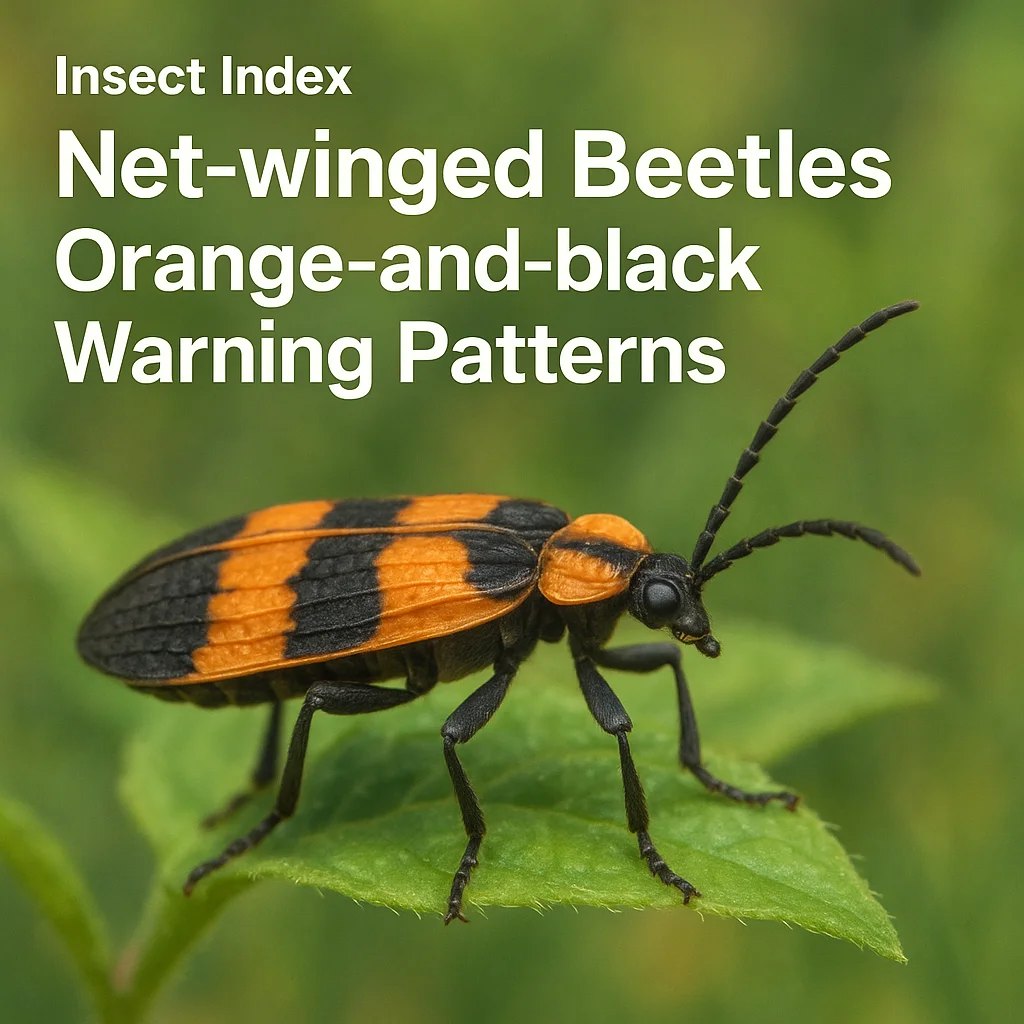
Net-winged beetles, known for their distinctive orange-and-black warning patterns, are an intriguing group of insects from the family Lycidae. Found across various regions, they are known for their striking appearance, which serves as a warning signal to potential predators.
- Common names: Net-winged beetles
- Scientific name: Varies by species
- Insect or not: Yes, they are insects, specifically invertebrates
- Order / family: Coleoptera / Lycidae
- Typical size range: 6 to 20 mm in length
- Key colors/patterns: Predominantly orange and black with net-like wing patterns
- Activity: Mostly diurnal (active during the day)
- Typical habitats: Forests, meadows, woodlands
- Where in the world it occurs: Found globally, with concentrations in tropical and temperate regions
- Seasonality: Adults are most visible in the warmer months, ranging from spring to late summer
🔍 Identification
The net-winged beetles are easily recognized by their flattened bodies and vibrant warning coloration. Their body shape is distinctively elongated with a soft exoskeleton. The antennae are usually long and may have a slightly serrated appearance.
The wings are the most striking feature, with a reticulated, net-like appearance that gives them their common name. They have short legs suited for crawling more than running.
They can be mistaken for other similarly colored beetles, such as soldier beetles, but are distinguished by their wing texture and softness.
- Look for a small, elongated body with a pronounced head and thorax
- The soft, flexible wings have a net-like texture
- Long filamentous antennae
- Bright orange and black coloration
- Poor fliers, often crawling on plants
- Often found on flowers or leaves
- Can be confused with soldier beetles
- Soft-bodied, unlike the hard elytra of many beetles
- Entire insect visible with wings closed
🧠 Basic Body Structure
As insects, net-winged beetles have a basic body structure divided into three parts: the head, thorax, and abdomen. They possess six legs and are equipped with two pairs of wings, with the forewings modified into elytra that protect the hindwings and abdomen. An exoskeleton provides them with protection and support, while they undergo molting to grow.
Net-winged beetles are invertebrates, meaning they lack a backbone, a common trait among insects influencing their movement and body design.
🌍 Habitat & Distribution
Net-winged beetles are primarily found in wooded areas, such as forests and woodlands, due to their reliance on plant feeding. Within these habitats, they are often seen on flowers, leaves, and near decaying wood, which serve as their food sources or breeding sites.
Geographically, they are distributed across continents like North and South America, Europe, Asia, and Africa, thriving in both tropical and temperate climates. Changes in habitat conditions, such as deforestation, can affect their population and distribution.
📅 Seasonal Appearance & Activity
These beetles are mostly active during the day and are commonly observed during the warmer months when adult populations peak. Their activity is influenced by weather conditions, favoring warm and humid environments.
- Spring to late summer for peak visibility
- Best spotted during warm, sunny days
- Activity increases after rain
- Diurnal, seen during daylight hours
- Prefers humid environments
🥚 Reproduction & Egg-Laying
Net-winged beetles engage in mating behaviors that include courtship displays, facilitated by their vivid coloration which possibly signals fitness. Mating usually occurs on vegetation where females lay their eggs.
The eggs are often laid on or near decaying wood or leaf litter, as these provide a nutritious environment for the larvae when they hatch. The number of eggs laid varies, but it is typically in the dozens.
🌀 Metamorphosis & Life Cycle
Net-winged beetles undergo complete metamorphosis, which includes the stages of egg, larva, pupa, and adult.
The larvae are typically found in decaying wood or plant material, where they feed on organic matter. This stage can last several months, after which they pupate in a protective environment.
The adult stage is relatively short compared to the larval period, often lasting just a few weeks. During this time, they focus on reproduction and can be seen feeding on plant nectar and pollen.
🍽️ Diet & Feeding Behavior
In their larval stage, net-winged beetles are detritivores, feeding on decaying plant material and contributing to decomposition processes. As adults, they primarily consume plant nectar and pollen.
They have chewing mouthparts that allow them to graze on soft plant surfaces. Their role in ecosystems varies, but they can be pollinators when visiting flowers.
🦉 Predators & Defense
Net-winged beetles face predation from birds, reptiles, amphibians, and other insects such as predatory beetles and spiders. Their most effective defense is their warning coloration, which signals to potential predators that they may be toxic or unpalatable.
- Bright coloration serves as a warning signal
- May secrete chemicals that deter predators
- Mimicry with other toxic species
- Camouflage among flowers and leaves
👥 Social Behavior & Swarms
Net-winged beetles are generally solitary insects. They do not form swarms or colonies and are typically seen alone or in small groups, usually when attracted to a common food source.
🧭 Senses & Communication
These beetles rely on their vision and sense of smell for communication, especially during mating when locating partners. Their bright coloration aids visual communication, whereas pheromones may play a role in attracting mates.
Sound or vibration communication is not prominent among net-winged beetles, as they do not possess specialized structures for producing sounds like some other insect groups.
🌱 Role in the Ecosystem
Net-winged beetles contribute to ecosystems primarily as decomposers in their larval stage, breaking down dead plant material. As adults, they aid in pollination by visiting flowers, thus supporting plant reproduction.
They have interactions with other plants and animals, sometimes engaging in mutualistic relationships with certain plant species that benefit from their pollination activities.
📉 Population & Conservation Notes
While net-winged beetles are often reported as common in suitable habitats, their specific population trends can vary by region. Habitat loss due to deforestation and the use of pesticides are potential threats to their populations.
- Plant native species to support local pollinators
- Avoid using pesticides in garden areas
- Maintain leaf litter for habitat creation
- Support conservation efforts in local forests
⚠️ Human Interaction & Safety
Net-winged beetles are generally harmless to humans. They do not bite or sting and pose no known health risks. When engaging with nature, it's best to observe respectfully and avoid collecting wild beetles.
If you have a reaction to contact with an insect, wash the area with soap and water and seek professional advice if a severe reaction occurs.
📌 Summary
- ID: Elongated, orange-and-black with net-like wings
- Habitat: Forests, woodlands across global regions
- Seasonality: Visible spring to summer
- Life cycle: Complete metamorphosis from egg to adult
- Diet: Larvae as decomposers, adults as pollinators
- Predators: Birds, reptiles; use warning colors for defense
- Ecology: Important for decomposition and pollination
- Human Notes: Harmless, promote natural habitat preservation