🕷️ Water Scavenger Beetles How They Differ From Diving Beetles
🧾 Quick Facts
Water scavenger beetles and diving beetles are two fascinating groups of beetles that share aquatic habitats, yet they have distinct characteristics. Understanding these differences enhances our appreciation of their unique adaptations and ecological roles.
- Common names: Water scavenger beetles, diving beetles
- Scientific name: Hydrophilidae (water scavenger beetles), Dytiscidae (diving beetles)
- Insect or not: Insects (invertebrates with three-part body structure)
- Order / family: Coleoptera / Hydrophilidae and Dytiscidae
- Typical size range: 1–40 mm for water scavenger beetles; 1–45 mm for diving beetles
- Key colors/patterns: Black, brown, occasionally with metallic sheen
- Activity: Primarily nocturnal
- Typical habitats: Freshwater ponds, streams, marshes
- Where in the world it occurs: Worldwide, particularly in freshwater environments
- Seasonality: Most visible during warm months
🔍 Identification
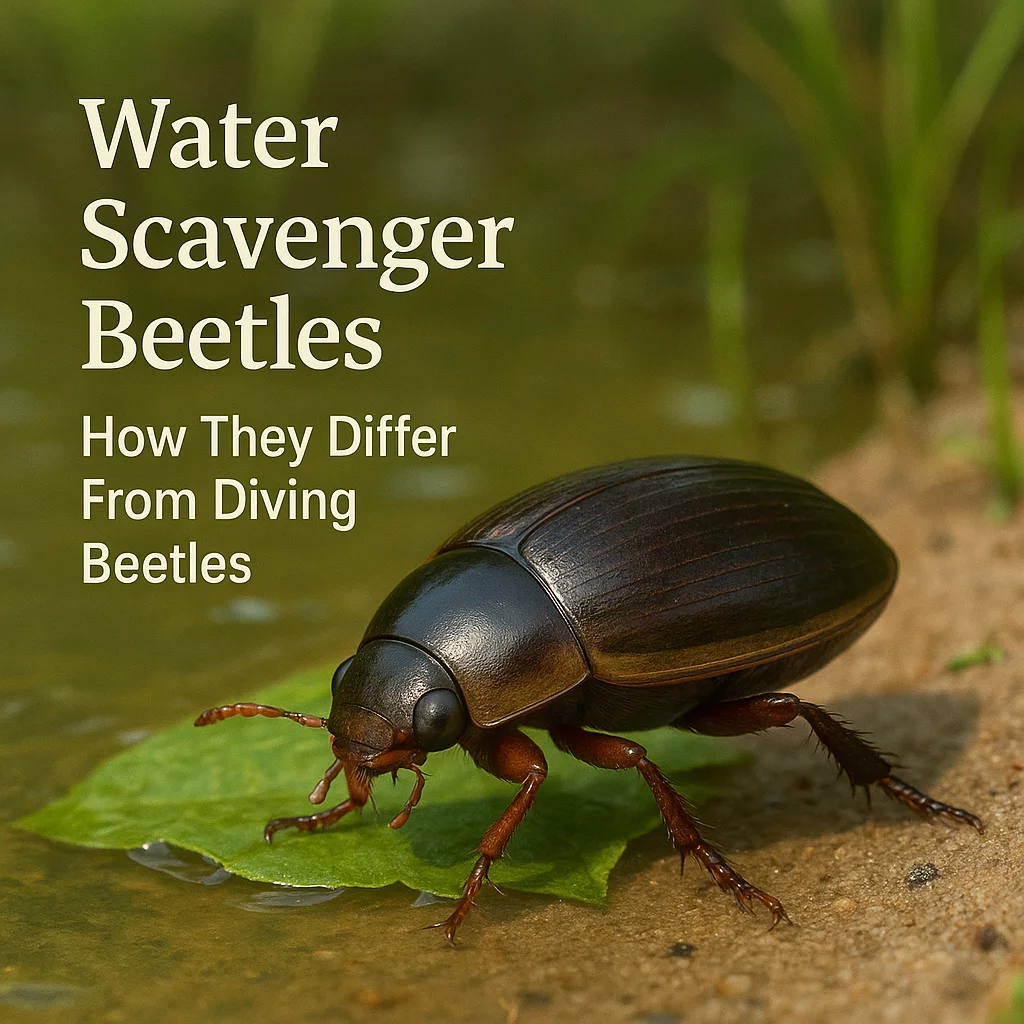
These beetles are best recognized by their streamlined bodies adapted for aquatic life. While both groups share a similar environment, certain traits help tell them apart. Water scavenger beetles have a more oval body shape and their antennae are clubbed with a distinct elbow. Their legs are designed for crawling rather than swimming.
Diving beetles, contrastingly, have smooth and streamlined bodies, ideal for swimming. Their antennae are long and thread-like, a key feature for identifying them. Powerful, paddle-like hind legs help them swim with ease and speed.
- Top ID Tips:
- Water scavenger beetles have more robust, oval bodies.
- Diving beetles are smooth, streamlined, and more elongated.
- Water scavenger beetles have clubbed antennae with an elbow.
- Diving beetles possess long, thread-like antennae.
- Paddle-like hind legs are a signature feature of diving beetles.
- Water scavenger beetles’ legs are adapted for crawling more than swimming.
- Observe behavior: diving beetles swim actively, whereas water scavenger beetles may crawl among submerged plants.
- Coloration: Both can be dark but check for any distinct markings.
- Watch movement on the water’s surface: diving beetles often dive quickly when disturbed.
🧠 Basic Body Structure
As insects, both water scavenger beetles and diving beetles have a typical insect body plan comprising a head, thorax, and abdomen. They have six legs and are invertebrates, meaning they lack a spinal column. Their bodies are covered by an exoskeleton, providing protection and support. Molting occurs as they grow, shedding their old exoskeleton for a new one. Both groups possess wings, though the way these wings are used varies.
🌍 Habitat & Distribution
Water scavenger beetles inhabit a diverse range of freshwater environments including ponds, marshes, and slow-moving streams. They thrive particularly in waters rich with organic material, where they can scavenge and feed. Diving beetles share similar habitats but are more generalized, allowing them to occupy a broader range of aquatic environments.
These beetles are cosmopolitan, found globally wherever suitable freshwater habitats exist. Changes in water quality, habitat destruction, and climate impacts can affect their presence and abundance in certain areas.
📅 Seasonal Appearance & Activity
Both beetle groups are more commonly observed during the warmer months when water temperatures are suitable for their activity and reproduction. They are mostly active at night, using the cover of darkness to feed and evade predators. Weather conditions such as rain and humidity can also influence their activity levels.
- Best Time to Spot It:
- Warm summer nights
- After rainstorms, as water levels rise
- In calm, still bodies of water
- During high humidity periods
- Late spring to early autumn
🥚 Reproduction & Egg-Laying
Both water scavenger and diving beetles engage in varied mating behaviors, often involving complex courtship displays. They typically lay eggs in or near water. Water scavenger beetles may lay eggs in jelly-like masses secured to submerged vegetation. Diving beetles are known to lay eggs encased in protective cases attached to aquatic plants or sediments.
Egg-laying strategies and numbers can vary significantly depending on environmental conditions, with some beetles laying hundreds of eggs to offset predation and ensure offspring survival.
🌀 Metamorphosis & Life Cycle
Both groups undergo complete metamorphosis, transitioning through four life stages: egg, larva, pupa, and adult. Upon hatching, larvae are active predators or scavengers, depending on the species. They are aquatic, residing in the same habitats as adults. The larval stage duration varies widely from a few weeks to several months.
Pupation occurs in a protected environment, often in damp soil or among aquatic vegetation. The pupal stage culminates in the emergence of the adult beetle, ready to continue the cycle of feeding and reproduction.
🍽️ Diet & Feeding Behavior
Water scavenger beetles primarily feed on decaying plant material and algae, but some species have been known to consume small invertebrates. They have chewing mouthparts suitable for scavenging rather than active predation.
Diving beetles, on the other hand, are proficient predators. They mostly feed on other aquatic insects, tadpoles, and even small fish. Equipped with strong jaws, they capture and consume their prey with ease.
🦉 Predators & Defense
Both water scavenger and diving beetles face predation from birds, amphibians, and larger aquatic insects. Defense strategies include strong exoskeletons, rapid diving to escape threat, and some may produce repellent chemicals to deter predators.
- Defense Highlights:
- Exoskeleton provides strong physical protection.
- Quick dives to evade capture.
- Chemical defenses to repel attackers.
- Camouflage through coloration to blend into the aquatic environment.
👥 Social Behavior & Swarms
Both beetle groups are primarily solitary, focusing on individual survival and reproduction rather than forming structured social groups. Mating often involves temporary male-female interactions, but they do not form colonies or swarms. Courtship can be a complex ritual as males and females interact briefly before mating.
🧭 Senses & Communication
The sensory world of these beetles involves a keen use of vision and chemically-mediated cues through smell and taste. Diving beetles, with their superior swimming capabilities, rely on water vibrations and hydrodynamic cues for navigation and hunting. Communication during mating can involve both tactile and chemical signals to identify and interact with potential mates.
🌱 Role in the Ecosystem
Both water scavenger and diving beetles play vital roles in maintaining healthy aquatic ecosystems. Water scavenger beetles contribute to decomposition by breaking down organic matter, enhancing nutrient cycling. Diving beetles, as predators, help control populations of other aquatic organisms, maintaining ecological balance.
These beetles are food sources for a variety of higher predators, linking different trophic levels within their ecosystems. Human impact through pollution and habitat destruction can disrupt these essential ecological roles.
📉 Population & Conservation Notes
Although many water scavenger and diving beetles are common, localized populations can be susceptible to changes in water quality and habitat loss. Conservation efforts focusing on habitat protection, pollution reduction, and climate resilience can help maintain healthy populations.
- How to Help (Low-Impact):
- Support clean water initiatives
- Protect local wetlands and aquatic habitats
- Avoid using pesticides near water bodies
- Encourage native aquatic plant growth
⚠️ Human Interaction & Safety
Water scavenger and diving beetles do not pose significant threats to humans. They are harmless, although diving beetles may bite if handled roughly, leading to minor discomfort. In case of a bite, clean the area with soap and water, avoid scratching, and seek professional advice if symptoms worsen.
Observing these beetles respectfully in their natural habitats contributes to conservation awareness without disrupting their ecological roles.
📌 Summary
- Water scavenger beetles have robust, oval bodies with clubbed antennae.
- Diving beetles possess sleek, streamlined bodies for efficient swimming.
- Habitats include freshwater environments worldwide.
- Active mostly at night, visible in warmer months.
- Complete metamorphosis with significant ecological roles.
- Water scavenger beetles focus on scavenging, while diving beetles are predators.
- Defense through speed, chemical repellence, and camouflage.
- Solitary lifestyle with temporary mating interactions.
- Roles include nutrient cycling and population control.
- Conservation through habitat protection and clean water.