🕷️ Weevil ‘snout' Anatomy How They Drill Into Plants
🧾 Quick Facts
The weevil, predominantly recognized by its prominent 'snout', is a fascinating invertebrate that has piqued the interest of scientists and nature enthusiasts alike. Known for its specialized feeding habits, weevils are a vast group within the beetle family, exhibiting diverse adaptations and behaviors across their range. Here’s a glimpse into their world:
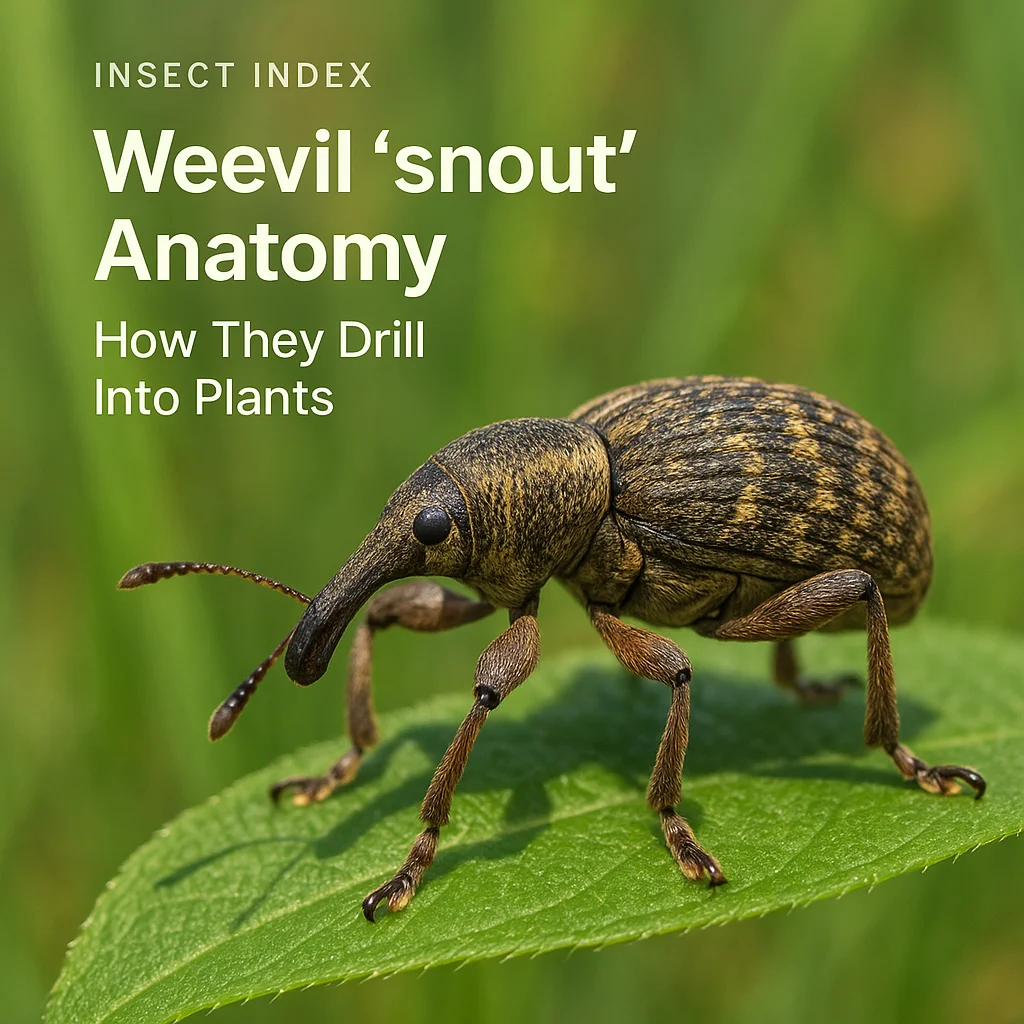
- Common Names: Weevils, Snout Beetles
- Scientific Name: Varies (Family: Curculionidae)
- Insect or Not: Yes, they are insects with six legs and an exoskeleton.
- Order / Family: Coleoptera / Curculionidae
- Typical Size Range (Adult): 1 to 40 millimeters
- Key Colors/Patterns: Usually brown, black, or gray, with some species having vibrant coloration or distinct markings.
- Activity: Mostly diurnal, but can vary by species
- Typical Habitats: Forests, grasslands, agricultural fields, and urban gardens.
- Where in the World: Globally distributed, more diverse in tropical regions.
- Seasonality: Varies; often more noticeable in warmer months or seasons.
🔍 Identification
Weevils are distinguishable by their unique body shape and the characteristic elongated snout or rostrum. Here's how to identify them:
- Body Shape and Silhouette: Compact and somewhat oval-shaped bodies with a pronounced snout.
- Antennae Type: Typically geniculate (elbowed), attached to the snout and often with a distinct club at the end.
- Wing Features: Hard forewings (elytra) protect the membranous hind wings, which may or may not be used for flight, depending on the species.
- Leg Traits and Movement Style: Typically slow-moving; legs are usually adapted to their habitat, some capable of jumping.
- Distinguishing Look-Alikes: May resemble some true bugs when viewed from a distance; however, the snout and elbowed antennae are key indicators.
Top ID Tips:
- Look for a prominent snout on the head.
- Note the elbowed antennae structure.
- Observe the color and pattern; many are plain, but some have distinctive markings.
- Notice the shape of the body: oval and compact.
- Check for the presence of hard wing covers.
- Typically sluggish movements compared to other beetles.
🧠 Basic Body Structure
As insects, weevils share the basic anatomical features common to their class. They have a head, thorax, and abdomen. The head supports the characteristic snout, which bears the mouthparts and antennae. The thorax holds three pairs of legs, vital for locomotion. Adults also bear wings that are protected by hard wing covers, crucial for survival. Weevils are invertebrate creatures, meaning they lack a spinal column but possess a robust exoskeleton that offers protection and structural support. They undergo periodic molting to grow, shedding their exoskeleton and forming a new one.
🌍 Habitat & Distribution
Weevils are highly adaptable and occupy a plethora of environments. They are predominantly found in:
Preferred Environments: Forests, grasslands, agricultural landscapes, and urban gardens. They often favor areas with abundant vegetation.
Microhabitats: They thrive under bark, within leaf litter, and among flowers, utilizing the natural cover for protection and feeding.
Geographic Range: Weevils are globally distributed, present on all continents except Antarctica. They are particularly diversified in tropical and subtropical regions.
As habitats change due to environmental factors and human influence, sightings may fluctuate, reflecting shifts in distribution, particularly concerning climate and agricultural practices.
📅 Seasonal Appearance & Activity
Weevils demonstrate varied visibility throughout the year, though they are often most active and visible during specific periods:
Time of Year: Sightings peak in warmer months, typically spring through fall in temperate regions, while tropical species may display less seasonal fluctuation.
Time of Day: Predominantly diurnal, they are more active during daylight hours.
Weather Influences: Mild to warm temperatures encourage activity; prolonged rainfall or extreme cold can decrease visibility as many may seek shelter.
Best Time to Spot It:
- Springtime in temperate climates.
- During blooming and growing seasons in gardens and fields.
- Mid-morning to late afternoon on sunny days.
- Early fall in agricultural landscapes as crops mature.
🥚 Reproduction & Egg-Laying
Weevil reproduction involves distinct courtship behaviors and egg-laying strategies. Mating can involve specific courtship displays and signals, although detailed behaviors vary widely by species and are not always well-documented.
Egg-Laying Sites: Eggs are often laid on or in host plants, embedding eggs within plant tissue, soil, or under bark to ensure protection and proximity to food sources for emerging larvae.
Egg counts and reproductive strategies can vary significantly between species, with some laying numerous eggs to increase survival odds, while others rely on protective placements or reduced numbers per site.
🌀 Metamorphosis & Life Cycle
Weevils undergo complete metamorphosis, transitioning through four distinct life stages: egg, larva, pupa, and adult. Each stage exhibits unique habits and adaptations:
Egg Stage: Eggs are small and often laid in clusters, camouflaged within foliage or other substrates. They vary in duration depending on species and environmental conditions.
Larval Stage: This stage is a crucial period of growth, with larvae typically boring into plant material or consuming decaying organic matter. Larval duration and diet vary, sometimes lasting weeks to months.
Pupal Stage: Larvae enter the pupal stage to undergo transformation into adults. The duration is species-dependent and can range from several days to weeks.
Adult Stage: Upon emergence, adults focus on reproduction and feeding. Lifespan can be several weeks to months, highly variable by species and environment.
🍽️ Diet & Feeding Behavior
Weevils are primarily herbivores, with a few species capable of scavenging or engaging in opportunistic feeding:
Diet: Their primary diet includes plant material, predominantly leaves, stems, seeds, and sometimes roots. Some species have adapted to specific plants, playing roles as significant agricultural pests or important contributors to plant control.
Feeding Tools: Weevils utilize chewing mouthparts located at the end of their elongated snout. This adaptation allows precise feeding and manipulation of plant material.
Ecological Role: As herbivores, they can influence plant community dynamics, act as pollinators in some cases, or affect crop yields significantly.
🦉 Predators & Defense
Weevils face numerous natural enemies, employing various strategies to defend themselves:
Natural Enemies: Birds, amphibians, reptiles, spiders, and wasps are common predators.
Defense Strategies: Camouflage is prevalent, with their color blending in with leaves or bark. Some may produce chemicals or exhibit behaviors such as feigning death to avoid detection.
Defense Highlights:
- Effective camouflaging patterns.
- Pretend death behavior to deter predators.
- Protective hard wing covers.
- Potential chemical deterrents by certain species.
👥 Social Behavior & Swarms
Weevils are primarily solitary but may congregate in large numbers under favorable conditions, though this is usually related to abundant food resources rather than genuine social cooperation. When swarming occurs, it is generally due to population explosions triggered by optimal conditions, often driven by availability of food and suitable habitats.
🧭 Senses & Communication
The sensory and communication adaptations of weevils are key to their survival, influencing feeding, reproduction, and defensive strategies:
Vision: Compound eyes provide a wide field of vision for detecting movement and potential threats.
Smell/Pheromones: Highly developed olfactory senses are crucial for locating mates and food sources.
Communication: Pheromones play a vital role in mating, often attracting potential partners over long distances.
Alongside chemical communication, physical cues via movement and vibration may also occur, although less obvious to human observation.
🌱 Role in the Ecosystem
Weevils contribute significantly to ecology, occupying various niches in ecosystems:
Pollination and Plant Control: While primarily herbivores, some weevils are involved in pollination, inadvertently transporting pollen as they feed.
Decomposition: They assist in the breakdown of organic matter, contributing to nutrient cycling within ecosystems.
Human/Agriculture Impact: As agricultural pests, some species can be detrimental to crops, requiring careful management to balance ecological benefits and economic impact.
📉 Population & Conservation Notes
Weevil populations are generally stable, with many species remaining common within their habitats:
Population Status: Local abundance varies, with shifts often reflecting changes in environmental conditions and food availability. While some species are threatened due to habitat loss and pesticide use, others maintain robust numbers.
How to Help (Low-Impact):
- Plant native vegetation to support local ecosystems.
- Avoid pesticide use where possible.
- Allow leaf litter and natural debris to provide habitat.
- Encourage diversified plantings to support ecological balance.
⚠️ Human Interaction & Safety
Weevils are generally harmless to humans and pose no significant threat. They do not bite or sting, though large populations can impact crops and stored foodstuffs. For any encounters with insect bites or allergic reactions, it is recommended to wash the area with soap and water and avoid scratching. Seek professional help if a severe reaction occurs.
It is important to respect wildlife and refrain from collecting or harming live specimens. Observation should be conducted responsibly, maintaining ecological integrity.
📌 Summary
- Weevils are identifiable by their characteristic snouts and oval-shaped bodies.
- They inhabit diverse environments worldwide, with high species diversity in tropical regions.
- Most active during warmer months, usually during the day.
- They undergo complete metamorphosis in their life cycle.
- Herbivorous diet, with some species known as crop pests.
- Natural defenses include camouflage and feigning death.
- Play critical roles in ecosystems as herbivores, decomposers, and sometimes pollinators.
- Generally common, but some species are affected by habitat loss and pesticides.
- Minimal risk to human health, emphasizing respectful observation practices.