🕷️ Elephant Beetle (Megasoma): heavy-bodied dynastines
🧾 Quick Facts
Elephant beetles, scientifically recognized under the genus Megasoma, are one of the heavy-bodied dynastine beetles found primarily in tropical regions of the Americas. These robust beetles are notable for their large size and striking appearance.
- Common names: Elephant beetle, Dynastine beetle
- Scientific name: Megasoma (genus)
- Insect or not: Yes, this is an insect (invertebrate)
- Order / family: Coleoptera / Scarabaeidae
- Typical size range: 7–12 cm in length (adults)
- Key colors/patterns: Black, yellowish-brown, often covered in fine hairs
- Activity: Nocturnal
- Typical habitats: Rainforests, tropical woodlands
- Where in the world it occurs: Central and South America
- Seasonality: Most active during the rainy season
🔍 Identification
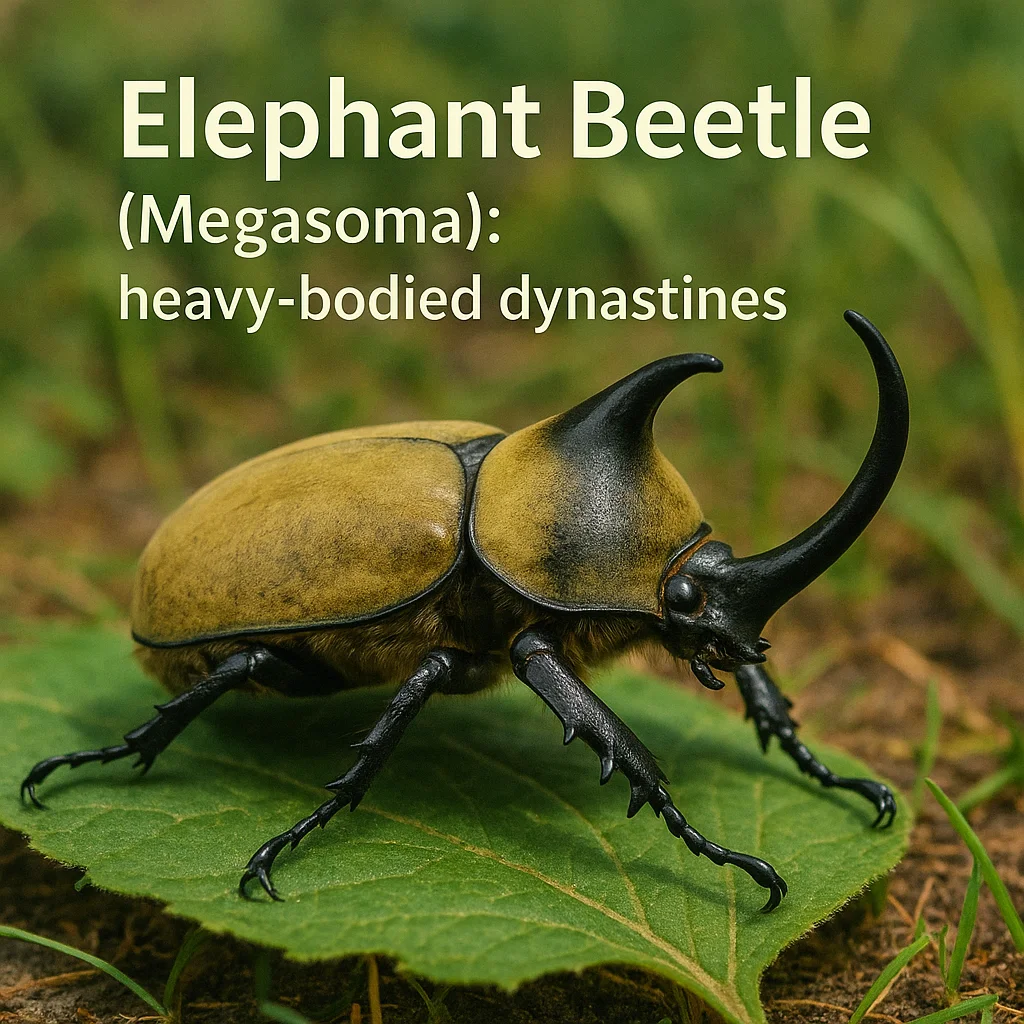
Recognizing an elephant beetle in the field involves observing several key physical characteristics. These beetles have a robust, voluminous body with a distinctive silhouette. Their heads host notable horns, especially in males, which they use during mating contests. The antennae are lamellate, common in scarab beetles, allowing them to sense their environment efficiently. Their wings are enclosed by hardened forewings called elytra, which provide protection and help them in flight. Elephant beetles move using their sturdy legs which are equipped with spiny protrusions for gripping surfaces. While they may be confused with other large scarabs, their size and distinctive horns set them apart.
- Large, robust body with a glossy appearance
- Notable horn-like projections on males' heads
- Hardened forewings with a scaly appearance
- Spiny legs aiding in strong grip and movement
- Lamellate antennae tips
- Yellow-brown coloration with black undertones
🧠 Basic Body Structure
Elephant beetles, like all insects, are characterized by a body divided into three main sections: the head, thorax, and abdomen. They possess six legs, attached to the thorax, which aid in movement and interaction with their environment. As typical of insects, elephant beetles have an exoskeleton that provides structural support and protection. They exhibit complete metamorphosis through distinct life stages, including egg, larva, pupa, and adult. These creatures are invertebrates, meaning they lack a vertebral column, a trait that influences their structural makeup and movement capabilities.
🌍 Habitat & Distribution
Elephant beetles thrive in humid, tropical environments where dense vegetation provides ample resources and shelter. They are typically found in rainforests and tropical woodlands across Central and South America, including countries such as Mexico, Brazil, and Venezuela. These beetles prefer microhabitats such as leaf litter, under logs, and tree bark where moisture retention is high. Changes in habitat, particularly due to deforestation and agricultural expansion, can influence their local abundance and visibility.
📅 Seasonal Appearance & Activity
Elephant beetles are most visible during the rainy seasons when humidity is high, facilitating their nocturnal activities. These beetles are strongly nocturnal and are most active during the warmest months, which vary regionally but typically align with the late spring and summer seasons. Weather conditions such as rain and increased temperatures encourage their emergence and activity.
- Spot them during the tropical rainy season
- Active on humid, warm nights
- Peak activity in late spring through summer
- Best visible after rainfall
🥚 Reproduction & Egg-Laying
Elephant beetle mating involves males competing for females using their horns in aggressive but non-lethal battles. Once a male has successfully won over a mate, the female will lay eggs in decaying wood, leaf litter, or soil rich in organic material. Egg-laying strategies vary, with females depositing small clusters of eggs in protected environments. The precise number of eggs and egg-laying strategies can vary by species and environmental conditions.
🌀 Metamorphosis & Life Cycle
Elephant beetles undergo complete metamorphosis, progressing through egg, larva, pupa, and adult stages. The larval stage occurs in nutrient-dense substrates such as decomposing wood, where they consume organic material. This stage can last for several months to a few years. Pupation takes place in the same type of substrate, where the larva undergoes transformation into an adult beetle. Adult beetles emerge primarily during the warm, rainy months, ready to mate and continue the cycle.
🍽️ Diet & Feeding Behavior
During the larval stage, elephant beetles feed on decomposing wood and other organic material, playing a crucial role in nutrient recycling in their ecosystems. Adult beetles primarily consume ripe fruits, sap, and sometimes nectar. They possess strong chewing mouthparts adapted for processing their fibrous, nutrient-rich diet. Elephant beetles act as primary decomposers and herbivores within their environments, and they are not typically known as pollinators.
🦉 Predators & Defense
Elephant beetles face predation from a variety of animals, including birds, reptiles, and mammals that can manage their large size. They have evolved several defense mechanisms to deter predators, such as their hard exoskeleton, cryptic coloration that helps them blend into their environment, and the physical cover provided by their elytra. When threatened, they may also employ intimidating displays to deter threats.
- Camouflage through coloration
- Thick exoskeleton for protection
- Horn displays to intimidate
- Quiet, nocturnal activity to avoid detection
👥 Social Behavior & Swarms
Elephant beetles are primarily solitary except during mating periods when competition arises among males. They do not form swarms or large group formations. Mating interactions are usually the only social behavior exhibited, with males often engaging in ritualistic combat to gain access to females. Outside of mating, these beetles spend their lives individually, foraging and locating suitable habitats for reproduction.
🧭 Senses & Communication
Elephant beetles possess well-developed senses that facilitate communication and environmental interaction. Their primary mode of communication involves chemical signals through pheromones, which are used during mating to attract partners. Their antennae act as crucial sensory organs, detecting chemical cues and environmental changes. Visual and tactile senses are integral, helping them navigate through dark, cluttered, and complex environments.
🌱 Role in the Ecosystem
Elephant beetles significantly contribute to their ecosystems as decomposers due to their diet of decaying plant material, facilitating nutrient cycling. By breaking down deadwood and plant debris, they play a pivotal role in soil health and forest ecosystem maintenance. Despite not being primary pollinators, they occasionally aid in distributing pollen. They are an essential part of the food web, sustaining a range of predators.
📉 Population & Conservation Notes
The population status of elephant beetles varies widely depending on the region and environmental factors. While some populations thrive in undisturbed tropical forests, others decline due to habitat loss driven by deforestation and agricultural activities. Conservation efforts focus on habitat preservation and mindful forestry practices. These beetles benefit from activities such as maintaining diverse plant cover and reducing pesticide usage.
- Promote forest conservation
- Encourage native vegetation
- Limit pesticide and chemical use
- Protect woodland areas
⚠️ Human Interaction & Safety
Elephant beetles are generally harmless to humans and do not bite or sting. Given their ecological role, they should be observed respectfully in their natural settings without interference. Collecting or disturbing wild specimens is discouraged to maintain ecological balance and support conservation efforts. In the rare event of a defensive situation, simple avoidance of interaction is recommended.
📌 Summary
- Large, robust beetles with notable horns
- Found in tropical environments, primarily nocturnal
- Active during the rainy season
- Undergo complete metamorphosis
- Decomposers feeding on organic material and fruits
- Face natural predators like birds and reptiles
- Contribute to nutrient cycling and ecosystem health
- Population influenced by habitat changes
- Harmless to humans, promoting respectful observation