🕷️ How rhino beetles fight: pushing contests
🧾 Quick Facts
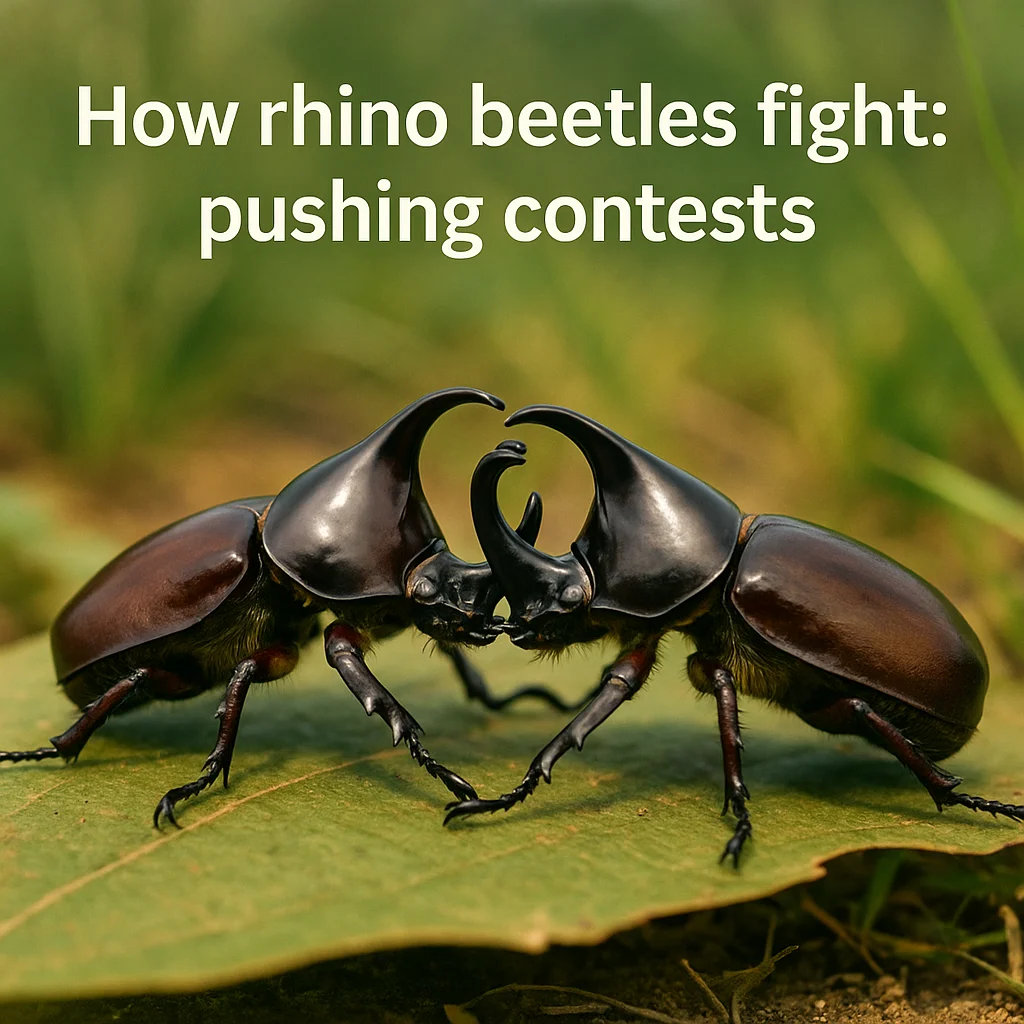
Rhino beetles, renowned for their formidable horns and dynamic fights, are fascinating creatures. In these intricate pushing contests, rhino beetles often exhibit unique evolutionary traits and behaviors to gain a competitive advantage.
- Common names: Rhino beetles, Hercules beetles, Atlas beetles
- Scientific name: Varies by species
- Insect or not: Yes, these are invertebrates
- Order / family: Coleoptera / Scarabaeidae
- Typical size range: 1.2 to 6.3 inches (3 to 16 centimeters)
- Key colors/patterns: Brown, black, green, often with shiny, hard exoskeletons
- Activity: Primarily nocturnal
- Typical habitats: Forests, gardens, tropical areas
- Where in the world it occurs: Asia, Africa, the Americas, and Australasia
- Seasonality: Most active during warm, rainy seasons
🔍 Identification
Rhino beetles are easily recognizable by their large size and prominent horns. Their bodies are sturdy, often with a glossy sheen. Male beetles exhibit more pronounced, multifunctional horns used during pushing contests over mates and territory.
Their antennae are club-shaped and segmented, capable of folding back. Most species possess well-developed wings concealed under robust elytra, although they may not always use them. Their legs are strong, adapted for gripping surfaces and wrestling during fights.
Rhino beetles can often be mistaken for other large beetles, like stag beetles, but their characteristic horns are a distinguishing feature. While stag beetles have sickle-shaped mandibles, rhino beetles sport horn-like protrusions on their heads.
- Large body, often shiny
- Distinctive horns, especially in males
- Segmented, club-shaped antennae
- Strong, grappling legs
- Fully visible wings inside hard elytra
- Frequently confused with stag beetles
🧠 Basic Body Structure
Rhino beetles feature the typical insect body structure, comprising a head, thorax, and abdomen. They have six legs and an exoskeleton, a hard outer shell that provides protection and support. This exoskeleton restricts growth, necessitating molting in juvenile stages.
As invertebrates, rhino beetles do not have a backbone. Their segmented bodies and jointed limbs facilitate mobility and complex behaviors. Despite possessing wings, not all rhino beetles are adept fliers, favoring ground activities.
🌍 Habitat & Distribution
Rhino beetles are primarily tropical, thriving in rainforests, woodlands, and suburban gardens. They occupy leaf litter, under bark, and soil near decomposing organic matter. Some species adapt to drier climates, illustrating diverse ecological preferences.
These beetles are widely distributed across continents, predominantly in regions with high humidity and dense vegetation. Changes in climate and deforestation can affect their habitats and population visibility, potentially challenging their survival.
📅 Seasonal Appearance & Activity
Rhino beetles become more visible during warm, humid seasons, coinciding with their breeding cycles and availability of resources. As nocturnal insects, they become more active after dusk, engaging in feeding and territorial contests.
- Warm, wet seasons are prime
- Most active at night
- Humidity increases sightings
- Rainfall encourages emergence
- Typically dormant during dry spells
🥚 Reproduction & Egg-Laying
During mating season, rhino beetles engage in combative contests, using their horns to wrestle rivals. Once victorious, a male will mate with a female, often in close proximity to food sources. Eggs are laid in decaying plant matter or moist soil, ensuring nutrients for larvae.
Egg laying numbers can fluctuate, but females typically produce between 30 to 100 eggs in their lifetime. Environmental factors significantly influence egg viability and larval success rates.
🌀 Metamorphosis & Life Cycle
Rhino beetles undergo complete metamorphosis, progressing through egg, larva, pupa, and adult stages.
The larvae, known as grubs, consume decomposing organic material, playing a vital role in nutrient cycling. They can spend several months in this stage, growing before pupation.
The pupal stage is a transformation period, where larvae develop adult features within a cocoon-like shelter in the soil. Duration varies but may last several weeks. Finally, adults emerge, ready to breed and restart the cycle.
🍽️ Diet & Feeding Behavior
As adults, rhino beetles primarily feed on fruit, nectar, and sap. Their mandibles allow them to chew, suited for their herbivorous lifestyle. Meanwhile, larvae decompose plant matter, benefiting ecosystems by recycling nutrients.
Adults contribute as pollinators, particularly when accessing floral resources. Despite a plant-based diet, some species might occasionally scavenge on decaying material.
🦉 Predators & Defense
Rhino beetles face predation from birds, reptiles, and small mammals. Their best defensive mechanisms include a tough exoskeleton and formidable horns, deterring many attackers.
Some species employ chemical defenses to repel predators, and their bulky armor further increases survival chances despite being slow movers.
- Tough exoskeleton armor
- Intimidating horn display
- Pigment-based camouflage
- Chewing mandibles as a deterrent
👥 Social Behavior & Swarms
Rhino beetles are generally solitary, especially aggressive males during mating struggles. These beetles do not form swarms but may aggregate in fruitful areas rich in resources.
Encounters are frequent during the breeding season, as individuals seek mates, sparking their iconic pushing contests. Females often delineate territories to organize egg-laying efficiently.
🧭 Senses & Communication
Rhino beetles rely heavily on their sense of smell, using antennae to detect food and pheromones. Vision is often moderate; however, nocturnal behavior decreases reliance on sight.
Communication involves visual signals through horn posturing and tactile feedback during contests. Pheromones play a crucial role in attracting mates and identifying individuals.
🌱 Role in the Ecosystem
Rhino beetles contribute significantly to ecological sustainability. As adults, they assist in pollination; meanwhile, larvae enhance soil quality by decomposing organic substances.
Their presence reflects ecosystem health, maintaining complexity and balance within tropical food webs. However, they can also impact local agriculture by damaging crops, necessitating balanced management strategies.
📉 Population & Conservation Notes
While generally abundant globally, rhino beetle populations face threats like deforestation and habitat degradation. Pesticide use further affects their numbers, highlighting the importance of conservation efforts.
- Protect existing habitats by avoiding deforestation
- Encourage native plant growth
- Limit pesticide use
- Support reforestation projects
⚠️ Human Interaction & Safety
Though intimidating, rhino beetles are harmless to humans, do not bite or sting, and pose no safety risk. When handling them, exercise gentle care due to their hard, fragile exoskeletons.
Encourage appreciation and observation from a respectful distance, avoiding capture or undue disturbance to wild populations.
📌 Summary
- Easy ID: Large size, prominent horns
- Habitat: Forests, gardens, tropical areas
- Seasonality: Most active during warm, rainy periods
- Life Cycle: Complete metamorphosis (egg, larva, pupa, adult)
- Diet: Fruits, sap, nectar
- Predators: Birds, reptiles, mammals
- Ecology: Pollinators and decomposers
- Human Notes: Harmless, respect and observe