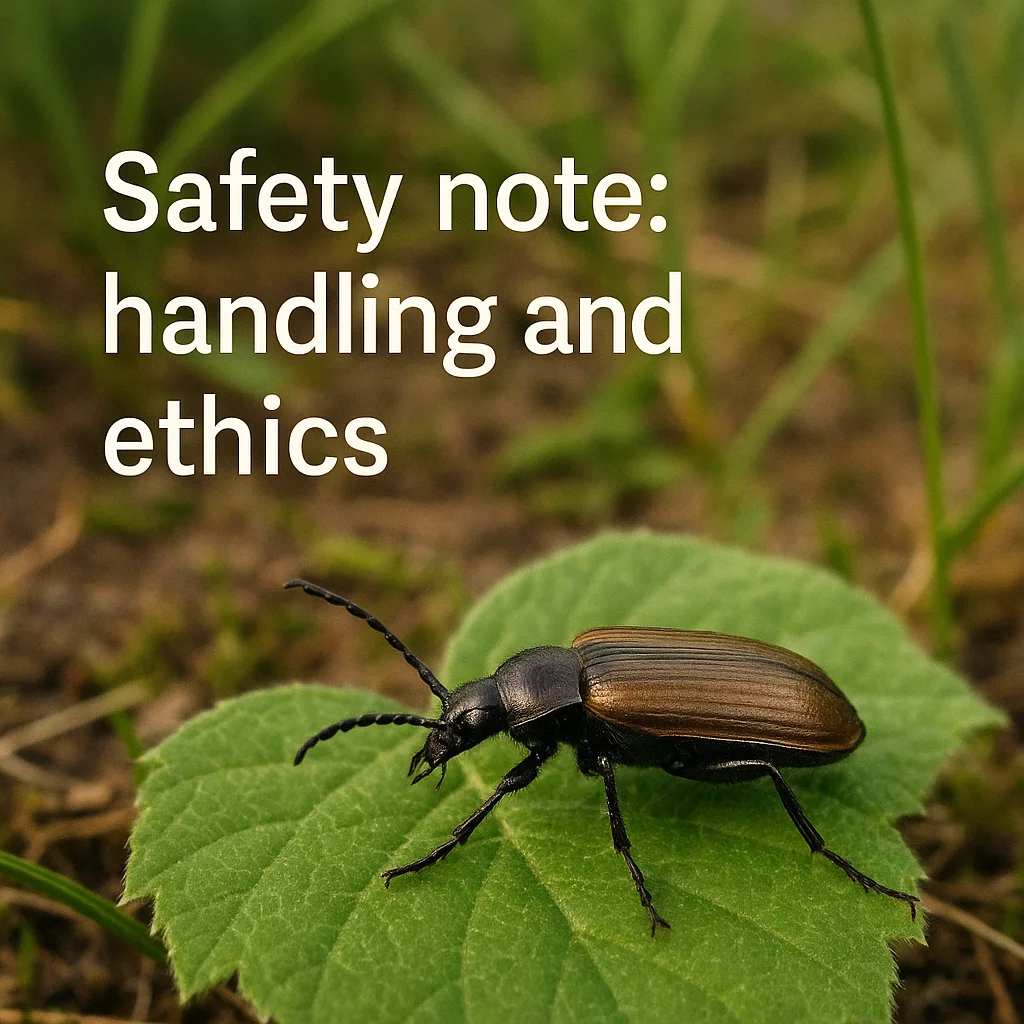
🕷️ Safety note: handling and ethics
🧾 Quick Facts
In the realm of insects and arthropods, understanding how to handle them safely and ethically is crucial for both personal safety and ecosystem health. While many people are fascinated by these organisms, it's important to treat them with respect and caution.
- Common names: Varies widely depending on species
- Scientific name: Varies
- Insect or not: Most are insects, but arthropods include non-insect invertebrates like spiders
- Order / family: Varies
- Typical size range (adult): From less than a millimeter to over 30 centimeters
- Key colors/patterns: Diverse; includes plain and vibrant colors, unique patterns
- Activity: Some are diurnal, while others are nocturnal
- Typical habitats: Forests, grasslands, deserts, wetlands, urban areas
- Where in the world it occurs: Found globally, adaptable to many environments
- Seasonality: Varies; some are highly seasonal, others are active year-round
🔍 Identification
Identifying arthropods involves observing various physical characteristics. While some have wings, others do not. The body shape and silhouette, such as elongated or round forms, are critical for identification. Antennae types may vary greatly and are often a key feature.
Wing features, when present, can range from transparent to vividly colored. Legs may be adapted for jumping, swimming, or digging, and movement style—such as crawling, flying, or creeping—is an identifying feature.
Common look-alikes might confuse novices; thus, it's important to consult reputable field guides or experts when uncertain.
- Observe body shape and size
- Take note of antennae length and form
- Check for wing presence and type
- Examine leg structure and movement behavior
- Be aware of mimicking species
- Pay attention to distinctive colors or patterns
- Use guidebooks for accurate ID
🧠 Basic Body Structure
Insects, as a group, have a specific body structure consisting of three parts: the head, thorax, and abdomen. They possess six legs, distinct from arachnids, which have eight. An exoskeleton encases and protects their body, which they must molt to grow.
Arthropods are invertebrates, meaning they lack a backbone, distinguishing them from vertebrate animals.
🌍 Habitat & Distribution
Arthropods inhabit a variety of environments, including forests, grasslands, deserts, wetlands, and even urban settings. Microhabitats, such as under bark, in leaf litter, or along water edges, provide essential niches.
Their geographic range is vast, spanning all continents and diverse climate zones. However, changes in habitat due to human activity can significantly affect their sightings and distribution.
📅 Seasonal Appearance & Activity
Many arthropods are seasonal, with increased visibility at certain times of the year, while others are perennial and can be spotted year-round. Time of day influences activity; some are diurnal, others nocturnal or crepuscular. Weather, particularly temperature and humidity, plays a crucial role in their behavior.
- Spring and early summer for temperate regions
- Year-round in tropical climates
- Nocturnal sightings are common in warm, humid conditions
- Daytime searches are effective on clear, sunny days
🥚 Reproduction & Egg-Laying
Reproductive behaviors can vary drastically. Some species participate in elaborate courtship rituals or establish territories. Eggs may be deposited on plants, in soil, within water, or in wood.
Egg counts and laying strategies differ based on species and environmental conditions, sometimes resulting in large clutches, while others optimize for fewer, protected eggs.
🌀 Metamorphosis & Life Cycle
Arthropods undergo either complete or incomplete metamorphosis. Complete metamorphosis involves progression from egg to larva to pupa to adult.
The larval stage is characterized by feeding and growth, while the pupal stage is a transformative phase. Adult stages focus on reproduction. Duration varies significantly across species, depending on environmental factors.
🍽️ Diet & Feeding Behavior
Dietary habits vary widely. Arthropods may be herbivorous, predatory, scavengers, or even parasitic. Feeding mechanisms include chewing or piercing-sucking mouthparts, tailored to their specific food sources.
Many play roles as pollinators or decomposers, crucial to ecological balance.
🦉 Predators & Defense
Arthropods face predation from birds, reptiles, amphibians, spiders, and mammals. Their defense strategies include camouflage, mimicry, and startle displays. Some can bite or sting in defense, though reactions vary widely by species.
- Camouflage to blend with environment
- Biting or stinging as deterrents
- Quick escape responses
- Mimicking more dangerous species
👥 Social Behavior & Swarms
Social behavior varies; some arthropods are solitary, while others live in colonies with complex social structures. Social species often communicate via pheromones, sound, or movement.
Swarms can occur due to food availability, mating behavior, or environmental triggers.
🧭 Senses & Communication
Arthropods communicate through a range of senses. Vision can be basic or highly developed, while smell and pheromone signaling facilitate mating and territory marking.
Other forms of communication include tactile interactions and sound production, like stridulation in crickets.
🌱 Role in the Ecosystem
The ecological roles of arthropods include pollination, decomposition, and serving as food sources for other animals. Some form mutualistic relationships with plants, while others may be parasitic.
Impacts on human activities can be beneficial, such as pollination, or negative, such as crop damage.
📉 Population & Conservation Notes
Population dynamics are affected by habitat changes, pesticides, and climate conditions. Local abundance can vary widely; however, data on many species remains limited.
Conservation efforts support maintaining habitat and ecological balance.
- Plant native species
- Avoid pesticide use
- Preserve natural habitats
- Support habitat restoration projects
⚠️ Human Interaction & Safety
Some arthropods can bite or sting, typically as a defense mechanism. To avoid adverse reactions, wash affected areas and seek professional advice if severe responses occur. Observations should be respectful, avoiding harm or collection of wild specimens.
📌 Summary
- Identification involves size, shape, and color
- Inhabit diverse global habitats
- Activity is seasonal and weather-dependent
- Mating and egg-laying behaviors vary widely
- Complete or incomplete metamorphosis
- Diet includes plants, other animals, or detritus
- Predators include birds, spiders, and reptiles
- Roles in pollination, decomposition, and food chains
- Population status varies, affected by human impact
- Handle respectfully, observing from a distance