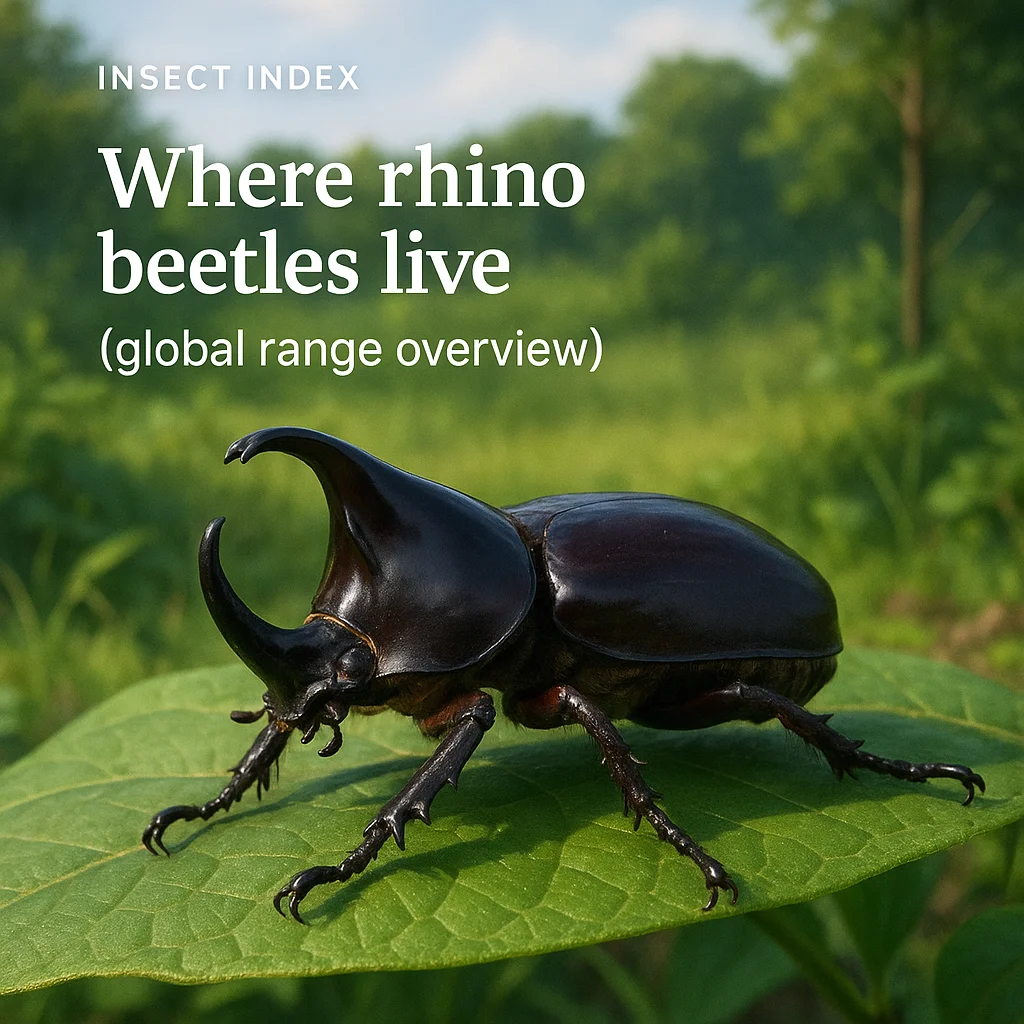
🕷️ Where rhino beetles live (global range overview)
Rhino beetles are fascinating creatures known for their impressive horns and thick exoskeletons. These beetles are part of a larger family group characterized by their robust bodies and remarkable ability to lift weights far greater than their own. This article provides an overview of where these beetles can be found globally and offers insights into their habitat preferences and unique biological traits.
🧾 Quick Facts
Rhino beetles are among the most intriguing insects due to their size and strength. Here are some quick facts about them:
- Common names: Rhino beetles, Hercules beetles, Unicorn beetles
- Scientific name: Varies (numerous species within the Dynastinae subfamily)
- Insect or not: Yes, they are invertebrate insects
- Order / family: Coleoptera / Scarabaeidae
- Typical size range: 1 to 7 centimeters (adults)
- Key colors/patterns: Black, brown, green, with some metallic finishes
- Activity: Mostly nocturnal
- Typical habitats: Forests, jungles, and wooded areas
- Where in the world it occurs: Predominantly tropical regions, but varies widely
- Seasonality: Adults are mostly visible during warm months
🔍 Identification
Rhino beetles are known for their horn-like projections, which are more pronounced in males. These beetles have a distinctive body shape that sets them apart from other beetles.
- Body shape: Heavy, robust body with a characteristic horn on the head for males
- Antennae: Short and clubbed, typical of scarab beetles
- Wing features: Elytra are hard, protecting the membranous flight wings beneath
- Leg traits: Strong legs equipped for digging and gripping
- Confusions: Often mistaken for other scarab beetles without horns
Top ID Tips:
- Look for the prominent horn, especially in males
- Check for the glossy, hard exoskeleton
- Note the size; they are larger than many beetle types
- Observe nocturnal activity
- Look in regions with abundant organic material
- Distinctive head and thorax horn in males
- Check habitats like dead wood or leaf litter
🧠 Basic Body Structure
Rhino beetles, like other insects, have a body divided into three main parts: head, thorax, and abdomen. They possess six strong legs, which aid in their mobility and digging ability.
The exoskeleton of a rhino beetle provides a protective, hard covering. They undergo molting as they grow, shedding the old exoskeleton for a new, larger one. They also have well-developed wings under their elytra, which are used for flight. As an invertebrate, they lack a backbone, which is typical of all insects.
🌍 Habitat & Distribution
Rhino beetles are typically found in tropical regions around the world. They thrive in forests, rainforests, and areas with plenty of decaying wood and organic material. Microhabitats often include spaces under bark and within rotting logs, which provide food and refuge.
Geographically, these beetles can be located across continents such as Africa, South America, Southeast Asia, and parts of North America. They generally prefer warm and humid climates, which influence their distribution patterns significantly. Changes such as deforestation can impact their natural habitats, affecting sightings and local population levels.
📅 Seasonal Appearance & Activity
Rhino beetles are most active during warmer months when conditions are suitable for their nocturnal activities. Their presence is more noticeable during the rainy season in tropical regions, as the increased humidity and warmth encourage their emergence.
- Best time to spot them: Late spring to early autumn
- Most active after sunset when seeking mates
- Peak observed after heavy rains
- Areas with abundant foliage are prime locations
🥚 Reproduction & Egg-Laying
Rhino beetles typically engage in dramatic mating rituals where males can be seen clashing horns, battling over access to females. Mating behaviors often include these territorial contests, which are more pronounced during peak breeding seasons.
Eggs are usually laid in soil, decaying wood, or under leaf litter, depending on the species. A typical female may lay several dozen eggs, and the specific location depends on availability of decomposed organic matter for nutrition.
🌀 Metamorphosis & Life Cycle
Rhino beetles undergo complete metamorphosis, a lifecycle that includes the stages of egg, larva, pupa, and adult.
After hatching from eggs, larvae (grubs) will burrow into the soil or wood, feeding on decaying plant matter for several months to years depending on the species. The pupal stage occurs within a hardened cocoon nearby. At this stage, the larvae undergo transformation into adult beetles. Once transformation is complete, they break out to the surface as beetles, capable of flying and seeking mates.
The ideal lifespan varies, but adults are relatively short-lived compared to the larval stage, surviving a few months at most.
🍽️ Diet & Feeding Behavior
Rhino beetles, primarily as larvae, feed on decaying plant material, making them important decomposers during this life stage. Adult beetles have chewing mouthparts and are often seen feeding on sap, fruit, and nectar.
Their role as detritivores during the larval phase is critical to nutrient cycling, breaking down organic materials and enriching the soil.
🦉 Predators & Defense
Rhino beetles have a number of natural predators, which include birds, small mammals, reptiles, and parasitic insects such as wasps. To protect themselves, they rely on several defense strategies.
- Strong exoskeleton acts as armor
- They can play dead to avoid detection
- Use of horns in combat against rivals
- Camouflaging colors to blend into their environment
- Adults may release sounds or stridulate when threatened
👥 Social Behavior & Swarms
Rhino beetles are generally solitary creatures except during the breeding season where combat between males is common. They do not form swarms or migrations, and their interactions with conspecifics are limited to mating or competition for resources.
When it comes to encounters, rhino beetles defend territories around chosen mating sites to impress females, highlighting their solitary nature outside breeding periods.
🧭 Senses & Communication
Rhino beetles rely heavily on their senses for communication and survival. Their compound eyes provide them with a broad field of visual detection crucial for navigation and locating resources. Smell is another vital sense, especially in finding mates, as females release pheromones to attract males.
Communication between individuals often combines visual displays and pheromone signals, particularly in mating contexts. These subtle yet effective communication forms play a major role in their daily existence.
🌱 Role in the Ecosystem
As decomposers, rhino beetles contribute significantly to breaking down organic matter, enhancing soil fertility, and promoting nutrient recycling. This process supports plant growth and maintains healthy ecosystems. Their existence creates a food chain link, providing nourishment to an array of predators.
Additionally, some adult beetles aid in the pollination of the plants they feed on, albeit less commonly than other floral visitors.
📉 Population & Conservation Notes
Many rhino beetle species are common within their preferred habitats. However, their populations are susceptible to changes from habitat destruction, pesticides, and climate alterations. Some specific species might be under threat due to these factors.
- Preserve native flora to maintain their natural habitat
- Avoid chemical pesticides that harm their life stages
- Promote awareness of their ecological roles
- Encourage leaving dead wood undisturbed
⚠️ Human Interaction & Safety
Rhino beetles are generally harmless to humans and do not bite or sting. Their frightening appearance belies their gentle nature. However, if disturbed, it's best to avoid handling them excessively to prevent stress or harm to the beetle.
If observing these creatures, maintain a respectful distance and avoid collecting them from the wild without proper permits, ensuring their continued presence in natural habitats.
📌 Summary
- Identifiable by their horn-like projections and robust body
- Thrives in tropical rainforests and similar habitats
- Nocturnal, most visible in warmer seasons
- Undergoes complete metamorphosis across several life stages
- Plays a decomposer role, feeding on decaying matter
- Protected by a sturdy exoskeleton against predators
- Limited direct interaction with humans, safe to observe
- Vital for nutrient cycling and contributes to ecosystem diversity