🕷️ Best time to spot stag beetles (seasonal tips)
🧾 Quick Facts
The stag beetle is one of nature's fascinating insects, celebrated for its striking appearance and unique behaviors. Here's a brief overview of what makes the stag beetle so intriguing:
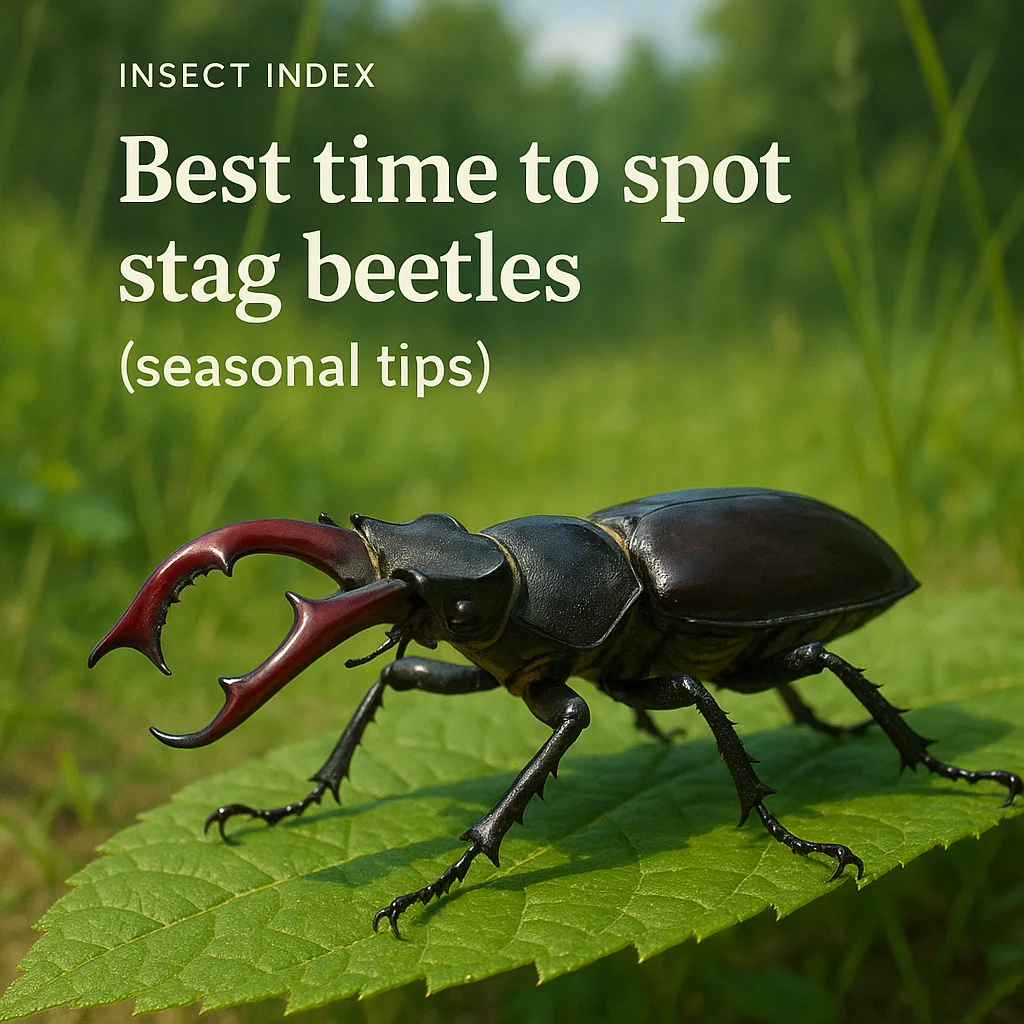
- Common names: Stag Beetle
- Scientific name: Varies by species (e.g., Lucanus cervus)
- Insect or not: Yes, it is an insect and an invertebrate
- Order/Family: Coleoptera / Lucanidae
- Typical size range (adult): 3 to 7.5 cm (1.2 to 3 inches)
- Key colors/patterns: Shiny black or brown with large mandibles
- Activity: Primarily nocturnal, especially males in search of mates
- Typical habitats: Woodlands, gardens, parks, hedges
- Where in the world it occurs: Europe, Asia, and North America
- Seasonality: Most visible in late spring to early summer
🔍 Identification
The stag beetle is easily recognizable by its distinct features which set it apart from other beetles.
Their body shape is robust, and they possess prominent mandibles resembling deer antlers (hence the name). Typical characteristics include:
- Body shape and silhouette: Broad and flat with elongated mandibles
- Antennae type: Elbowed with a club-like end
- Wing features: Hard, protective elytra covering flight wings
- Leg traits and movement style: Strong legs adapted for crawling
- Distinguishing look-alikes: Could be confused with rhinoceros beetles or some large water beetles
- Top ID Tips:
- Look for large mandibles on males
- Shiny, dark exoskeleton
- Nocturnal flight activity in warmer months
- Found near decaying wood
- Large size compared to many other beetles
- Distinct stag-like appearance of the head
- Presence in areas with old trees and stumps
- Often sighted grounded due to weight
- Full-body, whole specimen visible in frame in photos
🧠 Basic Body Structure
The stag beetle, like all insects, has a body segmented into three main parts: the head, thorax, and abdomen. They have six legs and a set of wings, including the protective elytra that cover the hind wings used for flying. As they grow, stag beetles undergo molting processes, shedding their exoskeleton to accommodate growth.
The stag beetle is an invertebrate, meaning it lacks a vertebral column, and relies on an exoskeleton for structural support and protection.
🌍 Habitat & Distribution
Stag beetles have a preference for deciduous woodlands, parks, and gardens. They are often found in areas with abundant dead wood, which serves as a food source for larvae. This can include large tree stumps, fallen branches, or rotting logs. In urban areas, old hedgerows and garden compost heaps can also be suitable habitats.
Geographically, stag beetles are primarily found in parts of Europe, especially in Southern England, as well as in some Asian regions. They are less commonly found in North American forests.
Their distribution is typically influenced by the presence of decaying wood and suitable microhabitats. Urbanization and deforestation can adversely affect their habitats, reducing local populations where wood is scarce.
📅 Seasonal Appearance & Activity
The stag beetle is most commonly seen during the warmer months, with adults emerging in late spring and early summer. This period aligns with their mating season, which is when they are most active and visible.
They are primarily nocturnal, with peak activity often occurring just after dusk. Weather conditions like warm temperatures and mild evenings are ideal for flying and mating.
- Best Time to Spot It:
- Late spring to early summer
- Evenings just after sunset
- In warm, humid weather
- Avoid unusually cool or wet weather conditions
🥚 Reproduction & Egg-Laying
During the mating season, male stag beetles use their impressive mandibles to fight rivals for access to females. Once a male has successfully encountered a female, mating occurs after an intricate courtship display. After mating, females lay eggs in decaying wood or around tree stumps, ensuring that the larvae have an immediate food source.
Each female can lay between 12 to 24 eggs, typically in a single clutch. The variability in egg-laying is influenced by environmental conditions and food availability.
🌀 Metamorphosis & Life Cycle
Stag beetles undergo complete metamorphosis, progressing through four distinct stages: egg, larva, pupa, and adult. Eggs hatch into larvae after several weeks. The larval stage is primarily concerned with feeding on decaying wood, which can last up to six years depending on climate and nutrition availability.
After reaching the appropriate size, the larva pupates and remains in the pupal stage for several months over the winter. The adult beetle emerges in late spring or early summer. It spends its short adult life focused on reproduction, living only a few months.
🍽️ Diet & Feeding Behavior
Throughout their life stages, stag beetles experience a shift in diet. As larvae, they are detritivores, feeding primarily on decaying wood and organic matter. This behavior plays a role in nutrient recycling within their ecosystems.
Adult stag beetles do not eat extensively; they rely on stored energy from their larval stage. They may feed occasionally on tree sap and juices from decaying fruit, using their chewing mouthparts.
🦉 Predators & Defense
Stag beetles face predation from birds, mammals, and reptiles. Birds such as crows and woodpeckers are adept at capturing them, especially during flight. Some mammals and larger spiders may also prey on larvae. To avoid predation, stag beetles have developed several defenses.
- Defense Highlights:
- Camouflage coloration blending into surroundings
- Hard exoskeleton for physical protection
- Use of powerful mandibles for defense
- Flight at night to avoid diurnal predators
👥 Social Behavior & Swarms
Stag beetles are generally solitary insects. However, during the breeding season, males congregate around likely breeding sites to vie for the attention of females. Males are highly competitive, often engaging in physical confrontations with other males.
They do not form swarms, but local groups can appear larger when many individuals are attracted to food sources like sap flows or fallen fruit.
🧭 Senses & Communication
Stag beetles rely on a mix of senses for communication and navigation, mainly focusing on vision and chemical signals. Their compound eyes enable them to detect movement and light changes, which are especially useful at night.
Pheromones play a crucial role in communication between males and females during breeding season, assisting in getting a mate through scent trails.
🌱 Role in the Ecosystem
As wood decomposers, stag beetles contribute significantly to the breakdown of organic matter, recycling nutrients back into the soil. This process is vital for forest health, promoting decomposition, and soil formation.
They are also an integral part of the food web, serving as prey for various animals. Their presence can indicate a healthy, balanced ecosystem, and their disappearance may signal habitat degradation.
📉 Population & Conservation Notes
The population status of stag beetles varies by region. In some areas, they are relatively common, while in others, they are declining due to habitat loss, pesticide use, and urban development. Conservation efforts are crucial for maintaining their populations.
- How to Help (Low-Impact):
- Promote conservation of old trees and woodlands
- Create beetle-friendly gardens with wood piles
- Avoid using pesticides and chemical treatments
- Support environmental organizations focused on habitat restoration
⚠️ Human Interaction & Safety
Stag beetles are generally harmless to humans and do not pose any direct risk. They may use their mandibles in defense if handled, potentially delivering a mild pinch, but they do not bite aggressively or sting. Simple measures include washing the area with soap and water if pinched and avoiding disturbing them.
Observing stag beetles should be done with respect and care, minimizing habitat disturbance and adhering to the principle of no collection in the wild.
📌 Summary
- Stag beetles are distinctively identifiable by their large mandibles and glossy exoskeleton.
- They inhabit woodlands, gardens, and areas rich in decaying organic matter.
- Most visible during late spring to early summer.
- Undergo complete metamorphosis over several years.
- Larvae feed on decaying wood, adults are less active feeders.
- Predators include birds and mammals; they employ camouflage and strong mandibles for defense.
- Critical for ecosystem functioning as decomposers and prey.
- Declining in some areas; habitat conservation is key.
- Harmless to humans; require careful and respectful observation.