🕷️ Common stag beetle myths (debunked)
🧾 Quick Facts
The stag beetle, known for its distinct appearance and prominent mandibles, has given rise to various myths and misconceptions. Here's a look at what these beetles are really like:
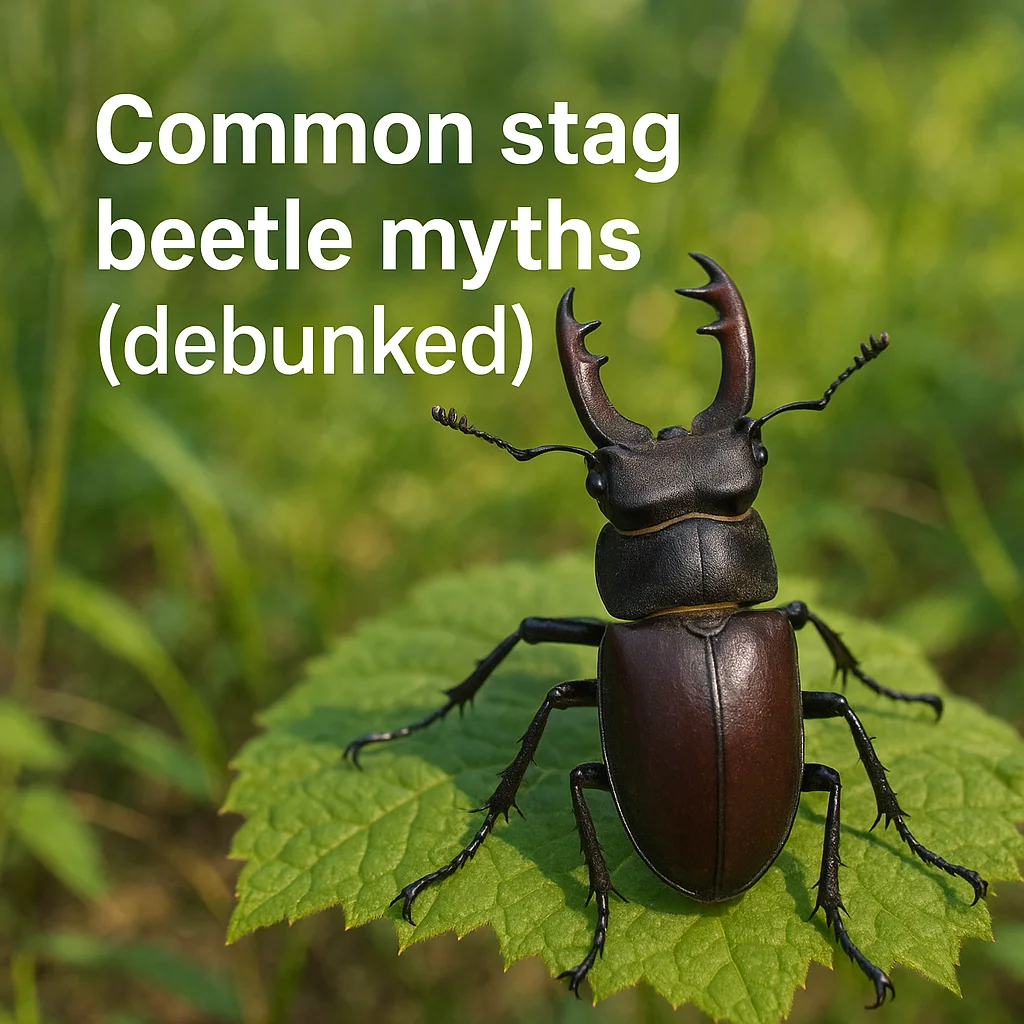
- Common names: Stag beetle, lucanid
- Scientific name: Varies (Family: Lucanidae)
- Insect: Yes, it's an invertebrate.
- Order/Family: Coleoptera / Lucanidae
- Typical size range: 20 to 90 mm (adults)
- Key colors/patterns: Dark brown to black; some species with reddish hues
- Activity: Mostly nocturnal
- Typical habitats: Woodlands, forests, gardens
- Where in the world it occurs: Europe, North America, parts of Asia
- Seasonality: Most visible from late spring to early summer
🔍 Identification
Identifying a stag beetle is often straightforward due to its unique features. The male beetle's sizable mandibles are the most distinguishing characteristic, resembling the antlers of a stag.
- Body shape and silhouette: Sturdy, elongated bodies with prominent mandibles in males
- Antennae type: Clubbed antennae with distinctly segmented ends
- Wing features: Hard elytra covering delicate wings beneath
- Leg traits and movement style: Six legs with clawed tarsi, providing a strong grip on bark
- Distinguishing look-alikes and common confusion: Can be confused with rhinoceros beetles, but those lack the large mandibles of stag beetles
- Top ID Tips:
- Look for elongate bodies
- Check for large mandibles in males
- Note the clubbed antennae
- Dark brown to black coloration is common
- Commonly found on tree trunks
- Nocturnal activity can aid in identification
🧠 Basic Body Structure
Stag beetles are classic representatives of insects, having a distinct body structure composed of three parts: the head, thorax, and abdomen. They possess six legs and are covered by an exoskeleton that provides protection and supports body shape. These beetles are invertebrates, meaning they lack a backbone. As insects, they undergo different life stages, including shedding their exoskeleton through molting.
🌍 Habitat & Distribution
Stag beetles prefer deciduous woodlands rich in old trees and rotting wood, providing an ideal habitat for their larvae. They can also be found in urban gardens with sufficient wood debris. These beetles are primarily distributed across Europe, North America, and parts of Asia. Habitat loss and deforestation can significantly impact their populations by reducing suitable breeding sites.
📅 Seasonal Appearance & Activity
Adult stag beetles are most visible during the warmer months, particularly from late spring to early summer. They are nocturnal and become active at dusk, attracted to lights. Temperature and humidity play crucial roles in their activity levels.
- Best Time to Spot It:
- Late spring evenings
- Warm, humid nights
- Near outdoor lights
- Around decaying wood sources
🥚 Reproduction & Egg-Laying
Mating behavior in stag beetles involves males using their large mandibles to compete for females. Females lay eggs in decaying wood or nearby soil, which provides a nutrient-rich environment for emerging larvae. The number of eggs laid varies, potentially ranging from a few dozen to over a hundred, depending on environmental conditions and species.
🌀 Metamorphosis & Life Cycle
Stag beetles undergo complete metamorphosis, progressing through egg, larva, pupa, and adult stages. The larvae are voracious feeders on decaying wood, helping in nutrient recycling, and can remain in this stage for up to five years. As pupae, they transform into adults, a stage that lasts a few months during summer. Adult stag beetles have a short lifespan, focusing largely on reproduction.
🍽️ Diet & Feeding Behavior
During the larval stage, stag beetles are primarily decomposers, consuming decayed wood and aiding in nutrient cycling. Adult stag beetles do not feed extensively but may consume tree sap or juice from ripe fruits using their mouthparts, classified as chewing.
🦉 Predators & Defense
Stag beetles face predation from birds, reptiles, small mammals, and even spiders. Their main defense strategies include using their mandibles for protection, armored exoskeletons, and hiding in wood debris. The males' large mandibles, while not suitable for biting, can be intimidating to potential threats.
- Defense Highlights:
- Armored body
- Hiding in wood debris
- Intimidating mandibles
- Camouflage amid leaves and bark
👥 Social Behavior & Swarms
Stag beetles are largely solitary, engaging mainly during mating encounters. They do not form colonies or swarms. Males may be territorial, sometimes clashing with rivals over mates.
🧭 Senses & Communication
Stag beetles primarily rely on pheromones for communication, using scent trails to locate mates. Their vision is adapted for low-light conditions, which aids nocturnal activity. Although not known for sounds, vibrations may play a role in detecting environmental cues.
🌱 Role in the Ecosystem
The ecological role of stag beetles is significant, particularly as decomposers. Larvae contribute to the decomposition of dead wood, enriching soil health. By breaking down organic matter, they indirectly support plant growth. In turn, stag beetles serve as food for several forest predators, maintaining balance within food webs.
📉 Population & Conservation Notes
Stag beetle populations vary considerably across their range. They are often common in suitable habitats but face threats from urbanization, deforestation, and pesticides. Conservation efforts focus on preserving natural woodlands and promoting urban garden habitats to support stag beetles.
- How to Help (Low-Impact):
- Create wood piles in gardens
- Avoid using pesticides
- Leave tree stumps and fallen branches in place
- Support tree planting initiatives
⚠️ Human Interaction & Safety
Stag beetles are harmless to humans. While males have large mandibles, they are not used for biting people. It's important to observe stag beetles respectfully, appreciating their role in nature without collecting them from the wild.
If interaction occurs, washing hands and avoiding handling them directly is advised. Seek professional advice if any unusual allergic reaction occurs due to handling, which is improbable but possible.
📌 Summary
- Identifiable by prominent mandibles and dark color
- Common in woodlands and gardens
- Most visible in late spring and early summer
- Complete metamorphosis with significant larval stage
- Larvae feed on decayed wood, adults sip sap
- Preyed on by birds, reptiles, and mammals
- Essential decomposers in ecosystems
- Populations affected by habitat changes