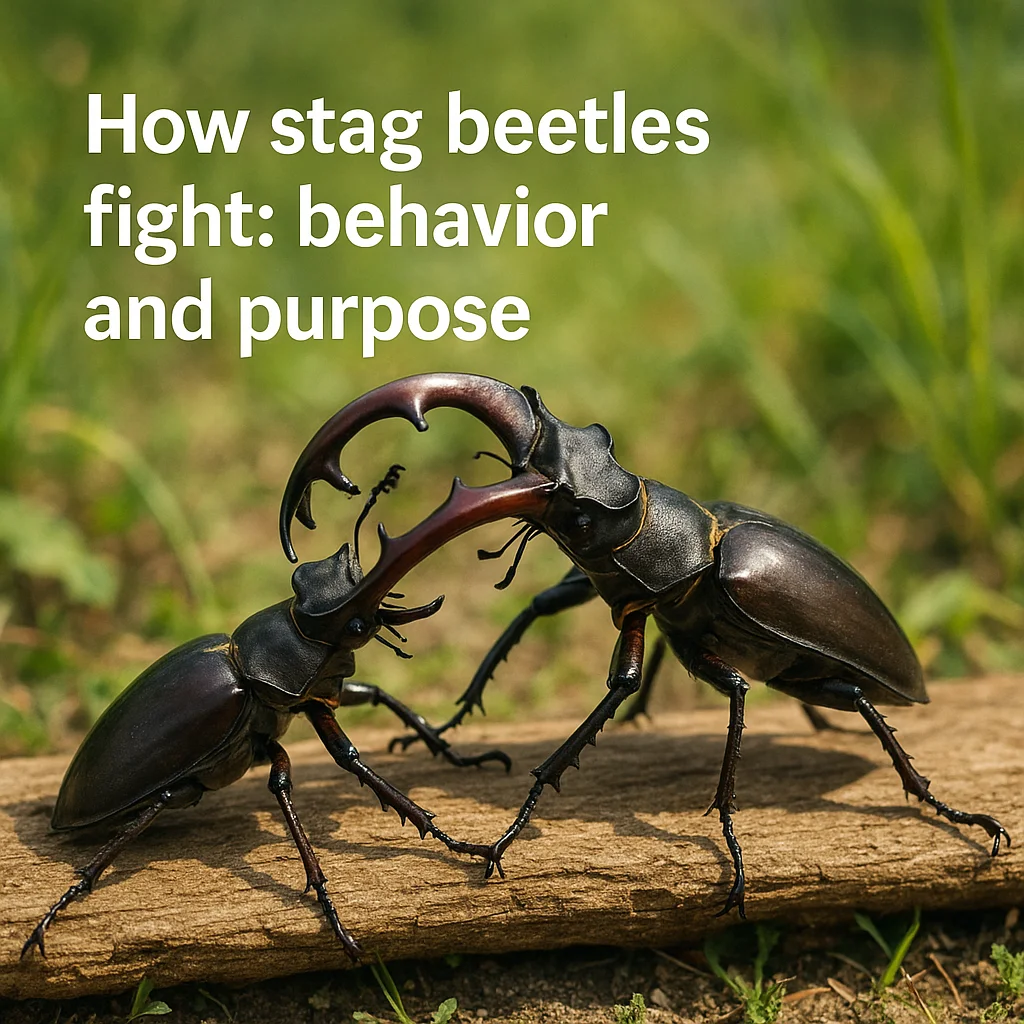
🕷️ How stag beetles fight: behavior and purpose
🧾 Quick Facts
The stag beetle is a fascinating insect known for its distinctive appearance and intriguing behaviors. This species is renowned for the ritualistic battles that male stag beetles engage in, primarily to establish dominance and in the pursuit of mates.
- Common names: Stag beetle
- Scientific name: Varies; commonly in the genus Lucanus
- Insect or not: Yes, it is an insect and an invertebrate
- Order / family: Coleoptera / Lucanidae
- Typical size range: 2 to 4 inches (5 to 10 cm)
- Key colors/patterns: Black, dark brown, sometimes reddish-brown
- Activity: Primarily nocturnal
- Typical habitats: Forests, woodlands, gardens
- Where in the world it occurs: Europe, Asia, parts of North America
- Seasonality: Seen mostly in late spring to midsummer
🔍 Identification
Stag beetles are easily recognized by their large mandibles, which resemble antlers—hence the name. These beetles have a robust body with a glossy appearance.
- Body shape and silhouette: Long-bodied with large mandibles
- Antennae type: Clubbed and elbowed
- Wing features: Hardened forewings (elytra) with membranous hindwings beneath
- Leg traits and movement style: Strong, adapted for climbing and gripping
- Distinguishing look-alikes and common confusion: Often mistaken for other large beetles, but mandibles are a key distinction
- Top ID Tips
- Look for large mandibles on male beetles
- Check for glossy black or brown color
- Clubbed antennae identify it as a beetle
- Elongated body with a hard shell
- Active mostly at dusk or during the night
- Found near decomposing wood or stumps
🧠 Basic Body Structure
As true insects, stag beetles possess the quintessential head, thorax, and abdomen structure, along with six legs. Their bodies are fortified with an exoskeleton, providing protection and support.
Stag beetles undergo molting to grow, shedding their exoskeleton periodically. They also have wings; the forewings are shield-like, concealing the more delicate hindwings used for flying. These beetles are invertebrates, meaning they lack a vertebral column, a common trait among insects.
🌍 Habitat & Distribution
Stag beetles favor environments rich in decaying wood, such as mature deciduous forests, woodlands, and occasionally urban gardens. They often seek out tree stumps and dead wood where larvae can develop.
These beetles are found across Europe, Asia, and some regions of North America, thriving in temperate climates. Habitat changes, however, can adversely affect their population, making sightings less frequent in deforested areas.
📅 Seasonal Appearance & Activity
Adult stag beetles are most visible during the warmer periods, with peak activity from late spring to the middle of summer. They tend to be active in twilight hours but may be observed during humid daytime periods, especially after rain.
- Best Time to Spot It
- Late spring evenings
- After warm rainy days
- Midsummer nights
- In humid conditions
🥚 Reproduction & Egg-Laying
Males use their large mandibles to compete for females, a ritual that involves clashing and grappling. Once a male has succeeded, fertilization occurs shortly afterward.
Female stag beetles lay their eggs in the soil near decomposing wood, providing essential nutrients for the larvae. The number of eggs laid can vary widely depending on species and environmental conditions, but typically ranges from 20 to 70 eggs.
🌀 Metamorphosis & Life Cycle
Stag beetles undergo complete metamorphosis, progressing through the stages of egg, larva, pupa, and adult. The larvae primarily feed on decaying wood, which helps break down organic matter in the ecosystem.
The larval stage lasts for several years, during which they consume wood and gain the nutrients needed for pupation. After pupating within the soil, adults emerge to compete for mating opportunities and continue the cycle.
🍽️ Diet & Feeding Behavior
Adult stag beetles typically consume nectar, tree sap, and occasionally fruits. Their larvae have a diet solely consisting of decaying wood, assisting in the decomposition process.
With chewing mouthparts, adult beetles are well-equipped for consuming solid substances. Although not direct predators, their role in decomposing organic material makes them vital ecological participants.
🦉 Predators & Defense
Common predators of stag beetles include birds, bats, and some mammalian species. They employ a variety of defense mechanisms, such as strong exoskeletons for protection and the ability to conceal themselves within tree bark and soil layers.
- Defense Highlights
- Thick exoskeleton for protection
- Camouflage among leaves and wood
- Noiseless flight reduces detection
- Utilize hiding spaces effectively
👥 Social Behavior & Swarms
Stag beetles are primarily solitary creatures, with their primary interactions occurring during mating periods when males compete for females. These beetles do not form swarms or colonies, nor do they migrate en masse.
Males occasionally congregate in areas with abundant food resources, leading to minor aggregations where dominance is established through combat.
🧭 Senses & Communication
Stag beetles rely on a combination of senses to navigate their environment. Their antennae play a crucial role in detecting pheromones, crucial for locating mates. Vision is used to navigate and identify potential threats, although their sight is not as developed as their olfactory senses.
Communication is predominantly performed through chemical signals (pheromones), especially during mating and when establishing territories.
🌱 Role in the Ecosystem
Stag beetles contribute significantly to the ecosystem by breaking down decaying wood, cycling nutrients, and supporting a healthy forest floor. As prey, they provide a food source for various animals, indicating their importance in local food webs.
Their larval decomposition activity aids in soil aeration and fertility, emphasizing their ecological benefit in their natural habitats.
📉 Population & Conservation Notes
Stag beetle populations are considered stable in regions with adequate forest coverage, yet they are experiencing decline due to habitat loss, notably deforestation and urban sprawl. In some areas, they are considered a priority for conservation efforts.
- How to Help (Low-Impact)
- Plant native trees and shrubs
- Avoid pesticide use in gardens
- Leave stumps and dead wood in situ
- Promote conservation awareness
⚠️ Human Interaction & Safety
Stag beetles are not harmful to humans. Their mandibles, though large, are used for defensive displays rather than biting. Handling should be gentle and respectful to avoid stress and injury to the beetle.
If a bite does occur, it is typically harmless, and basic care involves cleaning the area and monitoring for any adverse reactions, seeking medical advice if necessary.
📌 Summary
- Large mandibles and glossy body are key identifying features.
- Inhabits forests, woodlands, and gardens with decaying wood.
- Most active in warm months, especially at night.
- Undergoes complete metamorphosis with long larval wood-eating stage.
- Adults feed on nectar and tree sap; larvae decompose wood.
- Preyed upon by birds and bats; robust exoskeleton is a defense.
- Plays a crucial role in nutrient cycling and soil health.
- Conservation efforts focus on habitat preservation and awareness.