🕷️ Stag beetle conservation: deadwood matters
🧾 Quick Facts
The stag beetle is a fascinating group of beetles known for its striking mandibles and unique lifecycle, species of which can be found across various regions worldwide. Here's a quick look at this remarkable insect:
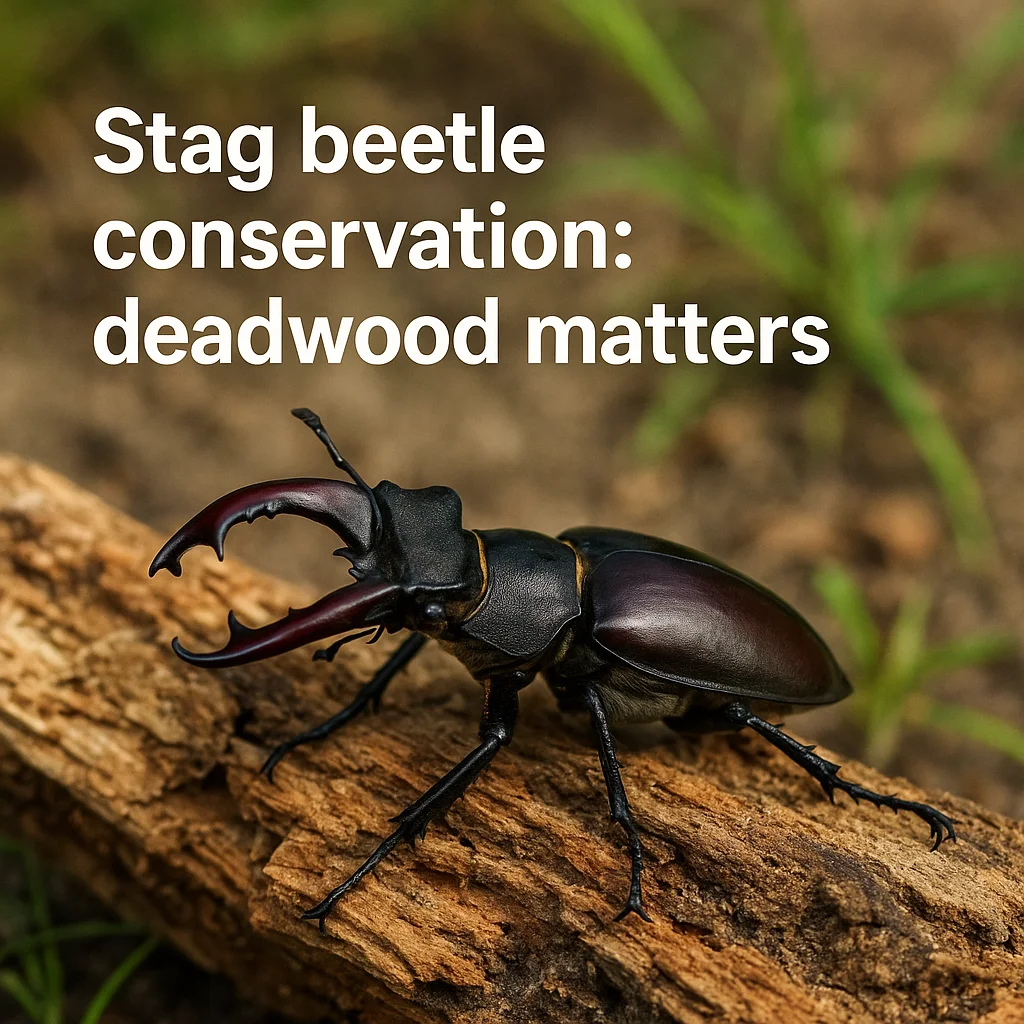
- Common names: Stag beetle
- Scientific name: Varies (often Lucanus cervus in Europe)
- Insect or not: Insect, a type of invertebrate
- Order / family: Coleoptera / Lucanidae
- Typical size range: 2.5 to 8 cm (adults)
- Key colors/patterns: Generally dark brown to black with shiny bodies and large mandibles in males
- Activity: Mainly nocturnal
- Typical habitats: Woodlands, forests, and urban gardens
- Where in the world it occurs: Europe, particularly central and southern regions, some species in Asia and North America
- Seasonality: Adults are most visible in late spring to summer
🔍 Identification
Identifying stag beetles in the field takes keen observation of their distinctive features. Mature males are known for their large mandibles that resemble stag antlers, while females have smaller mandibles. Their bodies are robust and elongated.
- Body shape and silhouette: Robust, elongated; males have prominent jaws
- Antennae type: Elbowed with a small 'club' at the end
- Wing features: Elytra (hardened forewings) protect soft hindwings
- Leg traits and movement style: Strong, adapted for gripping wood
- Distinguishing look-alikes: Similar to other dark, large beetles but with distinct mandibles
🧠 Basic Body Structure
The stag beetle is an insect, which means it has three main body parts: the head, thorax, and abdomen. It possesses six legs, true to its insect classification. The beetle's hard exterior, known as an exoskeleton, provides both protection and structural support and must be shed and renewed as the beetle grows, in a process known as molting. Most stag beetles have wings tucked under their elytra, although they are seldom used.
Being an invertebrate, the stag beetle lacks a backbone, distinguishing it from vertebrates like mammals and birds.
🌍 Habitat & Distribution
Stag beetles prefer wooded environments where old or decaying timber is abundant. They are commonly found in forests as well as urban gardens that offer suitable deadwood. They thrive in temperate climates found in Europe, with notable populations in the United Kingdom, France, and the forests of Germany. Some species can also be encountered in Asia and North America.
Changes in land use, particularly the reduction in ancient woodlands and traditional orchard management, have affected stag beetle populations by reducing habitat availability.
📅 Seasonal Appearance & Activity
Stag beetles are primarily observed during late spring through the summer months, with most activity occurring during warm, humid evenings. Their nocturnal nature means they are often seen around streetlights or other light sources in gardens and forests.
- Best Time to Spot It:
- Late spring
- Summer evenings
- After rainy days with high humidity
- Near dusk to late night
🥚 Reproduction & Egg-Laying
The stag beetle's courtship is a dramatic display of dominance among males, who use their large mandibles to spar with one another for mating rights with females. The winning male mates with the female and soon after, the female lays eggs in decaying wood or rich soil composed of wood fragments.
The number of eggs laid can vary, but typically it ranges from several dozen to over a hundred, taking advantage of the rich organic environment to sustain the emerging larvae.
🌀 Metamorphosis & Life Cycle
Stag beetles undergo a process of complete metamorphosis, transforming through distinct life stages: egg, larva, pupa, and adult.
After hatching, the larvae feed on rotting wood, breaking it down and contributing to the decomposition process. This stage can last from one to four years, depending on the species and environmental conditions. Following larval development, they pupate in chambers of rotting wood or soil, eventually emerging as adults in late spring or summer, ready to continue the cycle.
🍽️ Diet & Feeding Behavior
Larval stag beetles feed extensively on decaying wood. By consuming wood fibers, they play a vital role in the decomposition process, aiding nutrient recycling in forest ecosystems.
Adult stag beetles have a less voracious appetite, primarily feeding on sap runs from trees while some may additionally feed on sugary fluids from overripe fruits.
🦉 Predators & Defense
The stag beetle's main predators include birds, mammals (such as hedgehogs and badgers), and other insects like ants and parasitoid wasps. The beetle's dark coloring and nocturnal habits help it avoid predator detection, while its hard exoskeleton offers a physical defense against attacks.
- Defense Highlights:
- Thick exoskeleton for protection
- Nocturnal habits to avoid predators
- Camouflage within leaf litter and on tree bark
- Startle response from large mandibles
👥 Social Behavior & Swarms
Stag beetles are largely solitary insects. Males are more commonly observed during mating seasons when they are actively seeking females and may form small aggregations around feeding sites or during the mating competition. Apart from this, they tend to lead independent lives.
🧭 Senses & Communication
Stag beetles primarily rely on their sense of smell, using antennae to detect pheromones released by potential mates or signals indicating food sources. Males communicate dominance through jaw displays, which can also serve as visual signals in mating challenges.
🌱 Role in the Ecosystem
Stag beetles are essential to forest ecosystems due to their role in decomposing deadwood and recycling nutrients back into the soil. Their feeding activities as larvae help stimulate microbial activity, promoting soil health.
Moreover, they form a part of the food web, serving as prey for various predators while contributing to the biodiversity essential for balanced ecosystems.
📉 Population & Conservation Notes
Despite their ecological importance, stag beetle populations are declining in many areas due to habitat loss, use of pesticides, and urban development. In some regions, they are considered a threatened species.
- How to Help (Low-Impact):
- Leave log piles and deadwood in gardens
- Plant native species to create diverse habitats
- Avoid using pesticides
- Support conservation efforts for woodland preservation
⚠️ Human Interaction & Safety
Stag beetles are not aggressive towards humans and rarely bite. However, their large mandibles (in males) may look intimidating. If handling is necessary, it should be done gently, and for any unexpected reaction such as a bite or skin contact leading to irritation, washing the area with soap and water is advisable. Seek professional advice if any severe reactions occur.
Respectful observation, without capturing or disturbing their natural habitats, aids in the conservation of these fascinating creatures.
📌 Summary
- Stag beetles are easily identified by their large mandibles and dark, glossy bodies.
- They prefer wooded habitats with abundant deadwood, primarily inhabiting Europe and other areas worldwide.
- Activity is mainly nocturnal, with peak visibility during late spring and summer.
- Lifecycle includes complete metamorphosis, from egg to adult, with larval stages lasting several years.
- Larvae feed on decaying wood, whereas adults consume tree sap and fruit juices.
- Predators include birds, mammals, and insects, with defenses including strong exoskeletons and camouflaged behaviors.
- Important in ecosystems for nutrient recycling and as a food web component.
- Conservation is critical due to declining populations from habitat loss and urbanization.
- Safe to humans with rare instances of interaction needing general first aid steps if necessary.