🕷️ Stag Beetles (Lucanidae): why males have big jaws
🧾 Quick Facts
The Stag Beetles, belonging to the family Lucanidae, are remarkable insects known for the striking size of the males' jaws. These beetles play a fascinating role in ecosystems worldwide, often capturing the attention of both amateur and professional entomologists.
- Common Names: Stag Beetle, Pinching Beetle
- Scientific Name: Lucanidae (varies by genus and species)
- Insect or Not: Insect (a type of invertebrate)
- Order/Family: Coleoptera, Lucanidae
- Typical Size Range: 2.5 to 12 cm (1 to 4.7 inches)
- Key Colors/Patterns: Reddish-brown, black, dark with shiny elytra
- Activity: Primarily nocturnal
- Typical Habitats: Woodlands, forests, gardens with old trees
- Where in the World: Widely distributed across Europe, Asia, Americas, and parts of Africa
- Seasonality: Usually most visible during late spring to early summer
🔍 Identification
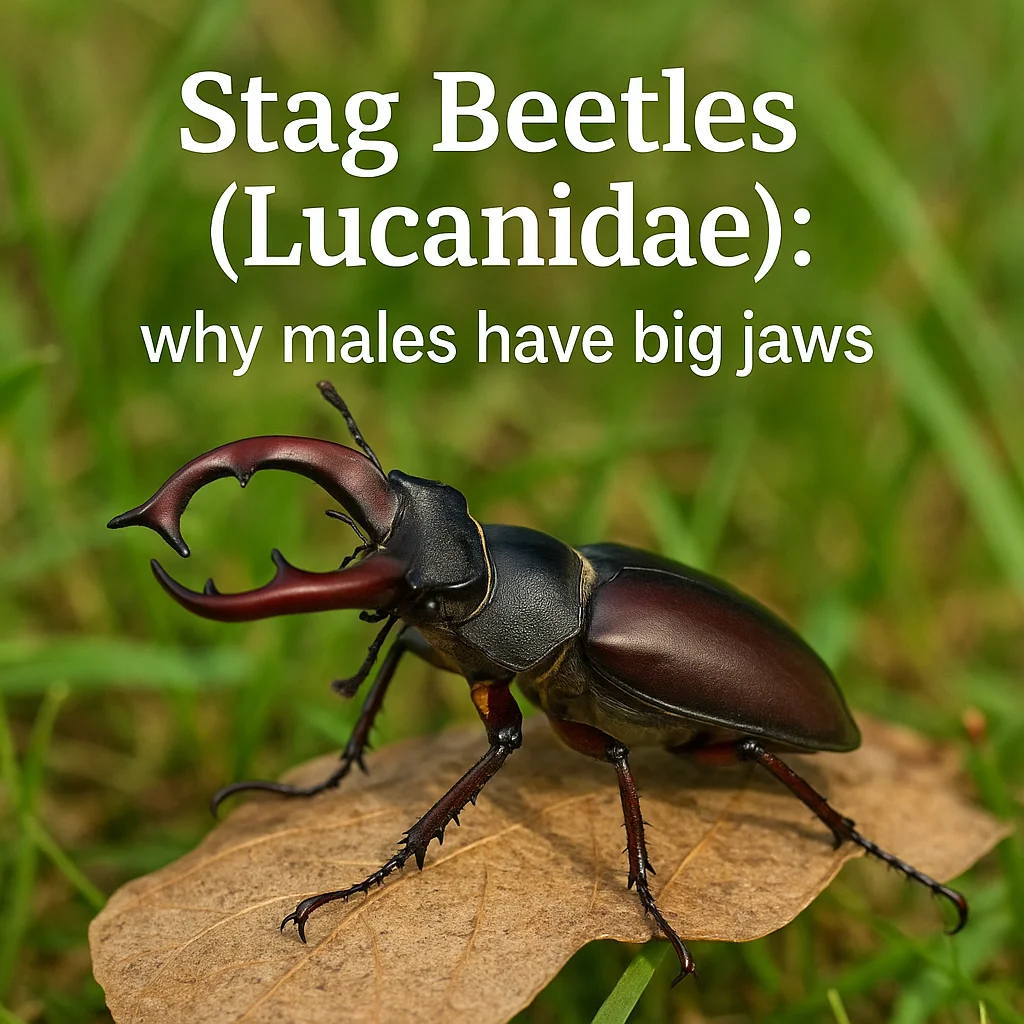
Stag Beetles are easily identified by their robust body and significant size. Males are particularly known for their large, antler-like mandibles, while females have smaller jaws. Their body is elongated with a somewhat flattened appearance.
- Body shape and silhouette: elongated and robust
- Antennae: elbowed with a fan-like end
- Wing features: Hard forewings (elytra) covering the softer hindwings
- Leg traits: Strong legs adapted for digging and clinging to surfaces
- Distinguishing look-alikes: Can be confused with rhinoceros beetles but are generally flatter and have visible mandibles
- Top ID Tips:
- Look for large mandibles in males
- Shiny, dark body with hard elytra
- Elbowed antennae with a fan-like end
- Prominent mandibles only in males
- Robust, elongated body
- Nocturnal appearance near lights
- Strong, spined legs
- Typically found near rotting wood
🧠 Basic Body Structure
As typical insects, Stag Beetles have a body divided into three primary sections: the head, thorax, and abdomen. They possess six legs attached to the thorax, and their body is covered by a hard exoskeleton. Stag Beetles undergo molting to grow as they progress through their life stages. They have wings, although they are not always strong flyers.
Stag Beetles are invertebrates, meaning they lack a backbone. Instead, their exoskeleton provides structural support and protection.
🌍 Habitat & Distribution
Stag Beetles are commonly found in habitats that provide ample wood for the larvae to feed on. They thrive in forests, woodlands, and gardens that have old or decaying trees. These beetles are adaptable and can sometimes be found in urban parks if suitable conditions are present.
They are distributed across the globe, primarily in temperate regions. They are highly adaptable, although their presence diminishes in areas where forest cover is lost or natural woodlands are removed.
📅 Seasonal Appearance & Activity
Stag Beetles are most active during the late spring and early summer, which is the primary time for males to use their large mandibles in combat for mating rights. They are nocturnal, most commonly seen at dusk or near light sources during warm nights. Wetter weather following dry conditions can also trigger increased activity.
- Best Time to Spot It:
- Ripest sightings from late spring to early summer
- Primarily active at night
- Often seen around lights in urban areas
- After rain during warm periods
🥚 Reproduction & Egg-Laying
The mating behavior of stag beetles is quite remarkable, with males often engaging in combat using their large mandibles to win over females. Once mating occurs, females lay their eggs in decaying wood or soil rich with organic material. The number of eggs varies, as the conditions for laying can differ significantly by region.
🌀 Metamorphosis & Life Cycle
Stag Beetles undergo complete metamorphosis, consisting of four distinct life stages: egg, larva, pupa, and adult.
During the larval stage, which can last several years, larvae feed on decaying wood, contributing to decomposition. The pupal stage is a transition period where they develop into adults. Finally, adult stag beetles emerge, ready to feed on tree sap or nectar before completing their lifecycle and engaging in reproduction. The adult stage typically lasts only a few weeks to months, therefore they are most visible during specific parts of the year.
🍽️ Diet & Feeding Behavior
The diet of stag beetles varies with their life stage. Larvae are mainly decomposers, feeding on rotten wood. This makes them crucial for nutrient recycling in forest ecosystems. Adult stag beetles usually feed on tree sap and fruits. They have chewing mouthparts well-suited for their various dietary needs across development stages.
🦉 Predators & Defense
Common predators of stag beetles include birds, wild mammals, and amphibians. Their defense mechanisms range from using their hard exoskeleton as armor to their ability to hide by burrowing into surfaces. The large jaws of males, though more for mating displays, can also serve as a mild deterrent to predators.
- Defense Highlights:
- Armor-like exoskeleton
- Burrowing and hiding abilities
- Distracting large jaws
- Nocturnal activity reducing exposure to diurnal predators
👥 Social Behavior & Swarms
Generally, stag beetles are solitary creatures, coming together primarily for mating purposes. Their encounters are predominantly male-focused, involving combat over females. There are no swarm behaviors typically observed in stag beetles.
🧭 Senses & Communication
Stag beetles rely on strong senses of smell and touch to interact with their environment. They use pheromones for communication, especially during the mating season, to attract mates over distances. While vision is not their strongest sense due to nocturnal habits, they have compound eyes that aid during their active hours.
🌱 Role in the Ecosystem
Stag beetles play a vital ecological role primarily as decomposers, particularly at larval stages when they consume decaying wood, aiding in nutrient cycling and soil health. Furthermore, adults can serve as pollinators while feeding on nectar. They form part of the food web, serving as prey to various insectivorous animals.
📉 Population & Conservation Notes
Stag beetles are considered of varying conservation status, with some specific species facing threats due to habitat loss, pesticide use, and urbanization. While many regions report them as common in suitable habitats, data on exact population numbers is typically limited.
- How to Help (Low-Impact):
- Encourage native plant growth
- Avoid using chemical pesticides
- Preserve old trees and decaying wood
- Create beetle-friendly gardens
⚠️ Human Interaction & Safety
Stag beetles are generally harmless to humans. Although they have large mandibles, these are not designed for biting humans and are primarily used for courtship displays. In rare cases, handling might provoke defensive pinching, so it's best to observe them respectfully. As always, if bites or pinches occur and reactions are severe, seek professional advice.
📌 Summary
- Stag Beetles are recognized by large mandibles in males
- Commonly found in wooded habitats with old trees
- Seasonal appearance during late spring to early summer
- Undergo complete metamorphosis with stages lasting years
- Feed on decaying wood, nectar, and sap; crucial decomposers
- Serves as prey to various animals, have some natural defenses
- Generally solitary, males engage in combat for mating
- Essential to ecosystems through roles in decomposition and nutrient cycling
- Population varies; conservation focuses on habitat preservation
- Safe around humans but best appreciated from a respectful distance