🕷️ Atlas Moth (Attacus atlas): one of the largest moths
🧾 Quick Facts
The Atlas Moth, known for being one of the largest moth species, is a fascinating insect found primarily in tropical and subtropical regions of Asia. Its striking appearance and impressive wingspan make it a marvel of the natural world.
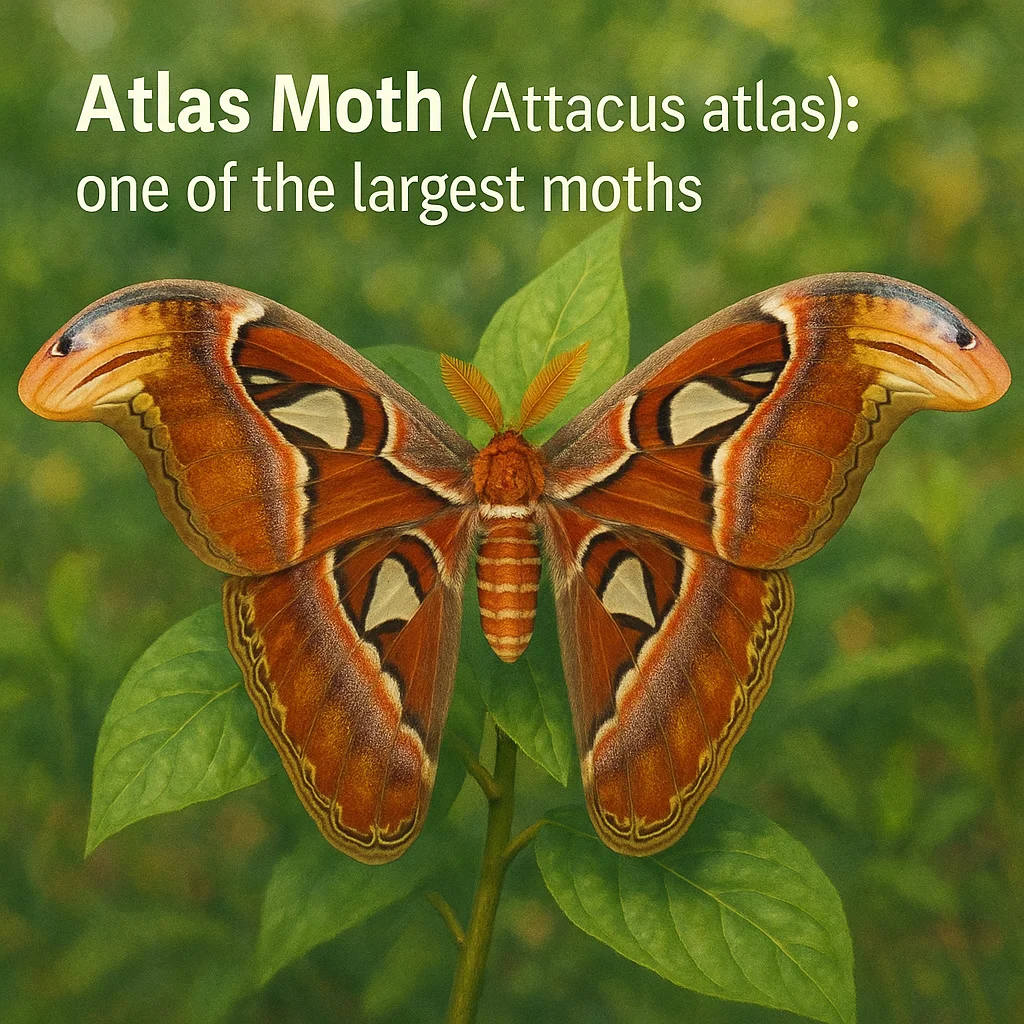
- Common Names: Atlas Moth
- Scientific Name: Attacus atlas
- Insect: Yes, an invertebrate
- Order/Family: Lepidoptera/Saturniidae
- Typical Size Range: 25-30 cm (9.8-11.8 inches) wingspan
- Key Colors/Patterns: Brown, orange, cream with intricate patterns
- Activity: Primarily nocturnal
- Typical Habitats: Rainforests, shrublands, urban gardens
- Where in the World It Occurs: Southeast Asia, Southern Asia, parts of Indonesia
- Seasonality: Varies by region, often seen during the monsoon season
🔍 Identification
The Atlas Moth can be easily recognized by its massive size and the unique pattern on its wings. Its wing tips are pointed and resemble a snake's head, which helps in warding off predators. The antennae are feathery and more pronounced in males.
- Body Shape: Robust body, broad wings
- Antennae Type: Feathery, especially in males
- Wing Features: Large, with distinct snake-head-like tips
- Leg Traits: Short, sturdy, adapted for grasping
- Common Confusion: May be confused with other large moths like the Hercules Moth
- Top ID Tips:
- Look for the snake-head pattern on the wing tips
- Notice the huge wingspan and broad body
- Identify the feathery antennae
- Observe the coloration of brown, orange, and cream
- Check for night activity
- Look in typical habitats such as rainforests
- Note the time of year for sightings
🧠 Basic Body Structure
As an insect, the Atlas Moth has a body divided into three main parts: the head, thorax, and abdomen. It possesses six legs, common to all insects, and is characterized by an exoskeleton that it must shed to grow, a process known as molting.
The moth is an invertebrate, meaning it lacks a backbone, which is typical of all insects. The wings are a prominent feature, with a series of scales that give the moth its distinctive coloration.
🌍 Habitat & Distribution
The Atlas Moth is predominantly found in tropical and subtropical forests, where it thrives in warm, humid climates. It is often seen near forest edges, gardens, and in cultivated areas with sufficient vegetation. Its distribution spans across Southeast Asia, including India, Sri Lanka, and Indonesia.
Microhabitats for the Atlas Moth include tree branches where it can rest during the day. Changes in habitat, such as deforestation and urban expansion, can impact sightings of this magnificent moth.
📅 Seasonal Appearance & Activity
The Atlas Moth is most commonly seen during specific times of the year, often dictated by local climate conditions. In regions with distinct rainy seasons, adults are more frequently observed when vegetation is lush.
- Best Time to Spot It
- During the rainy season
- At night or early in the morning
- In warm, humid weather
- In areas with dense foliage
🥚 Reproduction & Egg-Laying
Atlas Moth mating involves the use of pheromones, which females release to attract males. This occurs during the night when adults are active. Eggs are typically laid on the underside of leaves, where they have easy access to food sources when they hatch as caterpillars.
The number of eggs laid can vary, but it is generally high to increase the chances of survival. The exact count depends on environmental conditions and available resources.
🌀 Metamorphosis & Life Cycle
The Atlas Moth undergoes complete metamorphosis, consisting of four stages: egg, larva (caterpillar), pupa (chrysalis), and adult.
During the larval stage, caterpillars feed voraciously on leaves, growing rapidly before forming a cocoon. After the pupal stage, they emerge as adults. The entire life cycle can last several months, with the adult moth having a brief lifespan primarily dedicated to reproduction.
🍽️ Diet & Feeding Behavior
In their larval form, Atlas Moths are herbivores, feeding on leaves of various host plants. As adults, however, they do not feed, as they lack functional mouthparts. Their time as moths is dedicated to mating and laying eggs.
The role of the caterpillar as a herbivore is significant in controlling plant growth and fostering biodiversity within its ecosystem.
🦉 Predators & Defense
Natural enemies of the Atlas Moth include birds, reptiles, and small mammals. In its larval stage, the caterpillar may fall prey to parasitoid wasps and other insectivorous creatures.
The moth's defense mechanisms include its large size and the snake-head-like wing tips that startle predators. Camouflage is also used, as its wing patterns help it blend into its environment.
- Defense Highlights:
- Camouflage with wing patterns
- Snake-head appearance for predatory deterrence
- Quick flight to avoid threats
- Large size intimidating to some predators
👥 Social Behavior & Swarms
The Atlas Moth is primarily solitary, focusing on mating interactions between males and females. There are no swarming or migratory behaviors associated with this species.
Mating encounters are brief and occur sporadically in suitable habitats, driven by pheromones released by the females.
🧭 Senses & Communication
The Atlas Moth relies heavily on its sense of smell for communication, particularly during mating. Males detect female pheromones from considerable distances, guiding them toward potential mates. Vision plays a lesser role but is used for navigation during nocturnal activities.
🌱 Role in the Ecosystem
This moth is an integral part of its ecosystem. As a caterpillar, it contributes to plant control and nutrient cycling. The adult moth, despite not feeding, plays a role in pollination through accidental transfer of pollen as it moves between resting places.
The Atlas Moth also serves as a food source for various predators, linking different levels of the food web. Its presence indicates a healthy, biodiverse environment.
📉 Population & Conservation Notes
The Atlas Moth is reported as relatively common in suitable habitats but faces threats from habitat destruction and urbanization. Light pollution and pesticide use are additional challenges that can influence local populations.
- How to Help (Low-Impact):
- Plant native trees to foster habitat
- Avoid using pesticides in gardens
- Preserve natural forest areas
- Turn off unnecessary outdoor lighting
⚠️ Human Interaction & Safety
The Atlas Moth is harmless to humans. It doesn't bite or sting and poses no threat. When viewing these moths, it is important to do so respectfully, avoiding disturbance and not collecting them from the wild. This ensures their continued presence in natural habitats.
📌 Summary
- The Atlas Moth is one of the largest moth species, notable for its impressive wingspan and distinct markings.
- It inhabits tropical and subtropical regions and is mostly active at night.
- Witnessing adult moths is more common during monsoon seasons.
- Larvae are herbivores, while adult moths do not feed.
- They are preyed upon by birds, reptiles, and mammals.
- Their role in ecosystems includes plant control and accidental pollination.
- Populations face threats from habitat loss and light pollution.
- Encourage respectful observation to ensure their conservation.