🕷️ Cecropia Moth (Hyalophora cecropia): North American giant
🧾 Quick Facts
The Cecropia Moth, known for its significant size and striking appearance, is a fascinating species to observe. Here’s a quick overview:
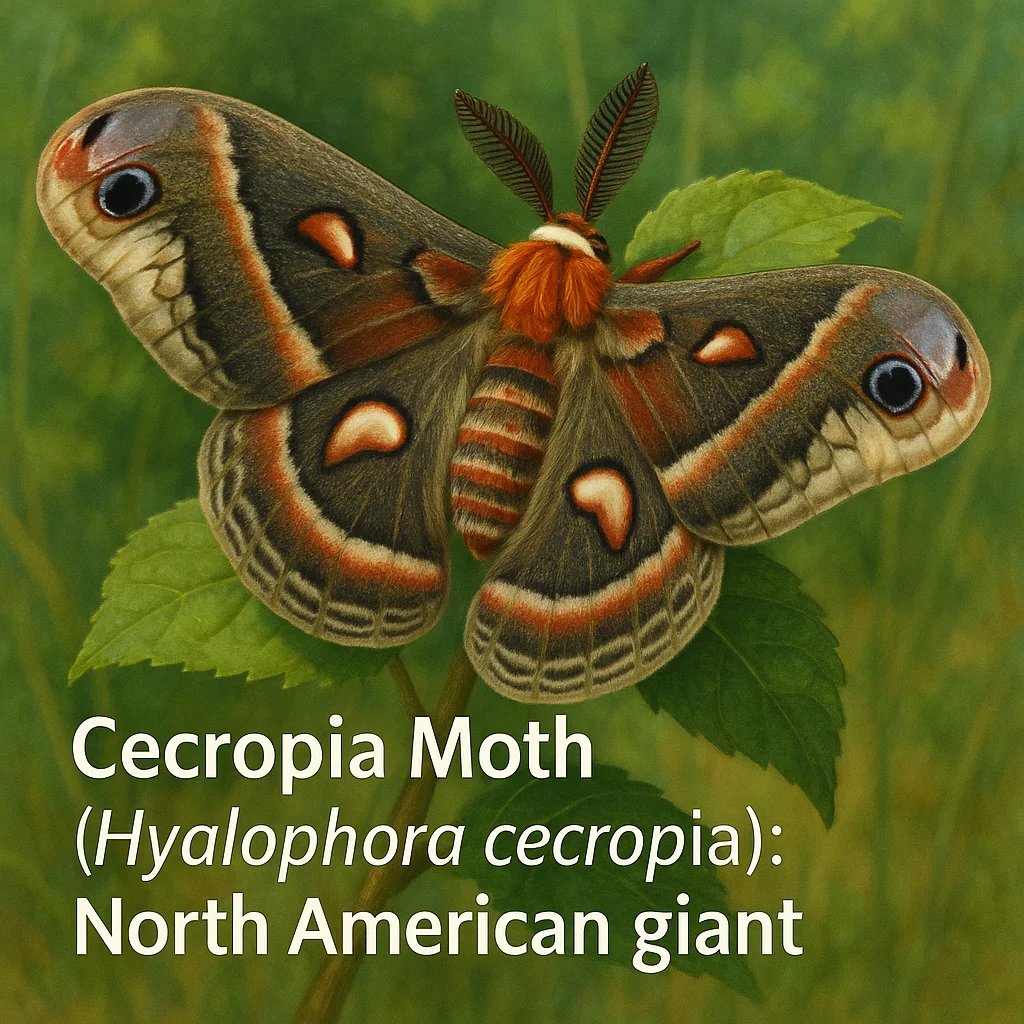
- Common names: Cecropia Moth
- Scientific name: Hyalophora cecropia
- Insect or not: Yes, it is an insect and an invertebrate
- Order / family: Lepidoptera / Saturniidae
- Typical size range: Wingspan 5 to 6 inches (approximately 13 to 15 centimeters)
- Key colors/patterns: Brownish-green wings with red and white markings
- Activity: Nocturnal
- Typical habitats: Deciduous forests, urban gardens
- Where in the world it occurs: North America, primarily in the eastern United States and southern Canada
- Seasonality: Adults are most visible from early summer to mid-summer
🔍 Identification
The Cecropia Moth is unmistakable due to its impressive size and vibrant patterns. To identify it in the wild, consider the following traits:
- Body shape and silhouette: Robust body, with wide wings and a heavy thorax
- Antennae type: Feathery in males, thin and less plumose in females
- Wing features: Large wings with eye-catching red, white, and brown markings
- Leg traits and movement style: Short, sturdy legs used for gripping onto surfaces
- Distinguishing look-alikes: May be confused with other member of the Saturniidae family, but its size and markings are distinctive
- Robust body with large wings
- Feathery antennae (particularly in males)
- Red and white patterns on wings
- Active primarily at night
- Found near hardwood trees
- Large size compared to other moths
🧠 Basic Body Structure
The Cecropia Moth shares the fundamental characteristics of insects:
- Head, thorax, and abdomen comprise its body
- Three pairs of jointed legs (six legs in total)
- Feathery antennae
- Two pairs of large wings
As an invertebrate, the Cecropia Moth lacks a backbone and relies on an external skeleton, known as an exoskeleton, for protection and support. The moth undergoes molting, shedding its exoskeleton as it grows.
🌍 Habitat & Distribution
The Cecropia Moth thrives in a wide array of environments. It favors:
- Deciduous forests with access to hardwood trees such as maples, birches, and cherry trees
- Urban areas, especially gardens that provide suitable plant hosts
- Microhabitats that include branches and leaves where eggs and larvae can be found
This species is primarily found in the eastern regions of North America, ranging from Canada to parts of the United States. The Cecropia Moth prefers temperate climates, and sightings may vary with local habitat conditions.
📅 Seasonal Appearance & Activity
The Cecropia Moth is most visible during warmer months, when adults emerge from cocoons to breed and lay eggs. Key periods include:
- Activity peaks from late spring to early summer
- Nocturnal, primarily active at night
- Warm, humid nights enhance visibility as moths emerge to mate
- Spotting is more frequent in regions with a stable climate free from adverse weather
- Best time to observe is May through July
- Moths are most active during warm nights
- Increased sightings after a rain in humid climates
- Look for them in deciduous areas during early summer
🥚 Reproduction & Egg-Laying
Cecropia Moths engage in a remarkable mating process primarily driven by pheromones. Males use their well-developed antennae to detect female pheromones from several miles away, leading to courtship. After mating, the female seeks suitable host plants, generally the leaves of specific hardwood trees.
- Eggs are laid on chosen plant leaves
- Females lay a few hundred eggs in clusters
- Each egg is carefully attached to minimize predation risk
🌀 Metamorphosis & Life Cycle
The Cecropia Moth undergoes complete metamorphosis, progressing through the stages of egg, larva (caterpillar), pupa (cocoon), and adult moth:
- Egg stage: lasts about 10-14 days before hatching
- Larva stage: Caterpillars feed on host plant leaves, growing larger over several weeks. They undergo multiple molts and display vibrant coloration with striking hues of green and blue
- Pupa stage: After reaching full size, caterpillars spin silk cocoons to enter the pupal phase, leading to transformation
- Adult stage: Emergence occurs in late spring; adults primarily focus on reproduction and have a brief lifespan of a few weeks
🍽️ Diet & Feeding Behavior
The feeding habits of the Cecropia Moth vary significantly across its life stages:
- Caterpillars: Herbivorous diet focused on leaves of host plants such as maples, birches, and cherry trees. Equipped with chewing mouthparts suitable for gnawing through foliage
- Adult moths: Do not feed as their mouthparts are underdeveloped; energy and nutrition are stored from the larval stage to fuel the adult life
Role: As herbivores in larval form, they play a role in controlling plant growth, while adults serve essential roles in reproductive cycles.
🦉 Predators & Defense
Cecropia Moths face various natural threats in the wild:
- Predators: Birds, small mammals, and parasitic wasps often prey on the caterpillars and eggs
- Defense strategies: Camouflage through coloration helps conceal eggs and larvae; adults produce a dust-like substance to escape predator grips
- Short adult lifespan reducing predator encounters
- Bright colors on larvae may deter some predators
- Adults produce noisy flight to startle threats
- Caterpillars showcase intimidating spikes (non-toxic)
- Cocoons are hidden in substrate during pupation
👥 Social Behavior & Swarms
Cecropia Moths are largely solitary creatures:
- Adults are solitary, gathering only for mating
- Brief courtship rituals for reproductive events
- No known swarming or cooperative behaviors
🧭 Senses & Communication
Cecropia Moths rely on heightened senses for survival and reproduction:
- Vision: Limited to basic shapes and movement
- Smell/pheromones: Strong reliance on chemical cues for mating; males are especially sensitive to female pheromones
- Touch: Sensitive hairs on body detect vibrations
- Vibration: Perception of environmental cues through minute changes
🌱 Role in the Ecosystem
The Cecropia Moth serves an essential ecological role:
- Acts as a food source for predators such as birds and mammals
- Larval feeding contributes to plant control in ecosystems
- Potential indirect benefits to predation cycles by supporting prey density
While the moth does not impact agriculture or humans negatively, its presence indicates healthy biodiversity through balanced fauna and plant relationships.
📉 Population & Conservation Notes
Cecropia Moth populations tend to thrive in suitable habitats, though localized factors may affect abundance.
- Generally common in deciduous forests
- Habitat loss and pesticide use may contribute to regional declines
- Light pollution potentially disrupts nocturnal behaviors and mating
- Using less pesticide in home gardens
- Encouraging native flora to boost natural habitats
- Reducing light pollution with motion-activated lights
- Leaving leaf litter undisturbed for caterpillar development
⚠️ Human Interaction & Safety
Cecropia Moths pose no direct harm to humans:
- No bites or stings associated with this species
- Observation offers a chance to appreciate natural biodiversity
- Advocate for respectful wildlife observation and discourage interfering with breeding cycles
📌 Summary
- Impressive size and unique coloration aid in identification
- Prefers deciduous and urban mixed habitats
- Active during nocturnal hours of late spring to early summer
- Complete metamorphosis from egg to large adult
- Herbivorous as caterpillars but do not feed as adults
- Major predators include birds and wasps, overcome using camouflage
- Essential ecosystem role as both prey and foliage consumer
- Population pressures from habitat loss and environmental change
- Non-threatening interaction with humans, promoting nature appreciation