🕷️ Death’s-head Hawkmoth (Acherontia): myth vs facts
🧾 Quick Facts
The Death’s-head Hawkmoth is a fascinating insect known for its skull-like pattern on the thorax and its eerie reputation in lore and popular culture. Here are some quick facts:
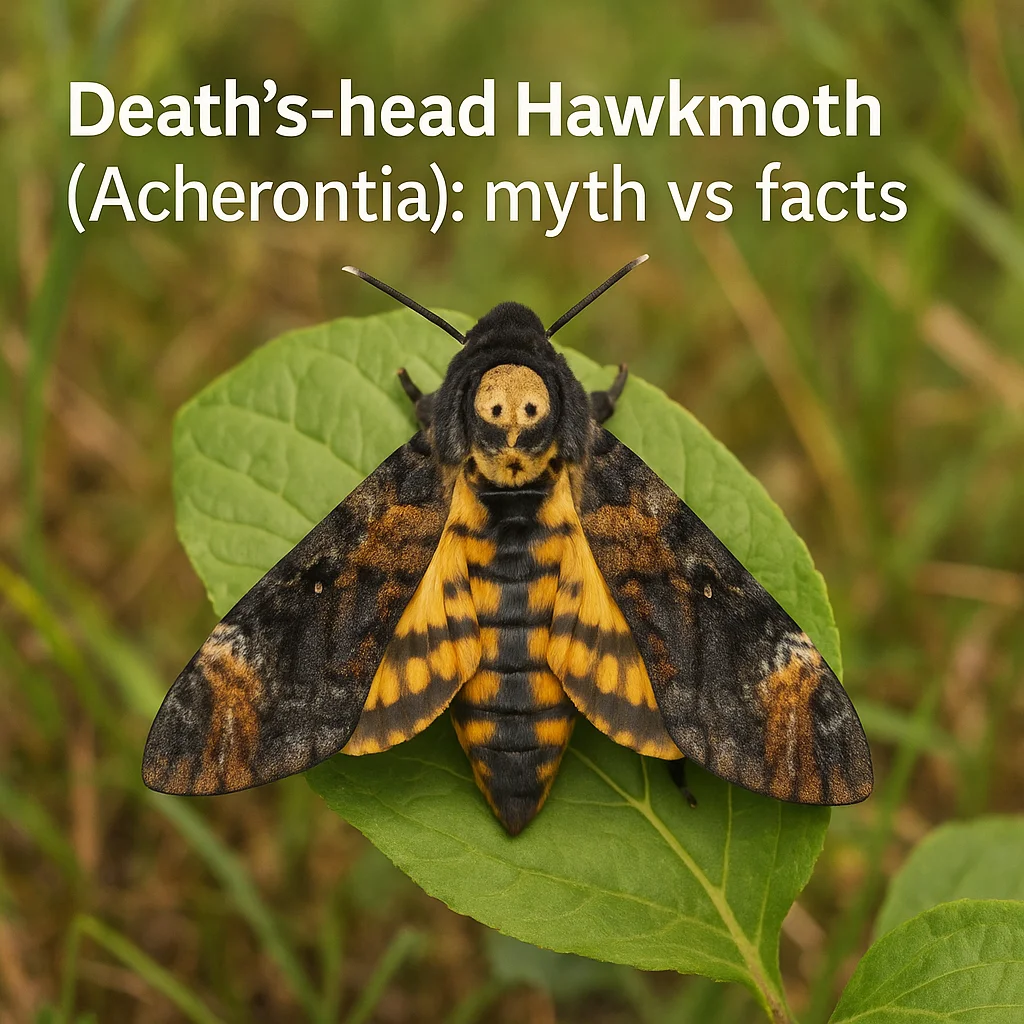
- Common Names: Death's-head Hawkmoth, Acherontia
- Scientific Name: Acherontia (three species: A. atropos, A. styx, A. lachesis)
- Insect or Not: Yes, it is an insect and specifically a moth, which is part of the invertebrate group
- Order/Family: Lepidoptera/Sphingidae
- Typical Size Range: Wingspan ranges from 90 to 130 mm
- Key Colors/Patterns: Brown, yellow, and black with a distinctive skull pattern
- Activity: Primarily nocturnal
- Typical Habitats: Gardens, cultivated lands, and forests
- Where in the World: Europe, Africa, and parts of Asia
- Seasonality: Most visible from late summer to autumn
🔍 Identification
The Death’s-head Hawkmoth can be recognized by its robust body and distinctive pattern. The moth has a stout body and a broad silhouette. Its antennae are feathery and short relative to body size. The wings are powerful and suited for long-distance flight, featuring yellow and black bands on the hindwings.
- Top ID Tips:
- Look for the skull-like pattern on the thorax
- Observe the robust body and wide wingspan
- Note the yellow bands on the hindwings
- Spot the feathery antennae
- Check for nocturnal activity patterns
- Listen for the peculiar squeaking sound when disturbed
🧠 Basic Body Structure
As an insect, the Death’s-head Hawkmoth possesses the typical body plan: a head, thorax, and abdomen. It has three pairs of legs, which are adapted for stability and climbing on various surfaces. The moth is an invertebrate, meaning it lacks a backbone, and it relies on an exoskeleton for support and protection. The moth undergoes molting to allow for growth, shedding its exoskeleton multiple times during development.
🌍 Habitat & Distribution
Death’s-head Hawkmoths prefer a variety of habitats, including gardens, woodlands, and agriculture lands. They are generally found in regions that offer ample food sources such as flowering plants. Geographic distribution includes areas in Europe, Africa, and parts of Asia, where they adapt to both temperate and tropical climates. Habitat changes, such as deforestation or urban expansion, can heavily influence their sightings and distribution.
📅 Seasonal Appearance & Activity
Death’s-head Hawkmoths are most active during the late summer to autumn months. These moths are primarily nocturnal, taking advantage of the cover of darkness to find food and mates. Their activity can be influenced by weather conditions, and they prefer warm, humid nights.
- Best Time to Spot It:
- Late summer evenings
- Warm, humid nights
- During heavy blooms of nectar-rich plants
- When temperatures are mild
🥚 Reproduction & Egg-Laying
During the mating season, male Death’s-head Hawkmoths are attracted to females by pheromones. After mating, females lay eggs on host plants, often species of the Solanaceae family. The exact number of eggs varies, but females typically lay clusters of small, round eggs. These eggs are strategic, ensuring proximity to food sources for emerging larvae.
🌀 Metamorphosis & Life Cycle
The Death’s-head Hawkmoth undergoes complete metamorphosis, which involves four distinct stages: egg, larva (caterpillar), pupa, and adult moth. The larval stage is characterized by a voracious appetite, mainly feeding on foliage of host plants like potatoes, tomatoes, and nightshades. They are predominantly green, sometimes with yellow or white striping.
Pupation occurs in the soil, where the caterpillar burrows and transforms into a pupa. This stage can last a few weeks to several months, depending on environmental conditions. Finally, the adult moth emerges, ready to reproduce and continue the cycle.
🍽️ Diet & Feeding Behavior
Larvae of the Death’s-head Hawkmoth feed on a variety of host plants, notably those in the Solanaceae family. As they mature into adults, their diet primarily consists of nectar. These moths are equipped with a proboscis suitable for sipping nectar but are also known to rob beehives by piercing wax honeycombs, hence their association with bee theft.
🦉 Predators & Defense
The Death’s-head Hawkmoth has several natural enemies, including birds, bats, and predatory insects. Its defense mechanisms are intriguing; the moth is capable of producing a squeaking sound by expelling air from its pharynx, potentially deterring predators. Additionally, its markings serve as camouflage amidst the foliage.
- Defense Highlights:
- Camouflage with environment
- Squeaking sound to startle predators
- Ability to fake death
- Strong flying capabilities to escape threats
👥 Social Behavior & Swarms
The Death’s-head Hawkmoth is primarily solitary, with no known social structure beyond mating encounters. These moths do not form swarms or colonies, and while they may migrate to warmer areas during certain seasons, this behavior is primarily driven by temperature and food availability rather than social tendencies.
🧭 Senses & Communication
Death’s-head Hawkmoths rely on keen olfactory senses to locate mates and host plants, utilizing pheromones for communication. Their vision is adapted for low-light conditions, aiding in nighttime activities. The aforementioned squeaking is another key communication method, although it is largely for defense rather than social interaction.
🌱 Role in the Ecosystem
In ecosystems, the Death’s-head Hawkmoth plays a unique role as both a pollinator and a consumer of plant matter in its larval stage. While not primary pollinators, they inadvertently assist in the cross-pollination of some plants. Their interactions with other species, including bees, underscore complex interdependencies within their habitats. Although regarded as pests when honey theft occurs, they otherwise contribute to the ecological balance.
📉 Population & Conservation Notes
The Death’s-head Hawkmoth is often reported as common in suitable habitats. However, their populations can be affected by habitat loss, use of pesticides, and climate change. Specific data on their numbers is limited, but conservation efforts focus on creating and maintaining sustainable environments for their survival.
- How to Help (Low-Impact):
- Plant native nectar-rich flowers
- Avoid pesticide use
- Provide habitats with natural shelter
- Leave leaf litter and native plant stems
⚠️ Human Interaction & Safety
The Death’s-head Hawkmoth does not bite or sting humans and is generally considered harmless. As with all wildlife, it is advisable to observe respectfully and avoid handling or disturbing these moths in their natural habitats. If allergic reactions or discomfort occur around moths or similar insects, simple first aid methods such as washing the affected area are suggested, with professional advice sought if severe.
📌 Summary
- Identifiable by the skull pattern on its thorax
- Thrives in diverse habitats from gardens to forests
- Most visible during late summer to autumn evenings
- Undergoes complete metamorphosis
- Feeds on host plants as larvae; nectar and honey as adults
- Defends itself through camouflage and sound production
- Ecosystem roles include pollination and feeding on plants
- Generally harmless to humans, impacts bees