🕷️ Elephant Hawkmoth: pink-green pattern ID
🧾 Quick Facts
The Elephant Hawkmoth is a captivating moth species, celebrated for its distinct pink and green coloration found predominantly in Europe and parts of Asia. Its vibrant appearance and unique life cycle make it a fascinating subject for butterfly and moth enthusiasts.
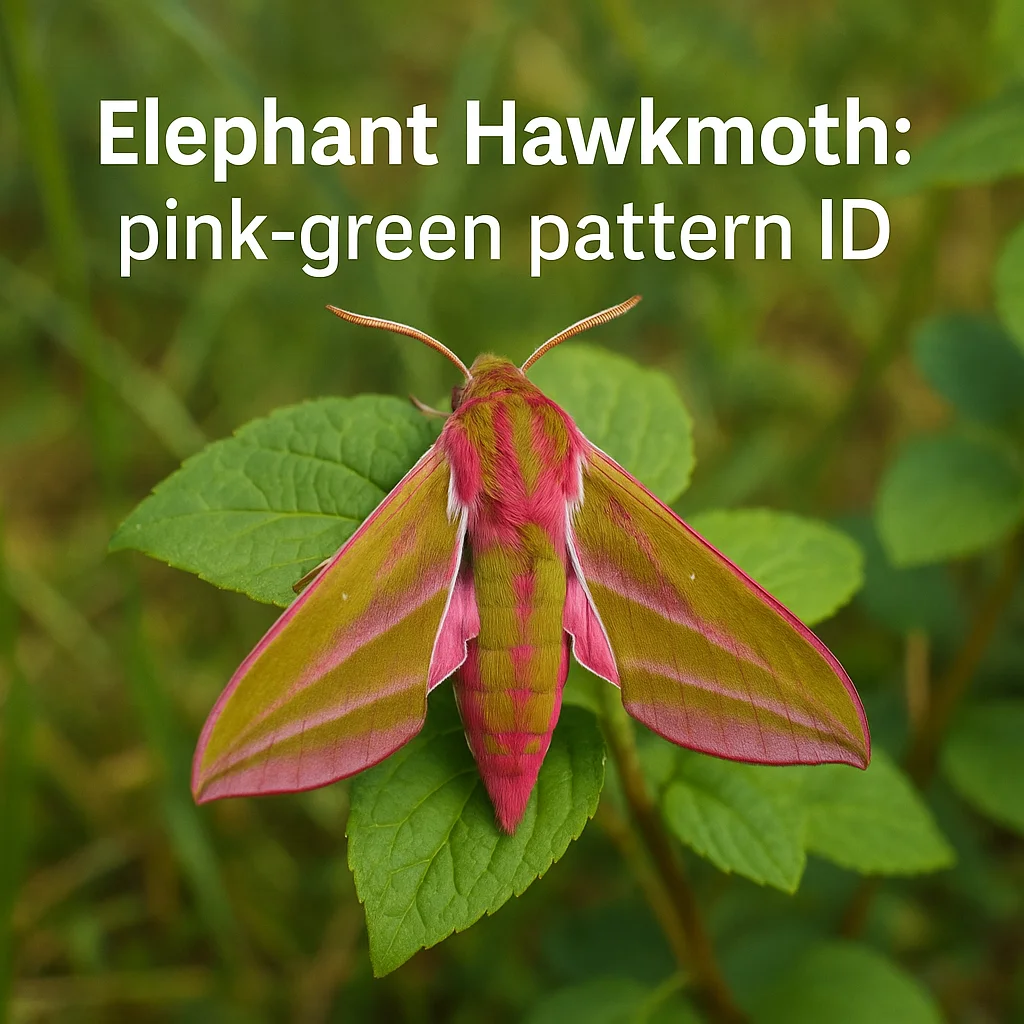
- Common Names: Elephant Hawkmoth, Large Elephant Hawkmoth
- Scientific Name: Deilephila elpenor
- Insect: Yes, it is an invertebrate
- Order / Family: Lepidoptera / Sphingidae
- Typical Size Range: Wingspan of 45-60mm
- Key Colors/Patterns: Pink and green body with brown highlights
- Activity: Nocturnal
- Typical Habitats: Meadows, woodland edges, gardens
- Where in the World: Europe, parts of Asia
- Seasonality: Adults visible mainly from May to August
🔍 Identification
Recognizing the Elephant Hawkmoth is straightforward due to its vibrant coloration. The moth has a subtle triangular and elongated body shape, with wings that are broader at the base and tapering towards the edges.
The antennae are clubbed, which is typical of moth species, and not prominently visible from a distance. The moth's forewings are primarily pink with olive green, while the hindwings are darker with a striking stripe pattern. Legs are slender and adapted for clinging to vegetation.
Commonly confused with other pink-green moths, its size and the specific shade of pink differentiate it. Distinctions can also be made by observing the patterns and intensity of colors.
- Elongated, triangular body shape
- Distinct pink and olive green wing pattern
- Broader forewings, darker hindwings
- Slender, clubbed antennae
- Typically rests with wings closed
- Active at night, rarely seen in daylight
- Whole specimen visible when resting on plants
🧠 Basic Body Structure
The Elephant Hawkmoth, like all insects, is composed of three main body parts: the head, thorax, and abdomen. It has six legs, which are used not only for movement but also for clinging onto various surfaces.
The moth's body is covered by an exoskeleton that provides support and protection. As an invertebrate, it lacks any internal skeleton or bones. The wings emerge from the thorax, which is the center of flight mechanics.
Moths undergo molting and metamorphosis, transitioning from one life stage to another. The wings enable their notable flight, which is often a graceful, fluttering motion observed at night.
🌍 Habitat & Distribution
Elephant Hawkmoths prefer environments where host plants are plentiful. These include areas such as meadows, woodland edges, suburban gardens, and grasslands. Their preference for flowers and open spaces often brings them into gardens where ornamental and native plants flourish.
Microhabitats include areas under leaves or within low-growing shrubs where they rest during the day. Their geographical range primarily covers Europe, extending into parts of Asia, often limited to temperate regions with mild summers and cold winters.
Sightings of this moth may fluctuate with environmental changes, as habitat destruction or climate changes impact their usual biorhythms and distribution.
📅 Seasonal Appearance & Activity
The Elephant Hawkmoth is most frequently seen during late spring to summer. Its activity peaks from late May, with adults visible until August. The moth is nocturnal and engages in active flight at night, drawn to light sources and flowering plants.
Weather significantly influences visibility, with warm, dry, and calm evenings being the best for sightings.
- Best spotted from May to August
- Most active during warm, windless evenings
- Attracted to artificial lights at night
- More prevalent after mild winters
🥚 Reproduction & Egg-Laying
Mating behaviors of the Elephant Hawkmoth are generally not observed due to their nocturnal nature. The female lays eggs on host plants, particularly on the leaves of rosebay willowherb and various fuchsia plants.
Egg counts can vary, with females potentially laying hundreds of eggs dispersed across a suitable area. The choice of egg-laying sites is critical to caterpillar survival, with plant selection ensuring food availability for the emerging larvae.
🌀 Metamorphosis & Life Cycle
Elephant Hawkmoths undergo complete metamorphosis, progressing through the stages of egg, larva, pupa, and adult moth. Eggs hatch into larvae within a few weeks.
The larval stage, where the caterpillar is active, lasts several weeks. It primarily feeds on host plants, growing rapidly. As it approaches pupation, the caterpillar will search for a suitable place to pupate, often beneath the soil or leaf litter, emerging as an adult moth following this secluded transformation.
🍽️ Diet & Feeding Behavior
During the caterpillar stage, the Elephant Hawkmoth is herbivorous, feeding voraciously on the foliage of its host plants. The feeding behavior is characterized by chewing mouthparts, enabling it to consume leaves effectively.
As adults, hawkmoths utilize a proboscis to feed on nectar. This transition in feeding methods reflects their role as potential pollinators, contributing to the ecosystem by aiding in plant fertilization while sourcing energy.
🦉 Predators & Defense
The primary predators of the Elephant Hawkmoth include birds, bats, and small mammals. To evade these threats, the moth utilizes various defense strategies.
Camouflage is the most prominent, with their striking colors serving to confuse predators or blend into floral environments. As larvae, they may assume a defensive posture resembling a small snake, deterring predators through mimicry.
- Excellent color camouflage among flowers
- Larvae mimic snake faces as a scare tactic
- Quick flight responses to escape predators
- Use of nocturnal activity helps avoid diurnal predators
👥 Social Behavior & Swarms
The Elephant Hawkmoth is generally solitary, with interactions primarily limited to mating. Adult moths may be drawn together by floral scents and nighttime light sources but do not form swarms or social groups.
Mating encounters are brief, followed by a return to a primarily solitary lifestyle focused on reproduction and feeding.
🧭 Senses & Communication
Elephant Hawkmoths rely heavily on their sophisticated sensory structures. They have well-developed vision adapted for low-light conditions, which aids in navigating at night.
Smell plays a critical role, with pheromone detection crucial for mating behaviors. Their antennae are sensitive to chemical signals, and they communicate through pheromones released by females to attract males over distances.
🌱 Role in the Ecosystem
Elephant Hawkmoths are integral to ecosystems as pollinators. By feeding on nectar, they inadvertently transfer pollen between flowers, supporting plant reproduction. This service is vital in maintaining plant diversity and health.
Their presence also serves as a food source for various predators, placing them as important components in the food web. Mutualistic relationships with flowering plants highlight the interdependence within their habitats.
📉 Population & Conservation Notes
While Elephant Hawkmoths are currently common in suitable habitats, their populations can be susceptible to changes in agriculture and urban development. Pesticide use and habitat loss pose threats to both their occurrence and the availability of host plants.
- Encourage native plant growth for larval food sources
- Avoid pesticide use to protect moth and caterpillar stages
- Preserve garden habitats to support moth activity
- Promote light pollution reduction initiatives
⚠️ Human Interaction & Safety
The Elephant Hawkmoth does not bite or sting and poses no harm to humans. It is safe to observe from a distance, and their presence is often welcomed in gardens due to their aesthetic value and pollination role.
Respectful observation entails not disturbing them during their vulnerable nocturnal activities and avoiding collecting wild specimens, which contributes to maintaining healthy populations.
📌 Summary
- Elephant Hawkmoth features distinct pink and green wing patterns
- Found mainly in Europe and parts of Asia
- Nocturnal with visibility from May to August
- Undergoes complete metamorphosis
- Caterpillars feed on leafy plants; adults consume nectar
- Acts as a pollinator and prey in ecosystems
- Camouflage and mimicry serve as defense strategies
- Promoting native plants aids their conservation
- Safe to observe, enhancing garden biodiversity