🕷️ Hawkmoth Tongues How They Reach Deep Flowers
🧾 Quick Facts
This field guide provides essential details about the incredible abilities of hawkmoth tongues and their interaction with deep flowers.
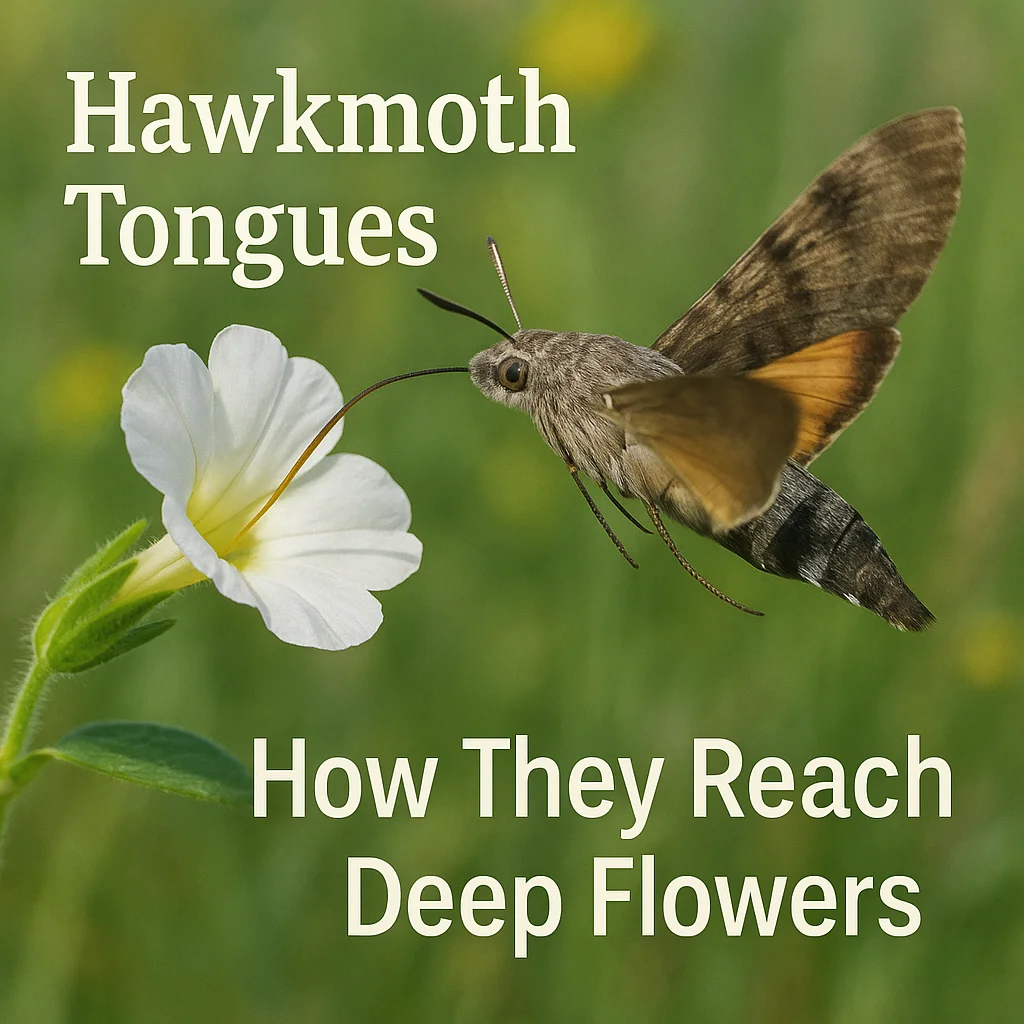
- Common Names: Hawk moth, Sphinx moth
- Scientific Name: Varies by species
- Insect: Yes, an invertebrate
- Order / Family: Lepidoptera / Sphingidae
- Typical Size Range: 5 to 20 cm wingspan
- Key Colors/Patterns: Typically brown, grey, or green with camouflage patterns
- Activity: Mostly nocturnal
- Typical Habitats: Gardens, forests, meadows
- Where in the World: Found on all continents except Antarctica
- Seasonality: Spring to fall depending on region
🔍 Identification
Hawkmoths are known for their robust bodies and streamlined shapes which facilitate their swift nocturnal flights. Their antennae are typically shorter than those of many other butterflies, being slightly feathery in appearance. They possess narrow, pointed wings that are ideal for fast movement. The legs are strong and adapted for clinging to vertical surfaces, aiding in their repoussé hovering behavior similar to that of hummingbirds.
- Body shape: bullet-like and streamlined
- Antennae: short and slightly feathery
- Wing features: narrow and pointed, aiding rapid flight
- Leg traits: strong for clutching surfaces
- Look-alikes: Some sphinx moths; check wing and body shape for distinction
🧠 Basic Body Structure
The hawkmoth, like all insects, is divided into three main body parts: head, thorax, and abdomen. It has six legs and two pairs of wings covered with microscopic scales. The exoskeleton protects its body and requires molting as the insect grows. As an invertebrate, it lacks a backbone, which allows for more flexible, lightweight movement among flowers.
🌍 Habitat & Distribution
Hawkmoths are highly adaptable and can be found in a variety of environments including dense forests, open meadows, and urban gardens. They thrive in areas where deep tubular flowers are abundant, as these provide essential nectar resources. Their geographic range is extensive, covering most temperate and tropical regions across the globe. Sightings can decrease in areas where habitat destruction and pesticide use are prevalent.
📅 Seasonal Appearance & Activity
Hawkmoths are primarily active during the warmer months, with peak activity varying by region. These moths are nocturnal, preferring to fly and feed during the cooler nights. Weather can significantly influence their presence, with mild, damp conditions being the most favorable.
- Best spotted spring to summer
- Nocturnal activity increases chances
- Prefers mild temperatures
- Enhanced sightings on damp nights
🥚 Reproduction & Egg-Laying
Mating behaviors in hawkmoths often involve intricate courtship flights and pheromone signaling to attract mates. Females typically lay eggs on host plants suitable for larvae, such as those with broad leaves. The number of eggs laid can vary widely, but some species produce hundreds per season.
🌀 Metamorphosis & Life Cycle
The hawkmoth undergoes complete metamorphosis, consisting of egg, larva (caterpillar), pupa, and adult stages. Eggs are usually laid on the underside of leaves, where larvae will hatch and begin feeding voraciously on the plant tissue. This stage is critical for growth and can last several weeks.
After reaching a suitable size, the caterpillar will pupate, forming a cocoon or a burrow in the soil. This stage may last several weeks to months depending on environmental conditions. The adult moth emerges, focusing primarily on feeding and reproduction.
🍽️ Diet & Feeding Behavior
Hawkmoth larvae are herbivorous, feeding on a variety of host plants. They possess chewing mouthparts designed for consuming tough foliage. Adult hawkmoths typically feed on nectar using a specialized proboscis adapted to reach the depths of tubular flowers, playing a crucial role as pollinators.
🦉 Predators & Defense
Natural predators of hawkmoths include birds, bats, and some mammals. To avoid predation, hawkmoths use camouflage, blending in with the surrounding vegetation. Some species have eye-like patterns to startle predators, while others may employ swift flight to escape threats.
- Camouflage among foliage
- Rapid, agile flight
- Startling eye markings on wings
- Nocturnal activity reduces predation risk
👥 Social Behavior & Swarms
Hawkmoths are typically solitary creatures, with males and females only coming together for mating. They do not form colonies but may be seen in significant numbers when optimal feeding or mating conditions arise, triggered by environmental cues such as season or floral abundance.
🧭 Senses & Communication
Hawkmoths rely heavily on their senses of smell and sight, particularly at night. They use their antennae to detect pheromones and other scents, finding mates and suitable flowers. Communication is primarily through chemical signals, and their large eyes are well-adapted for low-light conditions, aiding in navigation and locating nectar sources.
🌱 Role in the Ecosystem
Hawkmoths serve as vital pollinators, especially for night-blooming and deep tubular flowers. They play a role in maintaining the health of ecosystems and contribute to biodiversity. In turn, they are an important food source for many nocturnal predators.
📉 Population & Conservation Notes
While some hawkmoth species are abundant, others face threats from habitat loss and pesticide use. Conservation efforts focus on habitat preservation and promoting native plantings that support diverse life stages of these moths. In many regions, data on population status is limited but increased awareness may aid protection efforts.
- Plant native flowers to support food sources
- Reduce or eliminate pesticide use
- Conserve natural habitats and plant diversity
- Participate in citizen science to track populations
⚠️ Human Interaction & Safety
Hawkmoths do not pose any significant threat to humans, as they do not bite or sting. When observing these moths, it is essential to respect their habitat and avoid handling or disturbing them. If a hawkmoth is accidentally encountered indoors, gently guiding it outside can ensure its safety and minimize stress.
📌 Summary
- Hawkmoths are identified by their streamlined bodies and pointed wings.
- They inhabit gardens, forests, and meadows globally except Antarctica.
- Active primarily at night, their presence peaks in warmer months.
- Undergo complete metamorphosis: egg, larva, pupa, adult.
- Play critical roles as pollinators for night-blooming flowers.
- Utilize camouflage and rapid flight to evade predators.
- Solitary in nature, they rely on scent and sight for interactions.
- Conservation efforts focus on preserving their natural habitats.