🕷️ Io Moth: stinging caterpillar warning
🧾 Quick Facts
The Io moth is an intriguing member of the moth family known for its striking appearance and the stinging capabilities of its caterpillars. This guide provides a comprehensive overview of its characteristics, behaviors, and interactions with the ecosystem.
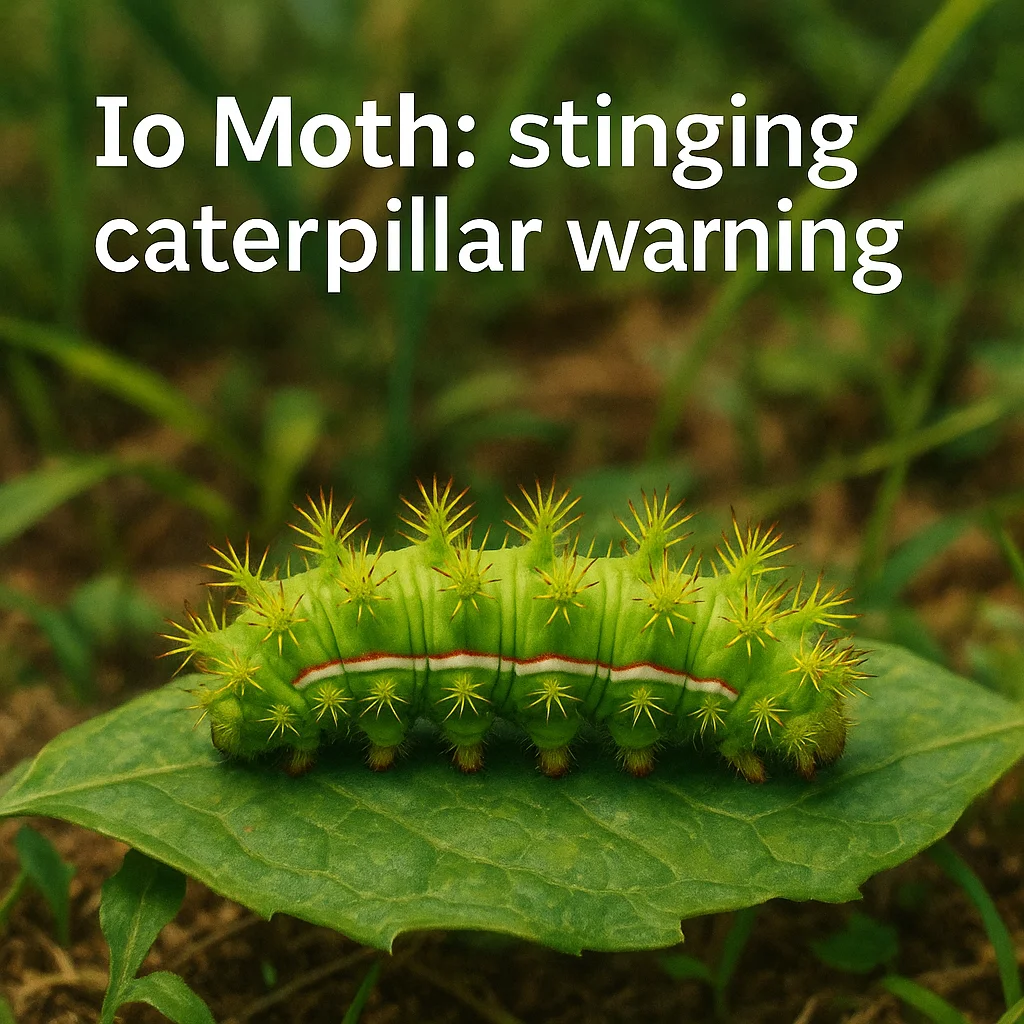
- Common names: Io moth
- Scientific name: Automeris io
- Insect or not: Yes, it is an insect, belonging to the order Lepidoptera.
- Order/family: Lepidoptera/Saturniidae
- Typical size range (adult): Wingspan of 2.5 to 3.5 inches
- Key colors/patterns: Bright yellow or brown wings with distinctive eye spots
- Activity: Mostly nocturnal
- Typical habitats: Woodlands, meadows, and suburban areas
- Where in the world it occurs: Primarily in North America, from Canada to Mexico
- Seasonality: Adults are most visible in late spring and summer
🔍 Identification
The Io moth can be identified in the field by its vibrant wing coloration and patterns. It has a stout body typical of many moths in the Saturniidae family. Its antennae are feathered, particularly in males, aiding in the detection of pheromones.
The moth's most distinguishing feature is the pair of large eyespots on its hind wings, which serve as a defense mechanism against predators. The forewings are usually a brownish or yellow hue, serving to camouflage the resting moth.
The caterpillars are noted for their vibrant green color, lined with spiny urticating setae that can cause skin irritation upon contact. These spines are a defensive measure against potential threats.
- Top ID Tips:
- Look for large size and robust body structure.
- Identify by the bright hindwing eyespots.
- Note the feathered antennae in males.
- Observe the yellow or brown forewings for camouflage when resting.
- Spot the vibrant green caterpillars with sting-capable spines.
- Check for diurnal resting and nocturnal activity.
🧠 Basic Body Structure
Like other insects, the Io moth has a segmented body divided into the head, thorax, and abdomen. It has six legs, which are typical for insects, emerging from the thorax. The moth is an invertebrate, meaning it lacks a backbone and has an exoskeleton providing structure and protection.
As a member of Lepidoptera, it undergoes complete metamorphosis, and its wings are covered with tiny scales. These scales contribute to its characteristic coloration and patterns.
🌍 Habitat & Distribution
The Io moth thrives in a variety of environments, including deciduous and mixed forests, meadows, and suburban gardens. They are commonly found in areas with ample host plants for the larvae to feed on, such as hackberry, willow, and various grasses.
Their geographical range spans much of North America, from the southern parts of Canada through the United States and into Mexico. Io moths prefer temperate climates but can adapt to warmer regions. Urban development and changes in local flora can impact their habitat availability, influencing local population sightings.
📅 Seasonal Appearance & Activity
The Io moth is most often observed from late spring through summer, aligning with its breeding and pupation cycles. It is predominantly nocturnal, becoming active during the evening and nighttime hours. This period coincides with warmer temperatures and higher humidity, which are conducive to its lifecycle activities.
- Best Time to Spot It:
- Late spring to late summer.
- During warm, humid evenings.
- Particularly active after sunset.
- Greater visibility in areas with abundant foliage.
🥚 Reproduction & Egg-Laying
Io moths engage in mating activities primarily during the evening, with males using their sensitive antennae to detect female pheromones. Courtship involves wing fluttering and close proximity interactions.
Females typically lay eggs on the underside of host plant leaves, often in clusters. The number of eggs per laying can vary, but they can deposit several hundred eggs across multiple sites to increase offspring survival chances.
🌀 Metamorphosis & Life Cycle
The Io moth undergoes a complete metamorphosis, transitioning through egg, larval, pupal, and adult stages.
The cycle begins with the eggs hatching into caterpillars (larvae) that feed voraciously on host plant leaves. This stage is widely variable, dependent on temperature and food availability, but typically lasts a few weeks.
Pupation occurs in cocoons spun from silk, providing camouflage and protection during the transformation into adult moths. The pupal stage can vary, often lasting several weeks. Upon emergence, the adults live for a short period, mainly focused on reproduction.
🍽️ Diet & Feeding Behavior
The Io moth caterpillars are herbivorous, feeding primarily on a range of plants such as maples, elms, and hibiscus. They have chewing mouthparts that enable them to consume leaves effectively.
Adult Io moths do not feed since they lack functional mouthparts for consuming nutrients. Consequently, their primary role in this stage is reproduction, drawing from fat reserves accumulated by the larvae.
🦉 Predators & Defense
Io moths face predation from birds, small mammals, and parasitic wasps. Throughout their lifecycle, they employ various defense mechanisms.
As caterpillars, their spines inject irritating substances, providing a physical and chemical deterrent to predators. The prominent eyespots on the adult moth's wings can startle or mislead predators into thinking they are staring at larger diurnal predators.
- Defense Highlights:
- Stinging spines on caterpillars deterring predators.
- Camouflage among foliage reduces visibility.
- Eyespots on wings to ward off threats.
- Curled wing resting position mimics a leaf.
👥 Social Behavior & Swarms
Io moths tend to be solitary creatures, primarily coming together for mating purposes. Males and females find each other through pheromone signaling.
These moths do not form swarms or migrate over large distances. Instead, they remain close to suitable breeding and feeding grounds based on the availability of host plants.
🧭 Senses & Communication
Io moths have well-developed senses of smell and touch, used chiefly during mating. The males use their highly sensitive antennae to detect pheromones released by potential mates.
These moths do not use sounds for communication. Their primary mode of environmental interaction is through their detection of chemical signals in their environment, which is critical for successful reproduction.
🌱 Role in the Ecosystem
The Io moth serves as both pollinator and prey within its ecosystem. Although adult moths don't feed, their presence can aid in pollination simply by their movement through flowering plants.
The caterpillars, as herbivores, can influence plant growth and health, serving as an integral connection between plants and the ecosystem's food web. They also provide a food source for various predators, linking them within a crucial ecological network.
📉 Population & Conservation Notes
Io moth populations are generally stable but can be affected locally by habitat destruction, pesticide use, and climate change. Efforts to preserve their natural habitats are crucial for their continued presence in various regions.
- How to Help (Low-Impact):
- Encourage native plant growth in local gardens.
- Avoid using broad-spectrum pesticides, especially in moth habitats.
- Leave leaf litter as habitat and food sources for caterpillars.
- Support conservation programs in your area.
⚠️ Human Interaction & Safety
Though adult Io moths pose no threat, their caterpillars can cause skin irritations if touched due to their urticating spines. It is advisable to avoid direct contact with the caterpillars.
If stung, gently wash the affected area with soap and water and avoid scratching. In cases of severe reactions, seeking professional medical advice is recommended. The respect for wildlife and observational enjoyment should guide human interactions, discouraging the collection of wild specimens.
📌 Summary
- Identifiable by distinctive eyespots and vibrant coloration.
- Prefers temperate woodlands and meadows.
- Seasonally active from late spring to summer, mostly nocturnal.
- Undergoes complete metamorphosis from egg to adult.
- Caterpillars feed on various host plants, adults do not feed.
- Natural predators include birds and small mammals.
- Essential ecological roles in herbivory and as prey.
- Respectful observation encouraged for safety and conservation.