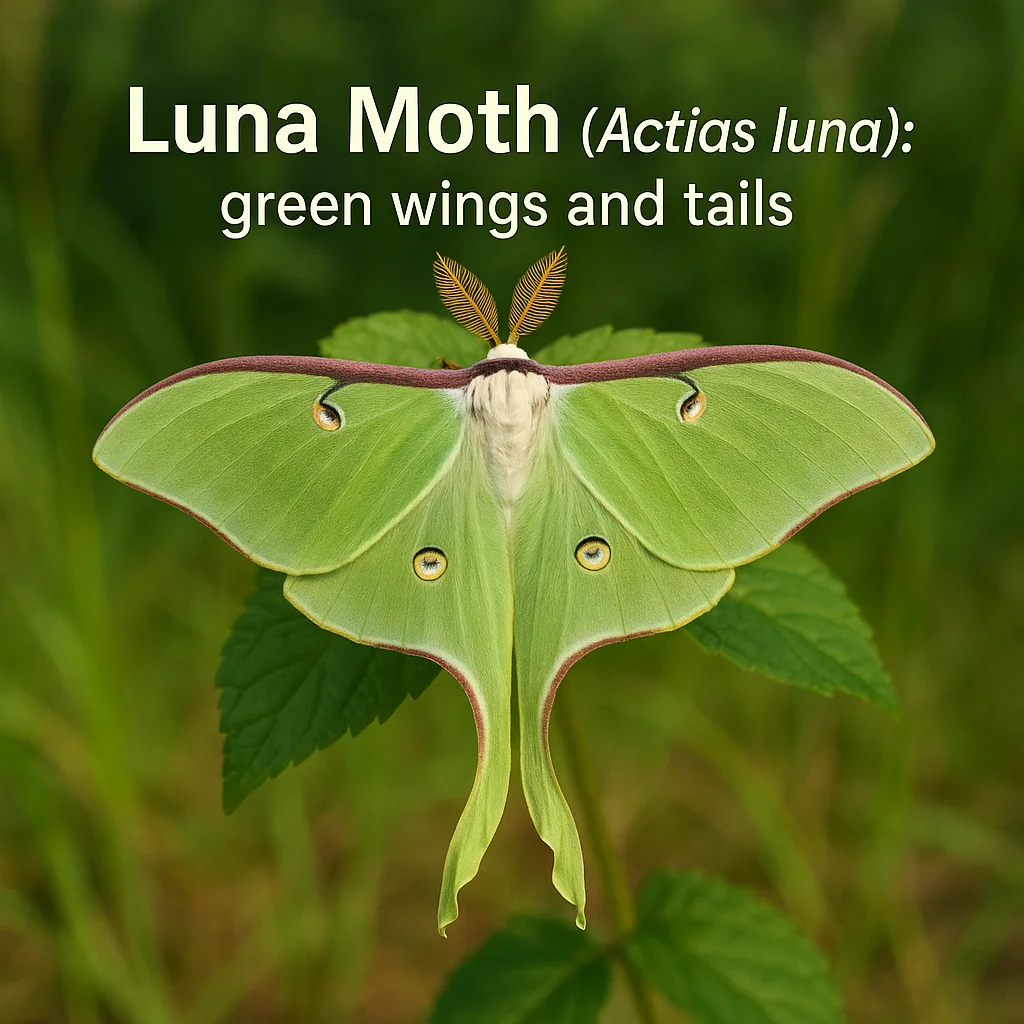
🕷️ Luna Moth (Actias luna): green wings and tails
🧾 Quick Facts
The Luna Moth, scientifically known as Actias luna, is one of the most iconic moths in North America, recognized for its spectacular green wings and distinctive tails. This species, as a member of the family Saturniidae, captivates enthusiasts with its nocturnal appearance and ephemeral adult stage.
- Common names: Luna Moth
- Scientific name: Actias luna
- Insect or not: Yes, it is an insect, invertebrate
- Order / family: Lepidoptera / Saturniidae
- Typical size range: 3 to 4.5 inches (7.5 to 11.5 cm) wingspan
- Key colors/patterns: Pale green wings with long tails; eyespots on forewings
- Activity: Nocturnal
- Typical habitats: Deciduous forests, urban and suburban areas with suitable trees
- Where in the world it occurs: Eastern North America, from Canada to Texas and Florida
- Seasonality: Adults visible in late spring to early summer, varies by region
🔍 Identification
The Luna Moth is unmistakable with its broad, pale lime-green wings extending into long tapering tails. Its forewings feature small eyespots, which may help deter predators. The insect’s body is covered with a soft, hairy texture, and its antennae are feathered, particularly notable in males. It possesses six legs, and while flightless in some stages, adult Luna Moths glide gracefully from perch to perch.
- Long bright green wings with yellowish margins
- Distinctive trailing tails on each hindwing
- Furry white body with legs mostly hidden under wings
- Feathered antennae, more prominent in males
- Dark circular eyespots positioned on each forewing
- Easily confused with other large Saturniidae moths, but wing shape and color help distinguish
🧠 Basic Body Structure
As an insect, the Luna Moth is comprised of three main body parts: the head, thorax, and abdomen. Each section plays a vital role in its biology. It possesses six legs and a pair of broad wings attached to its thorax, vital for its mobility. Covered by an exoskeleton, the Luna Moth undergoes molting as it develops through various life stages. Luna Moths are invertebrates, meaning they lack an internal skeleton, contrasting them from vertebrates, and possess a hard external covering for protection.
🌍 Habitat & Distribution
The Luna Moth thrives in deciduous forests across eastern North America where broadleaved trees are abundant. They can also inhabit adjacent urban and suburban areas where such tree species are cultivated. Preferring warm humid environments, they are infrequently seen in colder climates. The moth's life and visibility heavily depend on the availability of host plants like hickory, walnut, and sweetgum trees where they establish their life cycles.
📅 Seasonal Appearance & Activity
Luna Moths are most commonly observed as adults during late spring and early summer. Their presence can shift depending on the latitude; further southward, moths may emerge early, extending into late summer. As primarily nocturnal creatures, they are drawn to artificial lights from dusk through nighttime, a behavior that sometimes leads them to urban settings.
- April to July (north) and February to September (south)
- Nocturnal; highest activity at night
- Warm and humid evenings increase sightings
- Moonlit nights may increase visibility
🥚 Reproduction & Egg-Laying
The mating behavior of the Luna Moth involves males detecting female pheromones using their highly sensitive antennae. After mating, females lay hundreds of eggs scattered on the leaves of host plants such as birch, hickory, and walnut. The pale eggs are cylindrical and hatch in approximately one week, leading to the caterpillar stage. Egg-laying strategies vary; females aim to place eggs widely to increase survival potential.
🌀 Metamorphosis & Life Cycle
The Luna Moth undergoes complete metamorphosis, encompassing four stages: egg, larva (caterpillar), pupa (cocoon), and adult moth. As caterpillars, they primarily feed on leaves of deciduous trees, growing rapidly over a few weeks before spinning silk and forming cocoons in fallen leaves. The pupation stage can last up to three weeks. Adults emerge in spring or summer, notable for their lack of a digestive tract as their brief adult life focuses on reproduction.
🍽️ Diet & Feeding Behavior
Caterpillars of the Luna Moth are herbivorous, possessing chewing mouthparts used to consume a variety of leaves. Adult moths, however, do not feed and lack functional mouthparts, deriving all necessary energy and reserves during the larval stage. This energy sustains them throughout their short adult lifecycle, allowing focus on reproduction rather than sustenance.
🦉 Predators & Defense
Luna Moths face threats from avian predators such as birds and mammals like bats. Camouflage plays a crucial part in their defense; their green wings blend with foliage, and eyespots might deter or confuse predators. While lacking dangerous stings or bites, caterpillars employ tight cocoon spinning as a final safeguard during pupation.
- Camouflage through green wing coloration
- Eyespots as decoy targets against predators
- Pheromone distraction during mating
- Protection inside well-designed cocoons for pupation
👥 Social Behavior & Swarms
Luna Moths are solitary, with no active social structure beyond mating interactions. Males and females come together primarily for reproduction, influenced by pheromone chemistry. There are no established colonies or cooperative behaviors evident within the species.
🧭 Senses & Communication
Luna Moths boast well-developed senses of smell, primarily facilitated by their feathered antennae, to locate mates through pheromones. Visual perception is also integral, helping them navigate at night. Communication is limited to these chemical signals and visual cues rather than auditory or verbal messages.
🌱 Role in the Ecosystem
Within their ecosystem, Luna Moths serve essential functions. Caterpillars contribute to plant trim and growth dynamics by feeding on leaves. While adults are primarily preoccupied with reproduction, the species at large supports the food web, serving as prey for various animals like birds and small mammals. Additionally, caterpillars' consumption of specific tree leaves aids in nutrient cycling within forest environments.
📉 Population & Conservation Notes
While the Luna Moth is not currently listed as threatened, local populations may be impacted by habitat loss and light pollution. These factors disrupt their natural behavior patterns and habitat availability. Observations suggest varied abundance, with some regions plentiful while others see declines due to environmental changes.
- Preserve native tree habitats to support life cycles
- Minimize use of pesticides in gardens and forests
- Reduce unnecessary outdoor lighting to protect nocturnal habits
- Promote awareness on the ecological role of moths
⚠️ Human Interaction & Safety
Luna Moths are harmless to humans, possessing no biting or stinging capabilities. Observers are encouraged to appreciate these moths without interference or collection, respecting them in their natural environments. As always, when encountering wildlife, gentle observation is preferred over disturbance or physical interaction.
📌 Summary
- Easy identification by green wing color and tail extensions
- Found across eastern North America in deciduous settings
- Emerge mainly during late spring to early summer
- Complete metamorphosis with distinct larval and adult stages
- Herbivorous caterpillars, non-feeding adults
- Predators include birds and bats; effective camouflage defense
- Caterpillars contribute to plant health and nutrient cycling
- Encourage conservation by preserving nature and reducing light pollution
- Luna Moths pose no threat to humans; observe respectfully