🕷️ Polyphemus Moth (Antheraea polyphemus): giant eyespots
🧾 Quick Facts
The Polyphemus Moth, scientifically known as Antheraea polyphemus, is an impressive moth species belonging to the family Saturniidae. Notable for its large size and distinctive eye-like patterns, this moth plays a fascinating role in North American ecosystems.
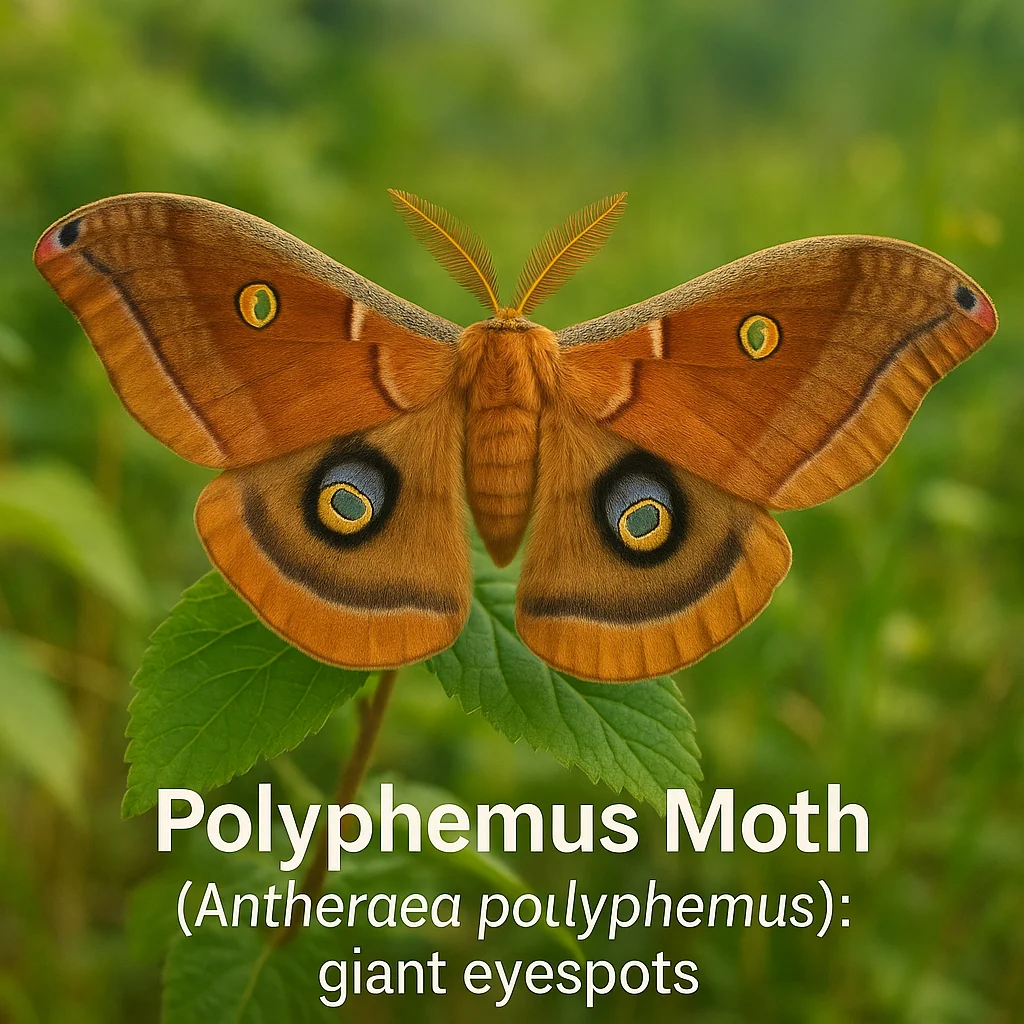
- Common names: Polyphemus Moth
- Scientific name: Antheraea polyphemus
- Insect or not: Insect (an invertebrate)
- Order / Family: Lepidoptera / Saturniidae
- Typical size range: Wingspan of 10 to 15 centimeters
- Key colors/patterns: Tan, brown, with large, bold eyespots
- Activity: Nocturnal
- Typical habitats: Deciduous forests, suburban areas
- Where in the world it occurs: North America
- Seasonality: May through July is peak adult visibility
🔍 Identification
The Polyphemus Moth is easily recognized by its large, broad wings adorned with vibrant eyespots. The body is robust, and the antennae are feathery, which is a typical characteristic of many male saturniid moths. These moths have a gentle flight pattern with their wings prominently displayed.
- Body shape: Large and robust with a plump body
- Antennal structure: Feathery in males, thinner in females
- Wing features: Two large eyespots on the hindwings
- Leg traits: Covered in fine hair, typical to moths
- Distinguishing look-alikes: Luna Moth lacks the eyespot variation
- Top ID Tips:
- Look for the large, prominent eyespots on hindwings
- Note the wingspan, often up to 15 centimeters
- Feathery antennae are a key marker
- Tan to brown body coloration
- Nocturnal habits, seen at night
🧠 Basic Body Structure
The Polyphemus Moth, like all insects, is divided into three main body sections: the head, thorax, and abdomen. It possesses six jointed legs, a feature characteristic of insects, and an exoskeleton that provides structure and protection. These moths are invertebrates, meaning they do not have a backbone.
🌍 Habitat & Distribution
The Polyphemus Moth thrives in a variety of habitats from dense deciduous forests to urban gardens. You might spot them around homes and light sources where they’re inexplicably drawn. Found throughout North America, their preference for temperate environments defines their distribution
📅 Seasonal Appearance & Activity
Polyphemus Moths are primarily active during the warmer months, typically appearing from late spring through midsummer. They are nocturnal creatures, most visible on warm, clear nights.
- Best Time to Spot It:
- Late spring to early summer
- Warm, dry evenings
- Near artificial light sources
- In temperate forested regions
🥚 Reproduction & Egg-Laying
Polyphemus Moths engage in nocturnal mating rituals. Males are drawn to females by pheromones. After mating, females lay eggs on host trees, mainly deciduous varieties such as oaks and maples. Each female can lay up to several hundred eggs semi-randomly distributed across suitable plants.
🌀 Metamorphosis & Life Cycle
Polyphemus Moths undergo complete metamorphosis:
- Eggs are laid on host plant leaves, hatching after a week or two.
- The larval stage (caterpillars) is marked by voracious feeding on foliage, lasting 5-6 weeks.
- During the pupal stage, they form highly durable cocoons, undergoing metamorphosis for several months.
- Adults emerge primarily to mate, living only for a few days.
🍽️ Diet & Feeding Behavior
As adults, Polyphemus Moths do not feed. Their short lifespan as moths is solely for reproduction. Larvae, however, are herbivorous, consuming leaves of several broadleaf tree species, which support their rapid growth.
🦉 Predators & Defense
The Polyphemus Moth has several natural predators, including birds, mammals, and reptiles. One of its key defense mechanisms is the eyespots on its wings, which act as a form of startle display to deter predators.
- Defense Highlights:
- Large eyespots mimic eyes of larger animals
- Nocturnal activity reduces daytime predation
- Quick erratic flight helps evade capture
- Cocoons are camouflaged and robust
👥 Social Behavior & Swarms
Polyphemus Moths are primarily solitary creatures. They do not form swarms or colonies. Their encounters with others occur primarily during mating when males seek out females through pheromone cues.
🧭 Senses & Communication
These moths rely heavily on their sense of smell, particularly males who detect female pheromones from kilometers away. While their vision is limited, their tactile senses are significant, as is their ability to sense vibrational cues from the environment.
🌱 Role in the Ecosystem
The Polyphemus Moth plays a critical role as a consumer of plant foliage during its larval stage, impacting leaf biomass and serving as a food source for various animals. As moths, they occasionally act as pollinators. However, their significance in this role is limited due to their short adult lifespan and lack of feeding.
📉 Population & Conservation Notes
The Polyphemus Moth is generally considered common within its suitable habitats across North America. Still, local populations may be impacted by pesticide use and habitat loss due to urbanization.
- How to Help (Low-Impact):
- Plant native trees and shrubs
- Limit pesticide use in gardens
- Encourage diverse garden ecosystems
- Leave leaf litter as habitat
⚠️ Human Interaction & Safety
Polyphemus Moths are harmless to humans, lacking the ability to sting or bite. As with all wildlife, it is important to observe respectfully without capturing or collecting specimens to ensure their natural behaviors and lifecycle continue undisrupted.
📌 Summary
- The Polyphemus Moth is a large, nocturnal insect with distinctive eyespots.
- It inhabits temperate regions of North America, favoring deciduous forests.
- Active primarily from late spring to midsummer, especially at night.
- Undergoes complete metamorphosis, with non-feeding adults.
- Larvae feed on broadleaf trees, playing a role in the ecosystem's foliage cycling.
- Key defenses include eyespots and nocturnal habits to evade predators.
- Interaction with humans is rare and non-threatening.
- Supports biodiversity by serving as prey for various animals.