🕷️ Silk moths (Saturniidae): why adults don’t eat
🧾 Quick Facts
Silk moths, known for their stunning appearance and significant role in ecosystems, are members of the Saturniidae family. While their caterpillars are active feeders, adult silk moths have a unique characteristic—they do not eat. Below are some quick facts about these fascinating insects:
- Common names: Giant silk moths, Emperor moths
- Scientific name: Varies by species
- Insect classification: Yes, they are invertebrates
- Order / family: Lepidoptera / Saturniidae
- Typical size range (adult): Wingspan from 7.5 cm to over 30 cm
- Key colors/patterns: Varied; often eye spots and vibrant colors
- Activity: Mostly nocturnal
- Typical habitats: Forests, meadows, shrublands
- Where in the world: Worldwide, especially in tropical and subtropical regions
- Seasonality: Often visible in spring and summer
🔍 Identification
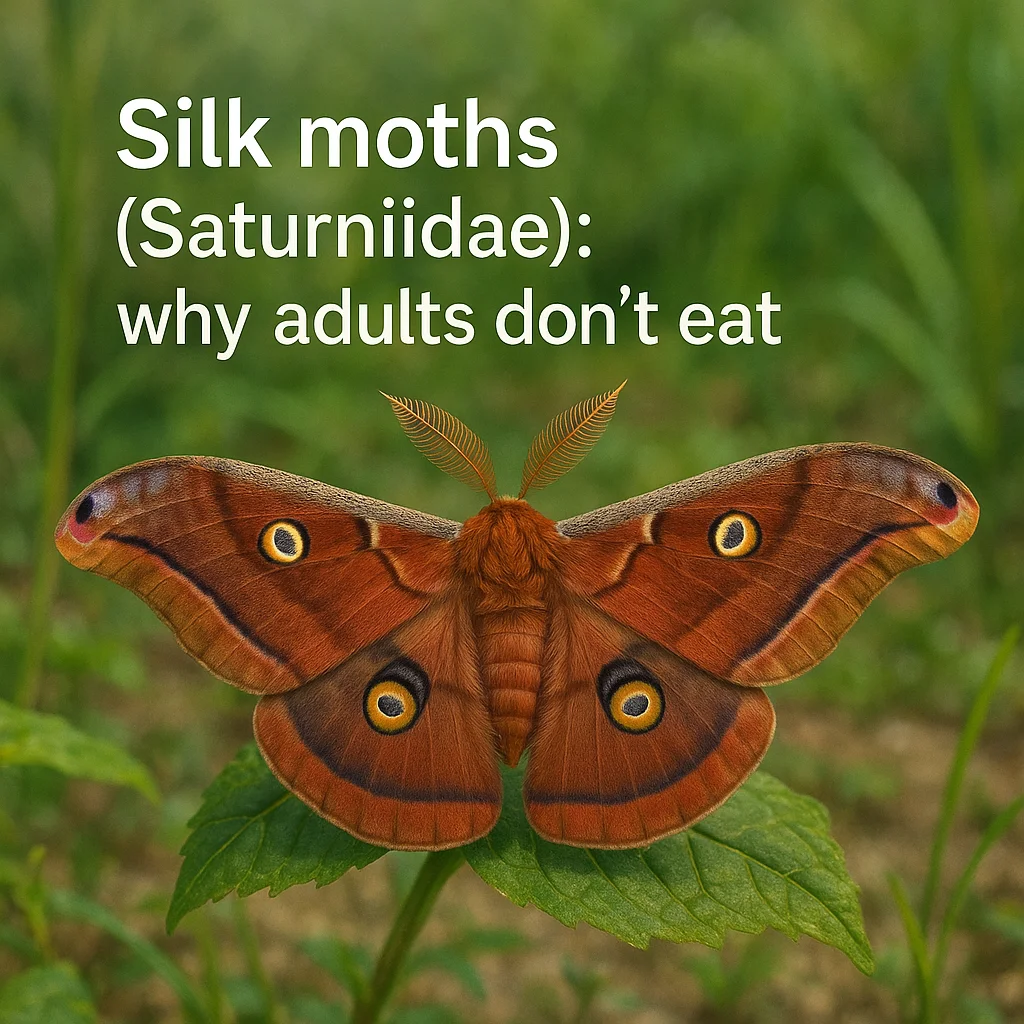
Identifying silk moths involves observing their large and robust bodies and the unique patterns on their wide wings. Adults exhibit various colorations, often mimicking eyes or frightening larger predators. Their feathery antennae help them detect pheromones during mating.
- Top ID Tips
- Observe their large, wide wings with distinctive patterns
- Note the feathery antennae, particularly prominent in males
- Check for robust, stocky bodies typical of Saturniidae moths
- Look for distinctive eye spots, common in many species
- Note the lack of mouthparts for feeding in adults
- Identify by the nocturnal activity pattern
- Consider their presence in ecological habitats like forests and meadows
🧠 Basic Body Structure
Silk moths, like all insects, possess a body divided into three main parts: the head, thorax, and abdomen. They have six legs and two pairs of wings attached to the thorax, which are often richly colored and patterned. As invertebrates, they rely on an exoskeleton for protection and structure, molting the exoskeleton as they grow.
🌍 Habitat & Distribution
Silk moths favor diverse environments, including dense forests, open meadows, and shrublands. These habitats provide the necessary resources for their larvae and suitable conditions for adult moth activities. Distribution of silk moths spans across tropical and subtropical regions, with some species adapted to temperate climates. Habitat loss and climate changes affect their distribution patterns and can lower local populations.
📅 Seasonal Appearance & Activity
The best time to observe silk moths is during the warmer months, where they are active mainly at night. The temperature, rain, and humidity influence their lifecycle and activity.
- Best Time to Spot It
- Spring through summer
- During warm evenings
- After rainfall, which triggers activity
- Across both tropical and temperate regions
🥚 Reproduction & Egg-Laying
Silk moths engage in mating rituals initiated by females releasing pheromones to attract males. Once mated, females lay eggs on host plants suitable for caterpillar development. Egg batches can vary widely between species, with some depositing a few dozen while others lay hundreds. The selection of specific plants ensures that newly hatched larvae have immediate access to food.
🌀 Metamorphosis & Life Cycle
Silk moths undergo complete metamorphosis, a four-stage life cycle:
- Eggs: Laid on host plants, they develop based on temperature and humidity.
- Larvae: The caterpillars feed voraciously on plant leaves, growing through several molts.
- Pupa: They form a cocoon, undergoing transformation over weeks or months.
- Adult: Emerges without feeding capability, living only to reproduce and fulfill their ecological roles.
🍽️ Diet & Feeding Behavior
Throughout their life stages, silk moths exhibit varying feeding behaviors. The larvae serve as herbivores, consuming large quantities of foliage from their host plants. In contrast, adult silk moths do not eat; they possess non-functional mouths, relying on larval energy reserves to sustain them through their short adult lifespan. As such, adults do not feed, fulfilling roles in reproduction and pollination instead.
🦉 Predators & Defense
Silk moths face numerous predators including birds, bats, and spiders. To counteract these threats, they employ various defense mechanisms. Their vibrant wing patterns can startle predators or serve as camouflage. Additionally, some mimic the appearance of toxic species, deterring predators through coloration alone. The sheer size of some species can also be an intimidating factor for potential threats.
- Defense Highlights
- Camouflage with surroundings
- Mimicry of toxic butterflies
- Startle defense with eye spots
- Large size deterring smaller predators
👥 Social Behavior & Swarms
Silk moths are largely solitary, with their primary social interactions occurring during the mating season. Although they do not form communal swarms like some other moth species, favorable conditions can lead to increased local concentrations, especially in areas abundant in host plants for their larvae.
🧭 Senses & Communication
Silk moths have a highly developed sense of smell, notably through their antennae, which males use to detect female pheromones across significant distances. Their eyesight, adapted to low-light conditions, aids in nocturnal navigation. However, auditory senses are less developed compared to diurnal moth and butterfly species.
🌱 Role in the Ecosystem
As essential members of the ecosystem, silk moths contribute vastly through different life stages. Caterpillars aid in plant population control through defoliation, while adult moths function as pollinators for night-blooming flowers. They have mutualistic relationships with various plant species and form critical parts of food webs, supporting biodiversity.
📉 Population & Conservation Notes
Silk moths often face threats from habitat destruction, pesticides, and light pollution. Some species remain common in suitable environments, yet others suffer population declines due to changing environmental conditions and anthropogenic effects. Conservation efforts emphasize creating moth-friendly habitats and reducing pesticide use.
- How to Help (Low-Impact)
- Plant native flora to support larvae and adults
- Reduce outdoor artificial lighting at night
- Avoid harmful pesticides and fertilizers
- Provide suitable overwintering sites, like leaf litter
⚠️ Human Interaction & Safety
Silk moths are harmless to humans and do not bite or sting. Their stunning appearance invites observation rather than collection, promoting a respectful approach to wildlife. Encouraging native plant growth and avoiding chemical detriments are the best practices for ecosystem balance.
📌 Summary
- Silk moths belong to the Saturniidae family
- Characteristic large wings and vibrant eye spots
- Adults do not eat; primarily mate and reproduce
- Favors forests, meadows; active in warm months
- Complete metamorphosis: egg, larvae, pupate, adult
- Larvae are voracious herbivores; adults non-feeders
- Threatened by habitat loss; benefits from conservation
- Non-aggressive, safe for human interaction