🕷️ Common Crow (Euploea core): glossy black ID
🧾 Quick Facts
The Common Crow, scientifically known as Euploea core, is a striking member of the butterfly family. With its glossy black wings adorned with white spots, it's a familiar sight in many parts of Asia and Australia. This invertebrate is a part of the brush-footed butterfly family, showcasing a unique combination of beauty and resilience. Here are some quick facts about this fascinating species:
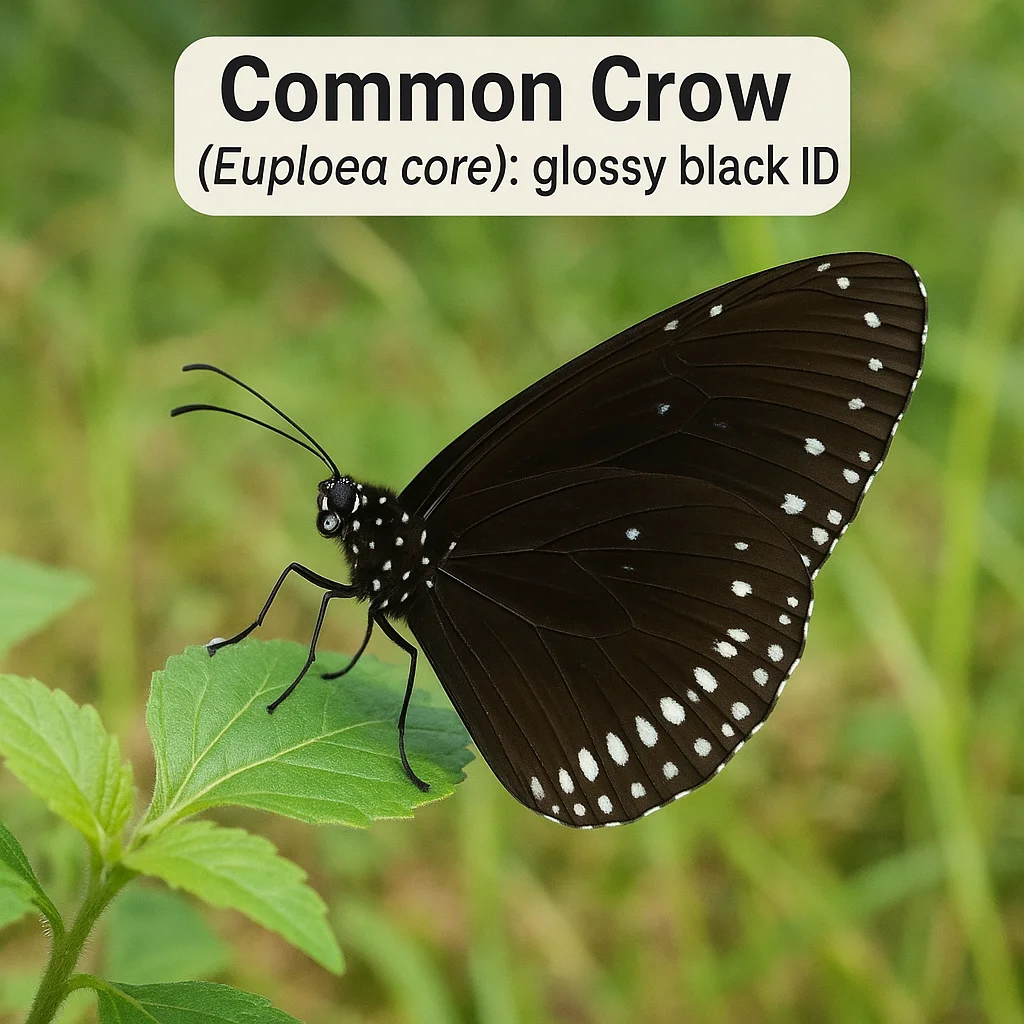
- Common names: Common Crow, Oleander Butterfly
- Scientific name: Euploea core
- Insect: Yes, this is an invertebrate
- Order: Lepidoptera / Family: Nymphalidae
- Typical size range: 8-9 cm wingspan
- Key colors/patterns: Glossy black with white spots and margins
- Activity: Diurnal (active during the day)
- Typical habitats: Forests, gardens, urban environments
- World regions: Widely found across South Asia and parts of Southeast Asia and Australia
- Seasonality: Most visible during warm months
🔍 Identification
Recognizing the Common Crow is relatively straightforward thanks to its distinct features. This species boasts a striking silhouette with its broad, rounded wings and slender body. The antennae are clubbed, a typical feature in butterflies, aiding in their sense of smell. The wings are the most prominent feature, displaying a glossy black color with bold white spots along the margins. These butterflies are often mistaken for other black-and-white butterfly species, but their patterns and flight behavior set them apart.
- Top ID Tips:
- Broad, rounded wings
- Glossy black coloration with white spots
- Clubbed antennae
- Uniform flight style: slow and steady
- Seen commonly in gardens and open fields
- Often confused with the Plain Tiger but lacks orange hues
- Active during daylight
- Prefers nectar-rich flowers
🧠 Basic Body Structure
As an insect, the Common Crow has a three-part body structure: head, thorax, and abdomen. Like all insects, it possesses six legs mounted on the thorax. The wings, also attached to the thorax, enable its graceful flight. Butterflies like the Common Crow have an exoskeleton, which provides protection and support, and they undergo molting throughout their life stages. The Common Crow is an invertebrate, meaning it lacks an internal skeleton or backbone, distinguishing it from vertebrates such as mammals and birds.
🌍 Habitat & Distribution
The Common Crow favors warm, tropical environments, thriving in both natural and man-made habitats. You'll often find them flitting through forests, gardens, and even urban landscapes where flowering plants abound. They show a partiality for open fields and gardens, particularly those rich in nectar plants.
The geographic range of Euploea core stretches across the Indian subcontinent, parts of Southeast Asia, and into northern Australia. They can also be found in various climatic regions but prefer areas with moderate to high humidity.
📅 Seasonal Appearance & Activity
The Common Crow is predominantly a warm-weather butterfly, with its highest activity during the spring and summer months. They are diurnal, which means they are most active during daylight hours. These butterflies are quite sensitive to weather conditions; they prefer dry, warm days and are less active in cold or rainy weather.
- Best Time to Spot It:
- Spring and summer months
- Mid-morning to afternoon
- Warm and sunny days
- Near nectar-rich gardens
- Urban parks with flowering plants
🥚 Reproduction & Egg-Laying
The reproductive behavior of the Common Crow involves a fascinating courtship display. Males are known to patrol their territories and display to females with aerial performances. Once mating occurs, females lay eggs on the underside of leaves of host plants, which caterpillars feed on once hatched. Typical host plants include species from the Apocynaceae family, such as Oleander.
The number of eggs laid by a single female can vary, influenced by environmental conditions and the availability of host plants.
🌀 Metamorphosis & Life Cycle
The Common Crow undergoes complete metamorphosis, featuring four distinct life stages: egg, larva (caterpillar), pupa (chrysalis), and adult butterfly. After hatching from eggs, the caterpillars feed voraciously on host plants, growing rapidly. This stage typically lasts a few weeks, during which multiple molts occur to accommodate growth.
Once fully grown, the caterpillar transforms into a pupa, enclosed within a chrysalis. This stage involves significant transformation, although the duration can vary. Finally, the adult butterfly emerges, ready to feed on nectar and begin the cycle anew.
🍽️ Diet & Feeding Behavior
The diet of the Common Crow changes as it matures. Caterpillars exclusively consume leaves of their host plants, which are often toxic, providing them with a measure of defense against predators. As adults, the Common Crow primarily feeds on nectar, utilizing its proboscis to reach deep into flowers. This butterfly also plays a role as a pollinator and is occasionally seen feeding on rotting fruit or sap.
🦉 Predators & Defense
Common predators of the Common Crow include birds, reptiles, and amphibians. However, this butterfly has evolved several defense mechanisms. The ingestion of toxins from host plants during the caterpillar stage provides a level of chemical defense, making them unpalatable to many predators. Additionally, they employ mimicry, resembling other toxic species to deter potential threats.
- Defense Highlights:
- Chemical defenses from host plant toxins
- Mimicry to resemble other unpalatable species
- Swift, erratic flight to evade predators
- Camouflage among dark foliage
👥 Social Behavior & Swarms
The Common Crow is primarily a solitary creature, with individual butterflies maintaining personal territories. However, mass gatherings do occur during migration periods, where groups move en masse in search of resources. These migrations are often triggered by changes in climate or food availability, demonstrating an adaptation to their environment.
🧭 Senses & Communication
Common Crow butterflies rely on a combination of vision and chemical cues for communication. Their eyes are sensitive to a broad spectrum of light, aiding in navigation and mate location. Antennae play a crucial role in detecting pheromones, essential for breeding and recognizing host plants. These butterflies also use subtle wing gestures to communicate with potential mates and establish territory.
🌱 Role in the Ecosystem
The ecological role of the Common Crow is significant, particularly in pollination. As they move from flower to flower feeding on nectar, they aid in the pollination of numerous plant species. They also contribute to the food web, serving as prey for a range of predators, and play a role in controlling the population growth of certain plant species through their caterpillar feeding activities.
While they can have some impact on human agriculture, particularly when caterpillars feed on certain ornamental or crop plants, they generally provide more ecological benefits than downsides.
📉 Population & Conservation Notes
The Common Crow is generally reported as abundant within its suitable habitats. However, like many butterflies, it faces threats from habitat destruction, climate change, and pesticides, which can impact local populations. Conservation efforts that focus on preserving natural habitats and promoting biodiversity can help ensure their continued presence.
- How to Help (Low-Impact):
- Plant native flowering plants to provide nectar sources
- Minimize pesticide use in gardens and agricultural areas
- Create butterfly-friendly gardens
- Preserve native host plants for caterpillars
- Participate in local conservation programs
⚠️ Human Interaction & Safety
The Common Crow butterfly poses no threat to humans. It neither bites nor stings, making it safe for close observation. However, they should be respected and observed in their natural setting without being collected or disturbed. Promoting safe and respectful interaction with wildlife contributes to the conservation and appreciation of these remarkable creatures.
📌 Summary
- Recognizable by glossy black wings with white spots
- Thrives in warm, tropical habitats with plenty of flowers
- Most active during warmer months, particularly in daylight
- Undergoes complete metamorphosis from egg to adult
- Nectar feeders as adults, herbivorous caterpillars
- Faces natural predators, employs chemical and visual defenses
- Plays a crucial role in pollination and the ecosystem
- Generally common, though conservation efforts are important
- No direct threat to humans, encourages respectful observation