🕷️ Common Mormon (Papilio polytes): female mimic forms
🧾 Quick Facts
The Common Mormon butterfly, scientifically known as Papilio polytes, is a fascinating species renowned for its ability to mimic the appearance of other butterflies. This trait is particularly evident in the females, which display a variety of mimic forms. Here are some quick facts about this intriguing butterfly species:
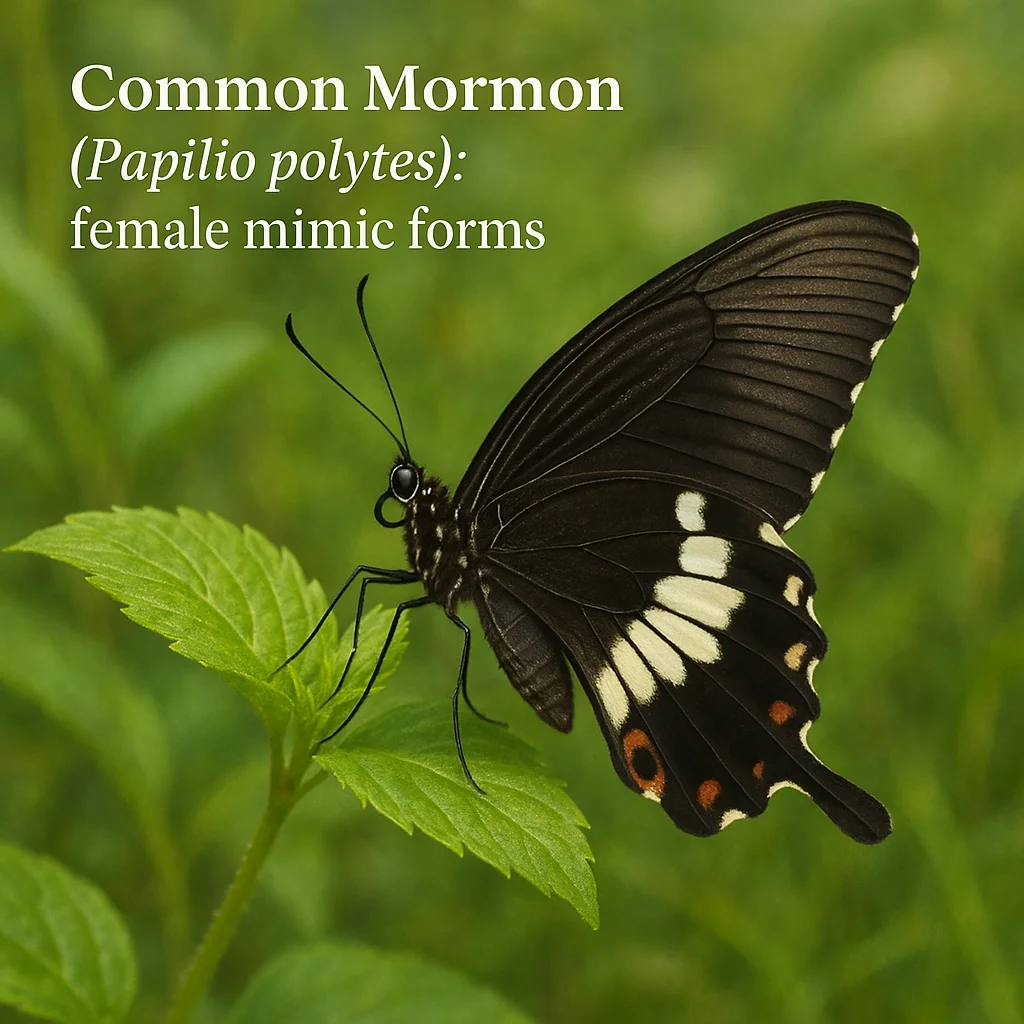
- Common names: Common Mormon
- Scientific name: Papilio polytes
- Insect: Yes, it is an invertebrate
- Order / Family: Lepidoptera / Papilionidae
- Typical size range: 70–90 mm wingspan
- Key colors/patterns: Black with white and red markings; females exhibit various mimic forms
- Activity: Diurnal
- Typical habitats: Gardens, deciduous forests, and urban areas
- Where in the world: South Asia, Southeast Asia, and parts of East Asia
- Seasonality: Most visible during warmer months
🔍 Identification
The Common Mormon butterfly is easily recognizable by its distinctive color patterns and wing shapes, although females can vary considerably due to mimicry. Identifying features include:
- Body shape and silhouette: Slim, elongated body typical of butterflies
- Antennae type: Clubbed antennae, a distinguishing feature of butterflies
- Wing features: Black wings with white and red patterns, especially visible in males; females often mimic other species
- Leg traits and movement style: Six legs used for perching; graceful, fluttering flight
- Distinguishing look-alikes: Other swallowtail butterflies; females mimic toxic butterflies like the Common Rose
- Observe the butterfly's flight pattern; swift and purposeful
- Note the white and red markings on the wings in males
- Watch for varying female patterns that mimic other butterflies
- Look for clubbed antennae characteristic of butterflies
- Females often resemble species like the Common Rose butterfly
- Size and shape consistent with other swallowtails
🧠 Basic Body Structure
The Common Mormon butterfly, like all insects, is composed of three main body parts: the head, thorax, and abdomen. These are common features among insects:
- Head: Contains sensory organs like antennae and compound eyes
- Thorax: Houses the wings and legs
- Abdomen: Responsible for digestion and reproduction
Butterflies, including the Common Mormon, possess six legs, a defining trait of insects. They have an invertebrate structure, meaning they lack a vertebral column, and an exoskeleton that provides support and protection. During their lifecycle, they undergo metamorphosis, which typically includes the molting of their exoskeleton.
🌍 Habitat & Distribution
The Common Mormon butterfly thrives in various habitats across its broad geographic range. Preferred environments include:
- Forested areas with abundant vegetation
- Gardens and urban green spaces
- Deciduous forests and shrublands
Geographically, this butterfly is found predominantly in South, Southeast, and East Asia. Its presence is strongly influenced by habitat availability; loss of habitats may reduce their sightings in certain regions.
📅 Seasonal Appearance & Activity
The Common Mormon is most active during warmer months, with visibility fluctuating depending on local environmental conditions. It is a diurnal species, meaning it is most active during daylight hours. Climate factors like temperature and humidity can influence their activity levels.
- Warm months are ideal for sightings
- Early mornings and daytime are best
- Low wind conditions favor activity
- Most visible after rains when vegetation is lush
🥚 Reproduction & Egg-Laying
The Common Mormon engages in various courtship behaviors involving visual displays and scents. Females typically lay eggs on host plants, such as citrus trees, which provide nutrients for emerging larvae. A single female can lay multiple eggs over different plants, although exact counts can vary significantly based on environmental conditions.
🌀 Metamorphosis & Life Cycle
The Common Mormon butterfly undergoes complete metamorphosis, consisting of four distinct stages: egg, larva (caterpillar), pupa (chrysalis), and adult butterfly.
Egg Stage: Eggs are laid on the leaves of host plants. They are small, spherical, and typically hatch within a week.
Larva Stage: The caterpillar feeds voraciously on host plant leaves and undergoes several molts. This stage lasts around 2-3 weeks, during which it grows significantly.
Pupa Stage: The caterpillar forms a chrysalis, attached to a suitable structure like a stem or leaf. During this stage, which lasts about 10-14 days, the butterfly undergoes transformation.
Adult Stage: Emergence as an adult butterfly, ready for mating and reproduction.
🍽️ Diet & Feeding Behavior
The diet of the Common Mormon varies significantly across its lifecycle:
- Larvae: Feed on leaves of host plants, such as citrus
- Adults: Nectar feeders, visiting a wide variety of flowers
As an herbivore, the Common Mormon plays a significant role in the ecosystem, primarily as a pollinator, particularly contributing to the reproduction of various flowering plants.
🦉 Predators & Defense
The Common Mormon butterfly faces various natural predators, including birds, reptiles, and spiders. Its primary defense strategy is mimicry, particularly among females, which often resemble unpalatable species. Additional defenses include:
- Camouflage when at rest among foliage
- Swallowtail pattern deters predators
- Swift flight helps avoid capture
- Startle displays with bright wing colors
👥 Social Behavior & Swarms
The Common Mormon butterfly is generally solitary, except during mating seasons. This species does not form social structures like colonies, and interactions are primarily limited to mating encounters. Swarming behaviors are not typical for this butterfly, although they may gather in large numbers when resources like nectar are abundant.
🧭 Senses & Communication
The Common Mormon butterfly uses a variety of senses to navigate and interact with its environment:
- Vision: Compound eyes help detect movement and color
- Smell: Antennae detect chemical signals, including pheromones for communication
- Touch: Sensory hairs on legs and body
Pheromones play a crucial role in communication, particularly during mating when they are used to attract potential mates.
🌱 Role in the Ecosystem
The Common Mormon butterfly is a critical pollinator, helping in the cross-pollination of various plant species. This function aids in plant reproduction and fruit development, which in turn supports broader ecological systems. While adult butterflies primarily interact with plants, the larvae can influence the health of host plants by feeding heavily on their leaves.
📉 Population & Conservation Notes
Populations of the Common Mormon butterfly are generally stable in regions with suitable habitats. However, factors such as habitat fragmentation and pesticide use can locally impact their numbers. Conservation efforts typically focus on preserving natural habitats and promoting native plant growth.
- Grow native plants to support caterpillar stages
- Avoid pesticide use to protect adults and larvae
- Support urban gardening and green spaces
- Encourage the preservation of forested areas
⚠️ Human Interaction & Safety
The Common Mormon butterfly poses no threat to humans as it neither bites nor stings. However, it's vital to observe all wildlife with respect, avoiding handling to prevent damage to their delicate structures. Encourage safe and non-intrusive observation, allowing the butterflies to thrive in their natural environments.
📌 Summary
- The Common Mormon exhibits impressive mimicry in females
- Common in warm Asian regions, particularly in gardens and forests
- Most active during warmer temperatures and daylight hours
- Complete metamorphosis from egg to adult stages
- Larvae are herbivores, while adults feed on nectar
- Mimicry serves as an effective defense against predators
- Acts as a vital pollinator within its ecosystem
- Stable populations, though susceptible to habitat loss
- Respectful observation advised; avoid capturing or harming