🕷️ Longwing Butterflies (Heliconius): slow flight and toxins
🧾 Quick Facts
Longwing butterflies, often known for their brilliant colors and leisurely flight, belong to the genus Heliconius. These butterflies are fascinating creatures due to their diverse patterns, unique behaviors, and chemical defensive mechanisms acquired from their diet.
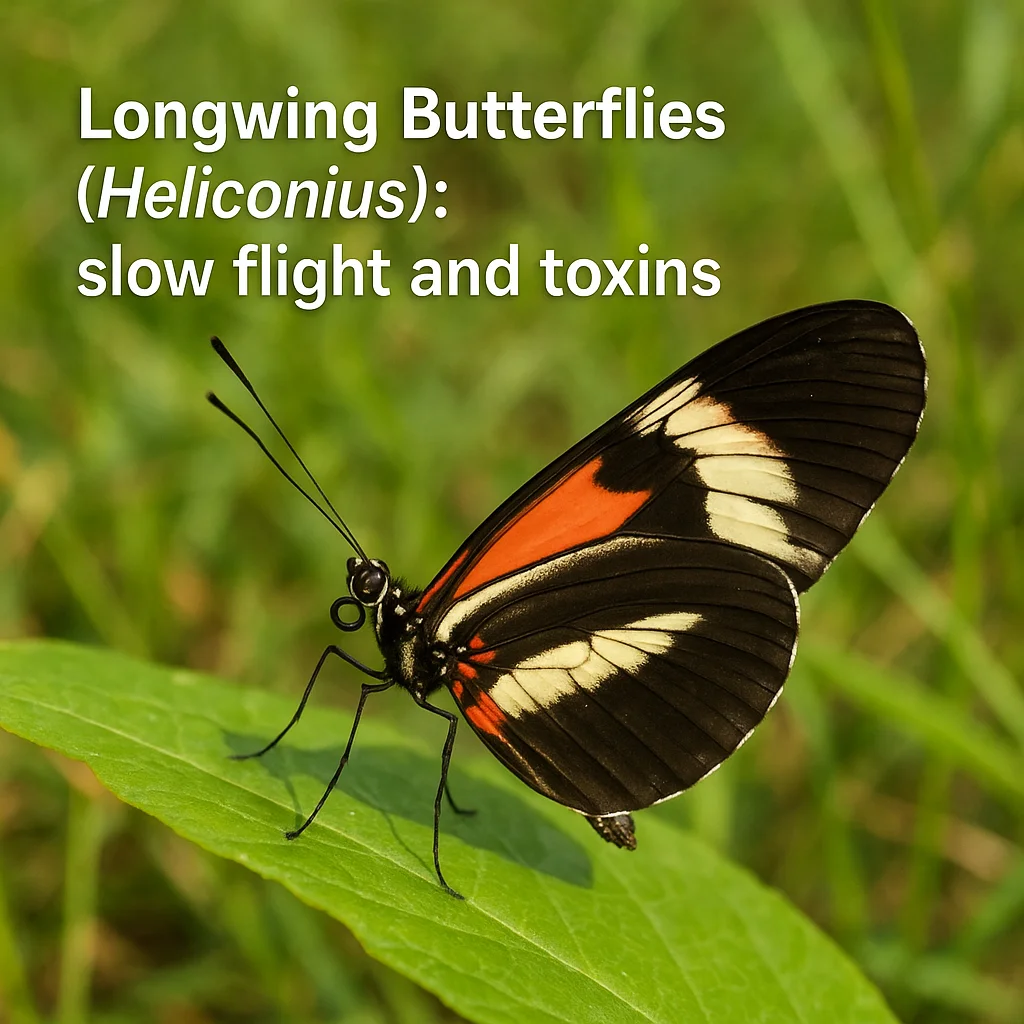
- Common Names: Longwing butterflies, Heliconians
- Scientific Name: Heliconius (varies within the genus)
- Insect: Yes, they are invertebrates.
- Order/Family: Lepidoptera / Nymphalidae
- Typical Size Range: 2 to 4 inches (5 to 10 cm) wingspan
- Key Colors/Patterns: Red, orange, yellow, black, white, often with striking patterns
- Activity: Diurnal (active during the day)
- Typical Habitats: Tropical and subtropical forests, gardens
- Where in the World: Central and South America
- Seasonality: Year-round in tropical areas, may vary in other regions
🔍 Identification
Longwing butterflies can be easily recognized by their elongated wings and slow, graceful flight. They possess clubbed antennae, which is a characteristic of most butterflies. Their wings often display vivid colors and distinctive patterns that make them highly recognizable.
- Their body is slender with elongated forewings and hindwings.
- They have club-tipped antennae that help in sensory detection.
- Wings are keeled like a bird’s wings, allowing for efficient gliding.
- Long legs are used for perching, giving a typical butterfly stance.
- Distinguished from look-alikes by their unique slow flight and feeding patterns.
- Top ID Tips:
- Look for elongated wings with symmetrical colorful patterns.
- Notice the slow, hovering flight style.
- Clubbed antennae are a key trait.
- Wing edges are typically rounded rather than jagged.
- Presence in dense vegetation indicates their habitat preference.
🧠 Basic Body Structure
As insects, Longwing butterflies have a three-part body structure comprising the head, thorax, and abdomen. They possess six legs which are attached to their thorax, aiding in movement and perching. Like all butterflies, they have an exoskeleton made of chitin that offers protection and structural support.
All butterflies, including the Heliconius species, are invertebrates, meaning they lack a vertebral column. They undergo molting as they grow, shedding their old exoskeleton to form a new, larger one.
🌍 Habitat & Distribution
Longwing butterflies thrive in tropical and subtropical environments where they are often found throughout the lush rainforests of Central and South America. They are adapted to microhabitats within these regions such as understory vegetation where host plants for their larvae are abundant.
Environmental changes can affect their sightings. In areas where deforestation or habitat destruction occurs, their populations may decrease. Conversely, in regions with abundant floral diversity and conservation efforts, sightings are more frequent.
📅 Seasonal Appearance & Activity
Longwing butterflies are primarily seen during sunny, warm days as they bask or indulge in nectar feeding. In tropical areas, they can be observed throughout the year, but their visibility might vary with seasons in more temperate regions. They prefer moderate temperatures and are less active in extreme weather conditions such as heavy rain or wind.
- Best Time to Spot It:
- Sunny, warm days increase activity.
- During mid-morning to early afternoon.
- Year-round in tropical climates.
- More abundant in areas with native flowering plants.
🥚 Reproduction & Egg-Laying
Longwing butterflies engage in courtship displays, with males often showcasing their vibrant wings to attract females. Once mating occurs, females lay eggs singly or in small clusters on host plants suitable for their larvae.
The number of eggs laid can vary significantly based on environmental factors and the availability of resources. Typically, they prefer laying eggs on passionflower plants, which provide a natural defense mechanism against predators due to the plant's toxicity.
🌀 Metamorphosis & Life Cycle
Longwing butterflies undergo complete metamorphosis, a process that includes four distinct life stages: egg, larva (caterpillar), pupa (chrysalis), and adult. After hatching, larvae begin feeding on the host plant, absorbing its toxins to become unpalatable to predators.
The larval stage can last several weeks, depending on the environmental conditions. After sufficient growth, the larva forms a chrysalis, where it undergoes transformation into an adult butterfly. The adults primarily feed on nectar and can live several months due to their ability to ingest and recycle pollen, providing them with amino acids and other nutrients.
🍽️ Diet & Feeding Behavior
As herbivores, the caterpillars of Longwing butterflies feed on leaves, especially from the passionflower plant family. They absorb chemical defenses from these plants, which makes them toxic to many predators.
Adults are primarily nectar feeders but have a unique ability to ingest pollen, providing amino acids crucial for reproduction and extending their lifespan. Their mouthparts are adapted for sucking up liquid nutrients from flowers, enhancing their role as pollinators in the ecosystem.
🦉 Predators & Defense
Longwing butterflies have several natural enemies, including birds, small mammals, and insects like spiders. However, their primary defense strategy is chemical; the toxins they ingest as larvae make them distasteful to many predators.
- Defense Highlights:
- Chemical defenses acquired from host plants.
- Bright warning coloration deters predators.
- Ability to regenerate wings in some species if damaged.
- Slow flight patterns can confuse or delay predators.
👥 Social Behavior & Swarms
Longwing butterflies are generally solitary creatures, but they can sometimes be seen in groups when feeding on abundant floral resources. On certain occasions, they may participate in migrations triggered by seasonal changes that affect food availability.
🧭 Senses & Communication
Heliconius butterflies have well-developed senses that aid in navigation, finding food, and selecting mates. They perceive their environment through sight, using their compound eyes to detect colors and patterns crucial for identifying flowers and partners. Their antennae are essential for detecting chemical scents and pheromones, which play a significant role in mating and alarm signaling.
Communication among Longwing butterflies is often chemical and visual, utilizing pheromones to find mates and their vibrant wing patterns to signal suitability to potential partners or ward off predators.
🌱 Role in the Ecosystem
Longwing butterflies are important pollinators in tropical ecosystems, contributing to the reproduction of many flowering plants. Their relationship with passionflower plants involves both defense and feeding: while the plants offer larvae a defense mechanism, adult butterflies ensure pollination.
Their presence in the ecosystem indicates the health of the environment, as they require intact, biodiverse habitats to thrive. Despite their sensitivity to ecological changes, they play a crucial role in maintaining the balance of their ecosystems through mutualistic relationships with flora.
📉 Population & Conservation Notes
Although some species of Heliconius butterflies are common in their natural habitats, others face threats from habitat loss, climate change, and pesticide use. Conservation efforts focused on preserving biodiversity and reducing habitat destruction are vital for their survival.
- How to Help (Low-Impact):
- Plant native flowering plants in gardens.
- Avoid using pesticides in butterfly habitats.
- Promote conservation of tropical forests.
- Support biodiversity-focused initiatives.
⚠️ Human Interaction & Safety
Longwing butterflies do not pose any direct threat to humans, as they do not bite or sting. Encounters with these butterflies are generally safe and pleasant, providing opportunities to observe their behavior and beauty. It is essential to respect their habitat by observing without touching or collecting.
📌 Summary
- Longwing butterflies are known for their slow flight and colorful patterns.
- They inhabit tropical and subtropical forests primarily in Central and South America.
- These butterflies are active during the day, especially in sunny conditions.
- Through a complete metamorphosis, they become vital pollinators.
- Adults feed on nectar and pollen, gaining essential nutrients.
- Predators are deterred by their chemical defenses acquired as larvae.
- Ecologically important, they help in plant pollination and ecosystem maintenance.
- Conservation efforts are critical due to habitat loss and environmental changes.
- They are generally safe to observe, offering delight to nature enthusiasts.